Showing posts with label convention. Show all posts

Sunday, April 21, 2013

DragonCon report #5: Photo Layout


You folks will have to be stuck with a few measly photos.

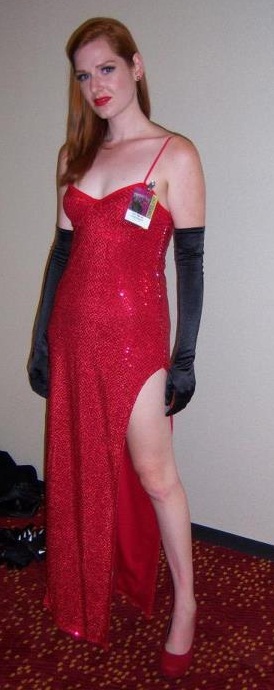
Granted, some of these photos are of some fairly spectacular stuff.  For example, we have this lovely woman on the right here, as Jessica Rabbit. 

Unlike some people, who came in with obviously plastic measurements,
this woman was your standard beautiful woman. 
She carried it off well because she had simple sexy down pat.  Yes, if you’re wondering, I do think sexy is more than just a collection of physical attributes.

But, obviously, that might just be me.  If you don't believe me, read A Pius Man.

That's one of the nice things about DragonCon -- people are there to be looked at. 

You can take a photo of a stunning person, then sit down from each other on the same rug because both of you have feet that are in serious pain.

Let me see, there were a whole boatload of costumes at DragonCon.  CosPlay is very much a factor.  And, while I would have really liked to have taken photos of whole crowds, it was too dark to capture all of them, at least with my camera.


One particular group was called CosPlay deviants. I'm sure you can find them online somewhere -- they even have their own calender.

I'm not entirely certain where the deviant parts come in, but what do I know?

As you can see, on the left we have yet another very lovely poison Ivy. You'll remember that a few days ago, I came across the same one twice -- there were actually so many kicking around at DragonCon, I couldn't keep track of them all.  And I had shot one on Friday, and one on Sunday ... even though it was the same exact woman.

But, well, I'm not exactly complaining.


One strange little phenomenon, though, were the ones doing full on impersonations.  Batman isn't that creepy unless he's sneaking up behind you and playing with zip lines in an atrium ballroom.

However, when you have a woman dressed like Harley Quinn (from the video game Arkham Asylum) and doing a pitch-perfect impersonation?  That is bloody terrifying.


She was actually go good, when she walked off stage at one of the many costume judging, she was actually called back by the crowd, and host Peter David (dressed on the left as the Green Hornet) so she could keep doing an impression of Harley.


Welcome to DragonCon.

Anyway....


Yes, there were women out there dressed in more, um, interesting costumes.

Exhibitionism at DragonCon?

 No, really?

Why do you ask?

Ahem....

I'm not complaining.  That's all I'm going to say about it.


There were other good costumes there that had no cleavage involved.  For example, we had one fellow in a very good Spawn outfit.

Yes, I know that he's a guy, therefore there can be no cleavage, but that has never stopped a Con-Goer before, why should it start now?

And if you have no idea what I"m talking about, you have obviously not been to many Conventions.

Moving right along....


This next costume will be of interest because it's of Carol Danvers, aka Miss Marvel, part of the Marvel comic universe, and possibly a participant in one of the upcoming Avengers movies, Guardians of the Galaxy -- which means we might be looking at one of our next Avengers.

No, no cleavage exposed here, either. But, again, I'm not complaining.

Besides, there's a reason I didn't post my photos of the "Power Girl" CosPlayer.

Anyway, I think that's enough for now, don't you?

Be well all. I hope to have Peter David live tomorrow.  Here's hoping.

Thursday, April 18, 2013

DragonCon report #2: Babylon 5 and Firefly


Wonder Woman at DragonCon
Believe it or not, I didn't get into a lot of panels at DragonCon because they were standing room only, and not even that. The Lord of the Rings panel was crowded out, Torchwood panels were crowded out, even guests Adam West and Burt Ward (Batman and Robin from the 60s) had so many fans that the place was crowded out.

However, as John Ringo has said, what happens at DragonCon, stays on YouTube.

So, who needs to go when stuff is being filmed?

Answer: Me. Much of what I did go into didn't even get put online.

So, one panel, which I didn't get into, is a Firefly panel.  For those of you who don't know Firefly, it is a sci-fi western of Joss Whedon's from about ten years or so ago.  This panel had Sean Maher, Jewel Staite, and an appearance from Adam Baldwin -- his first appearance in years, since he was busy working on a show called Chuck.


Below the break, Babylon 5 stars Mira Furlan and Bruce Boxleitner (aka: Tron), discuss their work on the show.

Wednesday, April 17, 2013

DragonCon Report 1: Marketing Wins, Epic Fails, MacGyver, and Rocket City Rednecks


A casual Con-goer at DragonCon, dressed

in a Witchblade costume
So, I survived DragonCon 2013.  This has possibly been one of the craziest I've ever been exposed to.  One panel said that the registration was up 30% this year, and another one mentioned that "We stopped selling tickets around 50,000 this year.  That's what we told the fire marshal. Shh."

Yes, "50,000" people spread over five hotels.  Did I ever mention I have a mild phobia of large groups of people?

Let me see, a few things worked, a few didn't.  You remember I had at least two evil plans for DragonCon.

One was an epic fail. I was going to give copies of It Was Only On Stun! to John Ringo, Timothy Zahn, and Peter David, and hope they liked it enough to give me a blurb.

John Ringo said that, since he tends to write in the voice of books he read, he was rereading his own books.

Timothy Zahn stated, before a room full of people, that he hasn't read fiction in ten years.

By that point, I didn't even bother with Peter David.

However, on the other hand, I was going to hand out flyers for the five free days I was giving out my book to Kindle users.  I had 500 flyers.  The free promo period ended last Thursday. I had 1304 people read the book. So, I guess that's a bit of a win.

Anyway, moving right along, we're going to start the first DragonCon report with something a little lazy -- to start with, I'm going to post a video of Richard Dean Anderson, better known as MacGyver, or as an officer from Stargate, the tv show.


Now, I found him a little boring, and if you folks agree, well, I'm going to try to make it up to you with a video of Travis Taylor (author, physicist, runs a show called Rocket City Rednecks) and John Ringo (author, author, and font of a lot of various and sundry knowledge),  Sadly, it's only ten minutes.  I couldn't get into this panel, since it was standing room only, and I didn't feel like being fit in with a shoehorn.

I actually thought it was kinda awesome, but I'm a nerd.


Be back tomorrow with more vids, and photos, and maybe some written reports.

Wednesday, April 10, 2013

Pricing, royalties, and Createspace

Before I begin, I should probably mention: Declan Finn has an Amazon.com author page. And two five star reviews.    And another one on A Pius Man.  Go me. :)

So, now that I've published the book, the one question I've gotten has been: "So, how much money do you make from this?" Alternately phrased as "What way of selling makes the most money for you?"

Well, that's a funny story.

First of all, you may have noticed my above links. I have different tabs for different pages -- in particular, Amazon.com and Createspace. Why is that? Here's the reason.

My first book book is $14.95. No matter where you see it, it's $14.95. In Great Britain, it's £9.55 ... which is $14.95, as of this writing. In Europe, €11.88. How much of that do I get? Depends on where people buy it.

If people buy an Amazon.com paperback, I get $5.22. If people buy it on Kindle (at the price of $9.99), I get between $3 and $7 (it's a long story, I either get 30% or 70%, depending on multiple factors). The same goes for the equivalent exchange rate in the UK and Europe.

If people buy at my original publishing website, Createspace, I make more money ... a whole $8.21 per book. It doesn't seem very impressive, but trust me, when you start selling a few dozen copies, that extra three dollars adds up quickly.

And here comes the reason why the publishing companies are in trouble, comparatively -- I am allowed "Expanded Distribution," which means my books are available at brick and mortar locations, such as bookstores, libraries, academic institutions, other online retailers, that sort of thing.

However, that way, I only make $2.23. Why? Think about it -- there are logistics involved, transportation fees, the inherent risks of not selling every last copy that a brick and mortar bookstore buys, making up for the money lost in the books that didn't sell, that sort of thing.

And people wonder why some authors, like Barry Eisler and Terry Goodkind, have gone to publishing on Kindle. Keep in mind, they have name recognition and they are their own franchise. I just have friends, family, and you, gentle readers.

In short, in an ideal world, to make close to six figures, I would need to sell 10,000 copies via Createspace, 20,000 copies via Amazon.com, or 50,000 copies at brick and mortar bookstores.

As of this date, I've sold 40 books, and made around $300. I don't think I've been this happy in a long time. No, it's not much, but I worked for every last penny.

In my quest to be published, I have worked within the system, and relied upon the people in it in order to reach the end goal. Through no fault of their own, these people could not get me published. And, because of that, I have been reluctant to rely on anyone besides myself and God Himself.

As the old Bill Cosby routine with Noah's Ark concludes, "It's just you and me, Lord."

Well, now I'm relying on myself, and God, and you, dear reader. Enjoy.

Tuesday, September 18, 2012

DragonCon report #5: Photo Layout


My attempt to upload Peter David's full panel [mentioned yesterday] has been continuously flouted by YouTube, so you folks will
have to be stuck with a few measly photos.


Granted, some of these photos are of some fairly spectacular
stuff.  For example, we have this lovely
woman on the right here, as Jessica Rabbit. 
Unlike some people, who came in with obviously plastic measurements,
this woman was your standard beautiful woman. 
She carried it off well because she had simple sexy down pat.  Yes, if you’re wondering, I do think sexy is
more than just a collection of physical attributes.


But, obviously, that might just
be me.


That's one of the nice things about DragonCon -- people are there to be looked at.  You can take a photo of a stunning person, then sit down from each other on the same rug because both of you have feet that are in serious pain.


Let me see, there were a whole boatload of costumes at DragonCon.  CosPlay is very much a factor.  And, while I would have really liked to have taken photos of whole crowds, it was too dark to capture all of them, at least with my camera.


One particular group was called CosPlay deviants. I'm sure you can find them online somewhere -- they even have their own calender.  


I'm not entirely certain where the deviant parts come in, but what do I know?


As you can see, on the left we have yet another very lovely poison Ivy. You'll remember that a few days ago, I came across the same one twice -- there were actually so many kicking around at DragonCon, I couldn't keep track of them all.  And I had shot one on Friday, and one on Sunday ... even though it was the same exact woman.


But, well, I'm not exactly complaining.


One strange little phenomenon, though, were the ones doing full on impersonations.  Batman isn't that creepy unless he's sneaking up behind you and playing with zip lines in an atrium ballroom.


However, when you have a woman dressed like Harley Quinn (from the video game Arkham Asylum) and doing a pitch-perfect impersonation?  That is bloody terrifying.


She was actually go good, when she walked off stage at one of the many costume judging, she was actually called back by the crowd, and host Peter David (dressed on the left as the Green Hornet) so she could keep doing an impression of Harley.


Welcome to DragonCon.


Anyway....


Yes, there were women out there dressed in more, um, interesting costumes.


Exhibitionism at DragonCon?


 No, really?


Why do you ask?


Ahem....


I'm not complaining.  That's all I'm going to say about it.


There were other good costumes there that had no cleavage involved.  For example, we had one fellow in a very good Spawn outfit.


Yes, I know that he's a guy, therefore there can be no cleavage, but that has never stopped a Con-Goer before, why should it start now?


And if you have no idea what I"m talking about, you have obviously not been to many Conventions.


Moving right along....


This next costume will be of interest because it's of Carol Danvers, aka Miss Marvel, part of the Marvel comic universe, and possibly a participant in one of the upcoming Avengers movies, Guardians of the Galaxy -- which means we might be looking at one of our next Avengers.


No, no cleavage exposed here, either. But, again, I'm not complaining.


Besides, there's a reason I didn't post my photos of the "Power Girl" CosPlayer.


Anyway, I think that's enough for now, don't you?


Be well all. I hope to have Peter David live tomorrow.  Here's hoping.


Tuesday, September 11, 2012

DragonCon report #2: Babylon 5 and Firefly


Wonder Woman at DragonCon

[No, I will not be doing a 9-11 article this year. Everything I could say in the matter was covered last year.]


Believe it or not, I didn't get into a lot of panels at DragonCon because they were standing room only, and not even that. The Lord of the Rings panel was crowded out, Torchwood panels were crowded out, even guests Adam West and Burt Ward (Batman and Robin from the 60s) had so many fans that the place was crowded out.


However, as John Ringo has said, what happens at DragonCon, stays on YouTube.


So, who needs to go when stuff is being filmed?


Answer: Me. Much of what I did go into didn't even get put online.


So, one panel, which I didn't get into, is a Firefly panel.  For those of you who don't know Firefly, it is a sci-fi western of Joss Whedon's from about ten years or so ago.  This panel had Sean Maher, Jewel Staite, and an appearance from Adam Baldwin -- his first appearance in years, since he was busy working on a show called Chuck.


Below the break, Babylon 5 stars Mira Furlan and Bruce Boxleitner (aka: Tron), discuss their work on the show.


For the record, the host had mentioned that this was more exciting than having the Obama's, because they were the President and First Lady of the United States, but Boxleitner and Furlan were President and First Lady of the Galaxy.


Yup, it continues.


A discussion of working with Peter Jurasik and Andreas Katsulas.


"What was your most momentous scene?"


Sleeping together, and character reveals.


Monday, September 10, 2012

DragonCon Report 1: Marketing Wins, Epic Fails, MacGyver, and Rocket City Rednecks


A casual Con-goer at DragonCon, dressed

in a Witchblade costume

Yup, I'm back from DragonCon.  This has possibly been one of the craziest I've ever been exposed to.  One panel said that the registration was up 30% this year, and another one mentioned that "We stopped selling tickets around 50,000 this year.  That's what we told the fire marshal. Shh."


Yes, "50,000" people spread over five hotels.  Did I ever mention I have a mild phobia of large groups of people?


Let me see, a few things worked, a few didn't.  You remember I had at least two evil plans for DragonCon.


One was an epic fail. I was going to give copies of It Was Only On Stun! to John Ringo, Timothy Zahn, and Peter David, and hope they liked it enough to give me a blurb.


John Ringo said that, since he tends to write in the voice of books he read, he was rereading his own books.


Timothy Zahn stated, before a room full of people, that he hasn't read fiction in ten years.


By that point, I didn't even bother with Peter David.


However, on the other hand, I was going to hand out flyers for the five free days I was giving out my book to Kindle users.  I had 500 flyers.  The free promo period ended last Thursday. I had 1304 people read the book. So, I guess that's a bit of a win.


Anyway, moving right along, we're going to start the first DragonCon report with something a little lazy -- to start with, I'm going to post a video of Richard Dean Anderson, better known as MacGyver, or as an officer from Stargate, the tv show.


Now, I found him a little boring, and if you folks agree, well, I'm going to try to make it up to you with a video of Travis Taylor (author, physicist, runs a show called Rocket City Rednecks) and John Ringo (author, author, and font of a lot of various and sundry knowledge),  Sadly, it's only ten minutes.  I couldn't get into this panel, since it was standing room only, and I didn't feel like being fit in with a shoehorn.


I actually thought it was kinda awesome, but I'm a nerd.


Be back tomorrow with more vids, and photos, and maybe some written reports.

Monday, July 16, 2012

Pricing, royalties, and "It Was Only On Stun!"

Before I begin, I should probably mention: Declan Finn has an Amazon.com author page. And two five star reviews.  Go me. :)


So, now that I've published the book, the one question I've gotten has been: "So, how much money do you make from this?" Alternately phrased as "What way of selling makes the most money for you?"


Well, that's a funny story.


First of all, you may have noticed my above links. I have different tabs for different pages -- in particular, Amazon.com and Createspace. Why is that? Here's the reason.


My book is $14.95. No matter where you see it, it's $14.95. In Great Britain, it's £9.55 ... which is $14.95, as of this writing. In Europe, €11.88. How much of that do I get? Depends on where people buy it.


If people buy an Amazon.com paperback, I get $5.22. If people buy it on Kindle (at the price of $9.99), I get between $3 and $7 (it's a long story, I either get 30% or 70%, depending on multiple factors). The same goes for the equivalent exchange rate in the UK and Europe.


If people buy at my original publishing website, Createspace, I make more money ... a whole $8.21 per book. It doesn't seem very impressive, but trust me, when you start selling a few dozen copies, that extra three dollars adds up quickly.


And here comes the reason why the publishing companies are in trouble, comparatively -- I am allowed "Expanded Distribution," which means my books are available at brick and mortar locations, such as bookstores, libraries, academic institutions, other online retailers, that sort of thing.


However, that way, I only make $2.23. Why? Think about it -- there are logistics involved, transportation fees, the inherent risks of not selling every last copy that a brick and mortar bookstore buys, making up for the money lost in the books that didn't sell, that sort of thing.


And people wonder why some authors, like Barry Eisler and Terry Goodkind, have gone to publishing on Kindle. Keep in mind, they have name recognition and they are their own franchise. I just have friends, family, and you, gentle readers.


In short, in an ideal world, to make close to six figures, I would need to sell 10,000 copies via Createspace, 20,000 copies via Amazon.com, or 50,000 copies at brick and mortar bookstores.


As of this date, I've sold 18 books, and made $120. I don't think I've been this happy in a long time. No, it's not much, but I worked for every last penny.


In my quest to be published, I have worked within the system, and relied upon the people in it in order to reach the end goal. Through no fault of their own, these people could not get me published. And, because of that, I have been reluctant to rely on anyone besides myself and God Himself.


As the old Bill Cosby routine with Noah's Ark concludes, "It's just you and me, Lord."


Well, now I'm relying on myself, and God, and you, dear reader. Enjoy.

Wednesday, April 4, 2012

Fighting and writing workshop, day 5 and 6: military fight scenes

This is the online workshop in writing fight scenes that I did for the Catholic Writer's Conference.  Karina Fabian had managed to draft me ... or I volunteered, I'm not entirely certain.  Either way, it was an interesting little experience.

Since most of you folks have been with me for a while, I'm going to give it to you.

Don't worry, I wasn't paid for this, so giving this away for free will hurt no one. And, few to no people wanted to show up and play with my workshop, even though there were over 25 viewers for each post.  But, I've been told few people showed up anyway for the forums, something to do with schedule confusion.

So, here is day five and six.... Day five was merely an assignment. Day six was more interesting.


 Day Five: Putting It Together

 
At this point, you should have an idea of what you're doing. Take assignments three and
four, and put them together. Whether you start from a weapon and go to hand-to-hand, or vice versa, is up to you. This is the assignment.

Like with most writing, practice makes perfect. So don't be discouraged if you're not writing full-scale battle choreography by now.

 
Day Six: Writing For Military Fights

 
Writing a military fight scene is no different from any other, when you get down to it. Do some research on terms, maneuvers, etc., but don't overstress that part. It's mostly just a matter of vocabulary.

But, seriously, there's little difference from warfare fighting.

Character: In describing filming for Lord of the Rings, and the Battle of Helm's Deep, director Peter Jackson discovered a basic law of fight scenes – Jackson had hours upon hours of stuntmen beating
each other to a pulp, but the battle was boring when the camera was not on the primary characters.

The important thing you need to know is, no matter what, you need to focus on the individuals involved. The more modern your setting, the more things are done by groups of individuals, squads and fire teams, and not massive lines of fire, one against another.

However, no matter how many people you have fighting whatever enemy, you need to have individuals the audience can focus on and care about. Writing about a line of tanks is boring. Writing about someone the audience has met, and is invested in, is much, much better.

For great examples of this, read the Richard Sharpe series by Bernard Cornwell – he has, on average, about six players in any battle that he focuses on, as well as a massive, historical battle taking place.
 
Setting: If you want to focus on a full-scale battle, in whatever age and setting, one thing you'll
want to focus on is the field of battle. You're going to want to focus on the sounds, and the sights, perhaps even the smells. You want to recreate it as though the battlefield is a character. A loud, monstrous, messy, rampaging character, with lots of property damage.

The best I've ever seen of this type of recreation is John Keegan's The Face of Battle, where he recreated the battlefields of Agincourt, Waterloo, and Verdun.
 
Hand-to-hand combat and weapons:
Depending on the scenario, military battles do not start with close combat, unless it's a type of covert infiltration, where getting in close and killing people silently is important. And, let's face it, the use of weapons will vary wildly depending on what time period and setting you're using. For the most part, it boils down to individuals.

Fighting and writing workshop, day 5 and 6: military fight scenes


This is the online workshop in writing fight scenes that I did for the Catholic Writer's Conference.  Karina Fabian had managed to draft me ... or I volunteered, I'm not entirely certain.  Either way, it was an interesting little experience.


Since most of you folks have been with me for a while, I'm going to give it to you.


Don't worry, I wasn't paid for this, so giving this away for free will hurt no one. And, few to no people wanted to show up and play with my workshop, even though there were over 25 viewers for each post.  But, I've been told few people showed up anyway for the forums, something to do with schedule confusion.


So, here is day five and six.... Day five was merely an assignment. Day six was more interesting.


 Day Five: Putting It Together


At this point, you
should have an idea of what you're doing. Take assignments three and
four, and put them together. Whether you start from a weapon and go
to hand-to-hand, or vice versa, is up to you. This is the
assignment.


Like with most
writing, practice makes perfect. So don't be discouraged if you're
not writing full-scale battle choreography by now.


Day Six: Writing For Military Fights


Writing a military
fight scene is no different from any other, when you get down to it.
Do some research on terms, maneuvers, etc., but don't overstress that
part. It's mostly just a matter of vocabulary.


But, seriously, there's little
difference from warfare fighting.


Character: In
describing filming for Lord
of the Rings
, and the
Battle of Helm's Deep, director Peter Jackson discovered a basic law
of fight scenes – Jackson had hours upon hours of stuntmen beating
each other to a pulp, but the battle was boring when the camera was
not on the primary characters.


The
important thing you need to know is, no matter what, you need to
focus on the individuals involved. The more modern your setting, the
more things are done by groups
of individuals, squads and fire teams, and not massive lines of fire,
one against another.


However, no matter how many people you
have fighting whatever enemy, you need to have individuals the
audience can focus on and care about. Writing about a line of tanks
is boring. Writing about someone the audience has met, and is
invested in, is much, much better.


For great examples
of this, read the Richard Sharpe series by Bernard Cornwell – he
has, on average, about six players in any battle that he focuses on,
as well as a massive, historical battle taking place.


Setting: If you want to focus on
a full-scale battle, in whatever age and setting, one thing you'll
want to focus on is the field of battle. You're going to want to
focus on the sounds, and the sights, perhaps even the smells. You
want to recreate it as though the battlefield is a character. A
loud, monstrous, messy, rampaging character, with lots of property
damage.


The best I've ever seen of this type of
recreation is John Keegan's The Face of Battle, where he
recreated the battlefields of Agincourt, Waterloo, and Verdun.


Hand-to-hand
combat and weapons
:
Depending on the scenario, military battles do not start with close
combat, unless it's a type of covert infiltration, where getting in
close and killing people silently is important. And, let's face it,
the use of weapons will vary wildly depending on what time period and
setting you're using. For the most part, it boils down to
individuals.


Tuesday, April 3, 2012

Fighting and writing workshop, Day 4: Guns in Fighting.


This is the online workshop in writing fight scenes that I did for the Catholic Writer's Conference.  Karina Fabian had managed to draft me ... or I volunteered, I'm not entirely certain.  Either way, it was an interesting little experience.


Since most of you folks have been with me for a while, I'm going to give it to you.


Don't worry, I wasn't paid for this, so giving this away for free will hurt no one. And, few to no people wanted to show up and play with my workshop, even though there were over 25 viewers for each post.  But, I've been told few people showed up anyway for the forums, something to do with schedule confusion.


So, here is day four.


***


Day 4: Guns in Fighting.


There are more weapons in Heaven and Earth than there are in Thomistic philosophy. However, guns seem to be the magic weapon that everyone uses, and uses badly.

With any weapon you decide to use, make certain that you have a basic
knowledge of these weapons, even if it's merely researching them
online. This day will also assume that you've never even seen a gun
up close and personal – perhaps an erroneous presumption, but I'm
not going to assume everyone knows guns. If you have do know things
about guns, please bring it up.

Weapons are tools. Knives do more than stab people. Lead pipes do more than club people over the head. And guns do more than shoot people. Don't get me
wrong, guns are great. But if you're writing for someplace like New York, guns are not readily available to the general populace. 

 
Remember Day One,writing the rules for the culture on fighting? Now you know why we
bothered.

Everything in a fight has to feel fast-paced, as we said before. But when you introduce a weapon into any scenario, the characters and the writing have to move fast. Or at least intelligently. What do I mean by this? I mean that no one is going to outrun a bullet – the best they can do is be faster than the trigger finger of the person targeting them – but finding cover, providing distractions, and
shooting elements of the setting or other uses of the gun.

In actuality, gunfights are not like an Arnold Schwarzenegger movie – if someone is moving in a straight line, a smart gunman will lead the target. However, smart gunmen do not use fully-automatic fire in extended bursts. Firing a full magazine of ammunition on full automatic will not lead to a stream of bullets that come out in a straight line, but will cause the muzzle of the gun to jerk around like a spastic mime having an epileptic fit. In a gun battle, at a distance, even slight deviations of the gun's barrel will cause bullets to go wildly off course.

Then again, stupid things happen with guns. The average shootout with the police takes place at a distance of nine feet, but three out of every four bullets will miss, mainly because everyone is popping in and out of cover, snapping off shots and hoping they'll hit something.

Again, now is not the time for technical terms. If you're writing for a medieval setting, or a fantasy setting, if specific parts of specific weapons are going to come into play, you may want to introduce them before the fight even begins. And, if you're using a technical detail of a gun that only people who field-strip their own weapons would know, don't discuss it in the middle of a fight. A previous example has been the Lee Child model, where his character Jack Reacher describes how a fight will turn out and why, before the first punch was even thrown. You can have such discussion then, but when the bullets start flying, try not to dwell too much on the pieces and parts.

You can, however,  have a technical analysis as the hero/ine is taking cover, and thinking about what to do next. If the pieces of the gun are important to the solution, and you can provide a “lull” in combat (if that's how one can describe taking cover while being shot at),then by all means, make it relevant. However, you do not want to give the vital statistics on a gun in mid-battle. In fact, you mightnot want to go into it at all.

The most anyone needs to know about most guns might include:

Ammunition capacity: Do not use Hollywood forever shooters. You will want to reload – if only because it's more thrilling to have a count of how many bullets your hero/ine doesn't have. (Would the end of Die Hard work at all if John McClane had had a full magazine left, instead of just two bullets?)

Type of ammunition: This only matters for level of impact, and penetration. If it's a .22-caliber from a handbag pistol, you can stop if with a pocket Bible. If it's a .45-caliber, you will stop someone if only from the shock value (no one takes an impact from a .45, rolls into a doorway, and returns fire. It's gonna suck to be that person). If it's a .50-caliber handgun, you can disable engine blocks and amputate limbs. If you're writing science fiction, ammunition type is doubly important. 

Type of gun: Revolvers, pistols, assault weapons, submachine guns, hunting rifles, and machine guns all have different strengths, ranges, weaknesses, and abilities inherent in the type of gun. You will not put a bayonet on a pistol, and no one should try to rob someone with a sniper rifle.

Length of weapon (optional): many handguns make for great blunt-force weapons.
 
Appearance: I'm a very visual reader. There are some guns that are very visually distinct: a FAMAS assault rifle looks nothing like an M-16, which looks nothing like an Uzi, which looks nothing like an H&K G-11, which looks nothing like an AK-47. However, there are a lot of knockoffs that resemble M-16s, AK-47s, and Uzis. You don't need make, model, and serial number; just say “it looked like X, Y, or Z” gun, unless you want to go into more detail.

In essence, you can boil down someone's handgun to “short-barreled .22-caliber revolver,” or “a semi-automatic that looked more like a hand cannon” (for an example of this, look up the image of a “Desert Eagle” .50 caliber.)

 
Note:
Please remember that Kevlar is not a magic shield. At best, it will take that small metal object going at hundreds of feet per second, and redistribute its force so that your character will essentially feel like s/he's being slapped with sheet metal at ten miles an hour.
 
Assignment #4: Choose Your Weapon.

 
Take your setting, hero/ine and the enemy from assignment #3. Pick a weapon and put it into a fight between the two. It does not have to be a gun (for thoughts on weapons, and improvised weapons, check the “How To” article link in the initial documents packet). It doesn't matter if your hero has the weapon, or your villain does. It doesn't matter if the weapon was found at the fight location, or if it was brought.

If your hero does not have a weapon to start with, they will need to disarm the bad guy and/or find their own weapon.

Youcan check the how-to article again to at least get the principles for gun and knife disarms, though the principle is mostly based in common sense – don't get in the way of the weapon.

Remember, you do not need to have anyone killed, even if you're using a gun in the scene. Guns can shoot the environment, make people flinch, duck, or buy the characters time.


Monday, April 2, 2012

Fighting and writing workshop, day 3: Writing Fight Technique


This is my online workshop in writing fight scenes that I did for the Catholic Writer's Conference.  Karina Fabian had managed to draft me ... or I volunteered, I'm not entirely certain.  Either way, it was an interesting little experience.


Since most of you folks have been with me for a while, I'm going to give it to you.


Don't worry, I wasn't paid for this, so giving this away for free will hurt no one. And, few to no people wanted to show up and play with my workshop, even though there were over 25 viewers for each post.  But, I've been told few people showed up anyway for the forums, something to do with schedule confusion.


So, here is day three.


****


 Day Three: Now, Let's Talk About Writing Fight Technique.


There are a lot of basic moves that you
don't need to describe too much. Most kicks and punches are like
that, for example. You don't necessarily require a full description
on a “forward vertical defensive kick” (as seen in the article on
how to throw a stop kick) – you can just write “X kicked Y in the
chest the way a fireman would kick down a door.” It's the same kick, just a less technical way of writing it. 

 Speed of attack: keep in mind that most fights don't even last for five seconds. A kick to the groin, a punch to the throat, and it's game over. Even a fight with a weapon can only last so long. Fighting over a knife will ensure that all sides get cut, and someone will be hurt in short order.

And, keep in mind, fighting is hard work. Even something as simple as punching is going to take a lot out of someone. If you don't believe me, go hit a punching bag for a minute. Punch it, kick it, headbutt it if you like, but do it at full speed, as hard as you can. You're going to find that it is very, very hard work. After the initial burst of energy, you're going to slow down after thirty seconds. Stamina should not be important in a fight, because most fights shouldn't last very long.

Another element to keep in mind: the enemy is also reacting. We don't need three-dimensional chess with hand-to-hand combat, but we also have to remember that (for example) kicking someone between the legs (even if they're feeling no pain), will still force the body to lean forward, and that opens up possibilities. If we punch someone, their head will go back. If we feint, they become defensive, preferably where we don't want them to be

If you're going to have a long fight scene, it should be for a good reason. Either it's a war—in which case it's perfectly understandable—or there are multiple attackers, or both participants are very, very well-trained.
 
Yes, you can have a half-page of description for something that takes only a split second. You can have all of the technical details down cold, but you must at least convey to the audience the speed. And, even if you don't go into exacting, excruciating detail for your audience, you should at least know the mechanics, so you know what you're doing. Don't be insulted – trust me, I used to do that a lot.

If you like, look at the fights scenes of Lee Child's character Jack Reacher. He'll give a half-page dissertation on something like the tactical usefulness of a headbutt, or he will work out a fight, chess-like, before the first punch is thrown. He then does it, writes a few lines of the enemy's reaction, and keeps going.

Note: If you have formal training, or have practical experience in a self-defense system or martial art, realize that high kicks, spin kicks, or any kick that goes above the hip can pose a danger in a real fight. In a real close-combat situation, there are no rules, and there is no tapping out. This may sound patronizing, but trust me, there are plenty of people who try to use fancy moves they learn on a gym mat and try to use the same moves on concrete. It doesn't end well, sometimes.

Assignment
#3: Writing Hand-to-Hand Technique

Look at the various articles assigned here: http://shar.es/giQgA.
Choose at least one technique. Do not worry about plagiarizing; there are only so many ways to describe some moves.  All that I require is that you use one element of one described technique over the course of your fight scene.
 

Step 1: Set up the fight, be it a mugging, or something with a minor villain, what have you. Write out a full technical description of what your character will do – not only with the technique, but most importantly with what comes next. (Continue to fight, to run, et al). How does the other combatant react/reply? 

Step 2: Give reasons for their actions, and how it fits with your character.

Step 3. Repeat step one, only take the entire technique and condense it.  Boil the technique into only a paragraph, at most. Now that you know what your character is doing, there's no reason to belabor the point for your audience. You can go into great detail, if it's an obscure method, or if you have a style similar to Lee Child, described above. You don't have to do one or the other in your writing, but you should at least be able to do both.

Please note: when writing your fight scene, be certain that you, and your readers, can keep track of
what side everyone is on. Even professional writers of military fiction, like Bernard Cornwell, will occasionally leave out details like “Character Y is blocking with the sword and hitting with the empty hand, and kicking someone else …. what direction  are all of these people coming from!!

Tuesday, March 27, 2012

Fighting and writing workshop, Day 1: fighting, your characters, and your world


As I mentioned, two weeks ago I said I was going to host an online forum workshop in writing fight scenes -- it was loosely based on one of my own blog posts. It just spun out of control.  Karina Fabian had managed to draft me ... or I volunteered, I'm not entirely certain.  Either way, it was an interesting little experience.


Since most of you folks have been with me for a while, I'm going to give it to you.


Don't worry, I wasn't paid for this, so giving this away for free will hurt no one. And, few to no people wanted to show up and play with my workshop, even though there were over 25 viewers for each post.  But, I've been told few people showed up anyway for the forums, something to do with schedule confusion.


So, since this workshop screwed over my blog posts last week, I figure that I should get some use out of it.


This was the first day.


***


Day One:
Fighting, Your Characters, and Your World.


Before one even gets to writing a fight
scene, you have to answer multiple questions, not only about you
character, but about the world s/he inhabits.


For example: if your main character is
a civilian in the modern world, not only do you have laws to contend
with, but a question of training.


Start with a situation. Your character
is mugged. Some strung-out druggie who needs a fix wants your
character's money. This character has a feeling that things are going
to end badly no matter what s/he does. It is time to resist.


But then you have a problem before you
even get to the technical aspects of writing a fight. Why would your
character know how to fight?


Family – is fighting in the family
business? Mercenary, samurai, knight, military family?


Culture – does your world resemble
Sparta 2.0? Are there laws against fighting? For fighting? Is
dueling outlawed or celebrated?


Profession – is your character a
SEAL? An enthusiastic reservist?


Sports: Does your character like MMA?
Wrestling? Target shooting? Hockey? Soccer? Any of these can be
adapted to create the realities of a fight scene.


Hobbies: Your character may be nothing
more than a smart, reasonable person who believes in self defense.
S/he may also be a ballerina who can launch a nasty spin kick because
that's what s/he did in Swan Lake – don't laugh, it works
for actresses Jennifer Gardner and Summer Glau. S/he may have taken
capoeira because s/he thought it was only a dance class. If
s/he likes to fire off a hundred rounds a week at the local shooting
range, why not? Even the basics of handling a gun can be useful.


Now, fight scenes do not necessarily
require fisticuffs. Running away is a good, reliable tactical
maneuver. Your character can always run.


Why does this matter? Establishing your
character's own style of fighting is perfectly reasonable, otherwise,
you have fight scenes that you've stolen from action movies … Yes,
I've done that. Then I took a real self defense system, and I'vesince rewritten every last one scene.


Assignment
#1


1) What are the cultural
rules/legalities of your world when it comes to fighting? In modern
settings, these laws vary by country, and even by state. In New
York, if you defend yourself against an armed mugger, laws can be
used to prosecute you. In Texas, if you defend yourself, you get a
medal.


2) If your character had to fight, how
would they do it? What is the style of fighting your character uses?
It can be straight up punching and kicking, or furious punching and
gouging, or something more informal like Krav Maga, or much more
formal, like Tae Kwan Do. Does your character fight with improvised
weapons, or instead use traps and trickery to dispose of the
adversary? Or (also acceptable) do they run away until they can find
a solid position to fight from?


3) Why does your character know that
system of fighting? If you're writing the character of a Navy SEAL,
that's one thing. If it's the civilian offspring of a military
family, that's another. Does a family member teach the fight system?
Was it something they thought was cool when they were twelve? Did
they read too many thrillers growing up? Did they take ballet, or
soccer, or football – something with a lot of kicking?


Monday, March 26, 2012

Fighting and writing workshop, from the Catholic Writer's Conference: Introduction


Two weeks ago, I had mentioned that I was going to be hosting an online forum workshop in writing fight scenes, for the Catholic writer's guild.  Karina Fabian had managed to draft me ... or I volunteered, I'm not entirely certain.  Either way, it was an interesting little experience.


Since most of you folks have been with me for a while, I'm going to give it to you.


Don't worry, I wasn't paid for this, so giving this away for free will hurt no one. And, few to no people wanted to show up and play with my workshop, even though there were over 25 viewers for each post.  But, I've been told few people showed up anyway for the forums, something to do with schedule confusion.


So, since this workshop screwed over my blog posts last week, I figure that I should get some use out of it.


This is how I began.


*****


Introduction: Writing a fight scene –
Who or what is a “John Konecsni,” and why does he get to tell me
about fighting?


It's a good question, and one that
needs to be answered before many of you begin this workshop. I have
been writing fight scenes since I was sixteen. I've written many
novels, most of which fester on my home computer, and that I
constantly revise the more I learn about life, the universe, and how
to better destroy both. I grew up wanting to write thrillers and
science fiction military novels, and I originally thought the best
way to go about having a fast-moving novel was to have as many fight
scenes as often as possible. Then I read them, and spiked more fights
than I can recall.


In short, I'm a person who has studied
many a fight scene, and has learned from his own mistakes. I mention
this because there will be instances where you will read some of this
and wonder, “Why is he telling me this? Does he think I'm stupid?”


The answer is no, but these were
mistakes that I have made repeatedly over time, and sometimes still
make when I don't think.


One of the documents that you will need
can be found at this link here. It is a collection of “how to” articles for self defense and
fighting. It is a compilation of a lot of basic fighting techniques,
as well as things related to fighting. In short, you don't need any
previous knowledge of any fighting technique, martial art, or even
the basics of street fighting for this workshop. I will, however,
recommend right now that you check out the link, and at least give
each article mentioned a passing glance. They will be used over the
course of the workshop.


References for certain techniques:
http://shar.es/giQgA


References for army technology:
http://www.army-technology.com/


Recommended reading:


Bernard Cornwell's Sharpe series
(for fight scenes on both small and large scale)


Lee Child's Jack Reacher novels (for
hand to hand combat)


David Weber's Honor Harrington series
(for navel warfare)


John Ringo's Posleen War, Ghost
and Princess of Wands
series (mostly for hand-to-hand, infantry, and special warfare)

Wednesday, May 18, 2011

Neil Gaiman, Minnesota, and Writer's Mistakes.


Writers make mistakes.


This is probably not a good topic to discuss on a writer's blog, but it's the truth. And I try to serve the truth as often as possible without getting myself into even more trouble than I find naturally. People can learn from mistakes, even if those mistakes are performed by other people.


Good Omens: The Nice and Accurate Prophecies of Agnes Nutter, WitchNeil Gaiman is a British author with a couple of novels to his name, and several tv episodes. I only enjoyed two works by him – Neverwhere, and The Graveyard Book. The one other book of his I truly enjoyed is called Good Omens, and there is nothing he can say or do to prove to me that Terry Prachett didn't take over the book entirely.


Recently, Mr. Gaiman (I prefer to pronounce it Guy-mun, not “Gay-man”) spoke at a Minnesota public library. He made a four-hour public appearance, for which he was paid $45,000 dollars.


Yes, he made over $10,000 per hour.


Harlan Ellison, an author who has been writing since the dawn of time … or at least the dawn of modern science fiction … makes $10,000 for an entire convention appearance, and Gaiman isn't half as interesting as Ellison. Trust me, I've met Ellison, and I've seen Gaiman.


A Minnesota politician has referred to Gaiman as a “pencil-necked weasel-thief” for walking off with that much money for a measely four hours.


Gaiman, in his defense, has said that he wanted to charge far less. The library claimed that the money was earmarked for library events, and the earmark expiration date was almost up. They could either use the money, or lose it. So, he took the money, and gave some to charity, some to his agent, etc.


Now, after the politician made noise, Gaiman has turned around, and started exchanging insults with Minnesota, at least on his Facebook page, as he tries to defend his honor (or honour, if you wish to go British). And he's whining that he's being put on a Republican “hate list”....


Now, I don't know about you, but there's something wrong about the whole thing.


For instance, should I ever become interesting enough to be invited anywhere to speak, I'm going to wonder at being offer forty-five grand.


I can imagine the conversation going as follows.


“Hey, we really liked your book, A Pius Man. We want you to come speak here. We'll give you $10,000 an hour. Please?”

Me: [Blink, blink, blink.] “How much?”

“About $45K. Is that not enough?”

Me: “I didn't think I was that interesting. Why $45K?”

“Because that's our event budget. We have to use it, or we're going to lose it.”

Me: “By 'lose it,' do you mean it will spontaneously combust? Fall down a rabbit hole and disappear? Turn to ash?”

“No, the state will just take it back.”

Me: “So, gee, you can either give me all of the taxpayer's money that you still have in your budget, or you can actually let the taxpayers actually have it back? Gee, I'm so happy I can give you an excuse to spend money for the sole purpose of spending money, in the middle of a major recession. How about this: get stuffed. I want nothing to do with you idiots.”

But, now, Neil Gaiman is the persecuted one. Huh. Really? One, it's Minnesota, how many people would know anything was up if it weren't for Gaiman's replies? I know I wouldn't. Two, this sounds like the library wanted to burn through the cash it had, and claim "We used our event budget this year, give us the same next year."

So, an open letter to Neil ....


Dear Mr. Gaiman.


I know you're not from the United States, so let me give you some pertinent information about Minnesota.


Number one: Minnesota is odd. This is a state that gave the position of governor to a former pro-wrestler named Jesse Ventura. It also made a clown one of their senators – a man named Al Franken.


In terms you can understand: Politically, Minnesota is Lewis Carroll country. They have fallen down a rabbit hole, and they have have yet to come out again. These people make Wonderland seem reasonable.


Number two: You took the money. I don't care what you did with it, you took taxpayer money. In the middle of a recession. You claim you would have attended the event for far, far less. Did they make you take it? Did they hold you up at gunpoint and force a check on you? I don't care how you redistributed the cash, this was taxpayer money. If the public library couldn't burn through it in the time allotted, that was their problem.


Didn't you think it odd that a public library paid you more money than bigger talents would get for an entire science fiction convention? They used you to aid and abet government waste in a recession. You were an excuse to burn cash. Why? Best guess: In all likelihood, if the public library didn't spend the money, their budget next year would have been cut to match what they spent this year.


Number three: You're Neil Gaiman. Why are you getting into the muck and mire with hacks from Minnesota? Why? You did nothing illegal. Some Minnesotan called you names … highly unoriginal names … and you, you poor widdle baby, are up in arms over it. You declare yourself on a Republican “hate list.” Really? You're going to play the Nixon card? Let's avoid the fact that there must be more than one person for there to be a list. Also, just because the politician is a Republican, you're not a target of the Republican National committee. You're not Bill Clinton; there is no vast, right wing conspiracy out to get you. As far as I can tell, there's just one guy – one guy who you have decided to make far more interesting by engaging with him.


You, sir, are a writer. You should have a thicker skin than this.


In conclusion … What the hell are you doing? While I question the wisdom of taking the cash, and thus exposing yourself to this idiocy, you are now actively diving into the muck and mire that is the cesspool of Minnesota politics. Do you think that a guy from Minnesota will affect your popularity in any way? If you hadn't decided to engage, I probably would have never heard of the quote, the politician, and I might have been safe from hearing anything about Minnesota until the next time Al Franken ran for political office.


This isn't your problem. Whoever paid you the money “just to get rid of it” shouldn't have burned through the money because it was there. That person should be fired. While I question your wisdom in taking the cash, you did nothing against the law. Why are you defending yourself against a gnat?


Stop playing silly buggers with rejects from the madhouse. Just tell these idiots that you didn't set the price, and if they're going to insult you, tell them to hire Terry Prachett as their speechwriter.


Thank you.


PS: The only Republican I know who may have an opinion on you is President George W. Bush -- and that's only because he liked Babylon 5: a show you wrote for.