Showing posts with label buffy. Show all posts

Wednesday, July 15, 2015

Jack Bauer, Harry Potter, and the Cassandra effect.

So, what do Jack Bauer and Harry Potter have in common?

No, this is not a joke.

Jack Bauer, the hero of 24, is the key agent on the Counter Terrorism Unit.  He will torture (mostly just interrogation with yelling and threats), kill, fight his superiors, and lop off heads in order to save the day. He developed a drug addiction to go undercover with a cartel, stopped LA from being nuked about three times, saved the President of the United States at least a dozen times, and will occasionally go on revenge-fueld rampages. He is also the winner of going-the-longest-without-sleep-while-still-kicking-ass award.  He's mostly a lone wolf, because everyone who helps him eventually dies.

Harry Potter is essentially experiencing the worst high school experience since Buffy the Vampire Slayer. Instead of being born with martial arts skills and preternatural strength, all he has are the wits of a ten-year-old (to start with) and inborn magical ability that he's still learning to control.  His biggest assets are his friends-- one of whom is smarter than he is. And he's got a death sentence on him since he was born, all because of some Saruman wannabe who has his own Manson family.

So, what do the two of them have in common?

The Cassandra effect.

No, really.

Going through both series, you'll notice that no one actually listens to either Jack Bauer or Harry Potter.  If people listened to Jack Bauer in several seasons, the show would be called 12, not 24.  Every time Harry Potter falls head first into a plot, like some sort of magical Jessica Fletcher, no one over the age of 18 listens to him.  They are both Cassandra, knowing something will happen for certain, only no one will listen to them, especially when they're right. Leaving it up to our heroes to act on their own to save the day, despite the stupidity of others.

Now, granted, it's a plot device specifically designed so it can end with the hero standing alone against all odds, with maybe some cavalry coming over the hill at the last minute. One might say it's a very American concept -- rugged individualism, cowboy duels in the street, the Lone Ranger, every superhero, every Clint Eastwood western-- except that there is still the basic mythology of Odysseus, or Bellerophon, and other folks of yore who have special powers and abilities that make them the only ones to face demons and monsters.  It's the same concept, only we need different reasons for the lone hero to be lone anything.

In the case of comic books, that's easy-- most superheroes have superpowers that enable them to go toe-to-toe with the bad guy and walk away. Even Batman and Iron Man have special toys, special training, and a wealth of experience on their side.

But what happens outside of that? When everyone has the same training? The same knowledge base?

Enter the Cassandra effect.  In both cases, it stems from Konecsni's Law of Committees: to get the IQ of a committee, you take the total IQ of the individual committee members, and then divide it by TWICE the number of members on said committee.  Why? Because people are dumber in groups.

In either case, this holds.  In the Hogwarts School model, the faculty obviously know more than this pissant little child, so how could he possibly have the answer to anything in particular?  In the case of Jack Bauer, the CTU bureaucracy looks something like the bureaucracy of the damned, filled with political operatives who know nothing about kicking ass and taking names, and everything about kissing ass and shuffling papers.  And, in both cases, our heroes can only appeal to an individual --Harry Potter's Dumbledore, or Bauer's President Palmer -- and that person can cut through the red tape that has made everything so very, very screwed up.

If you don't have that, you don't have a plot in either case.

"Oh, Harry? People are going to try and steal this valuable stone we have in the forbidden wing? We'll triple the guard on it. Thank you."

Or...

"Jack, you've got information that says that there were other people behind the terrorist threat? Sure, we'll have an air strike on them in the next five minutes."

Sounds boring, doesn't it?

At the end of the day, individuals who will fight the good fight are always more appealing to us than a massive, faceless bureaucracy. We trust individuals to get things done, but not the byzantine structure of bureaucracies, who will seemingly let anyone in. It doesn't matter if it's the IRS, the State Department, the NSA, CTU, or Hogwarts.  But good fiction uses this plot device well, exaggerating the natural ineptitude of bureaucracies into a plot point -- and sometimes, you don't need that much exaggeration.

Even when you have something like the Magnificent Seven, or the Avengers, it's very much the same concept. It's the individuals coming together to take on a threat that none of them could deal with alone.

Now, one could counter with military fiction... except in that case, fiction makes certain to focus on the officers and high-ranking foot soldiers -- people who have already been promoted because they have special abilities and knowledge that put them at the head of the back. Just look at 300-- we focus on, possibly, six of three hundred Spartans. It's hard to make us emotionally invested in 300 individual soldiers in the time and space allotted, but making us invested in a select few allows us to be invested in all of them.

At the end of the day, we the audience become invested in individuals.  The Cassandra effect -- or the committee effect -- gives writers the excuse to focus on a select few in a modern age where great big monolithic installations are supposed to take care of everything.

Monday, January 19, 2015

Amy Acker is a Person of Interest @DragonCon2014


I have an irrational love of the show Person of Interest. The main character is basically Batman with guns. How can you not love that premise?


Friday, April 19, 2013

DragonCon Report #3: Fightin' and Writing with Ringo; Buffy with Marsters and Landau


A Poison Ivy on line, with Zombie backup.
So, yesterday, believe it or not, didn't go exactly as planned. I would have sworn that I had filmed at least twenty minutes of the Furlan / Boxleitner panel. So much for that idea.

I had taken notes, but much of the notes I had taken had been posted online in various and sundry pieces and parts.

As I said, it wasn't exactly as I wanted it to go.

However, one of the things I did get to record involved John Ringo.  You might get the impression that John Ringo is my favorite author, given how much he's been mentioned lately (and considering my review of his latest novel). He might be, but considering that I read practically anything that's not nailed down, that would be hard for me to say.

I can tell you that it would be nice to be John Ringo when I grow up.  I'm already about as sane, but I would like to write as much, and as often ... then again, that would presume I'm also published, so....

Anyway, John Ringo appeared at one panel on the Saturday night of DragonCon, called Fightin' and Writin' ... yes, it was spelled exactly that way, try not to shoot me.  Things went a little strange with the audio, so I spliced the bad audio to the end --  the last part might be harder to hear, but it's a small part of the whole video. I thought the facts he went through are fun.

Writers really should be taking notes.


I shot her twice on two different days.

The Ivy's started to blur after a while.

Now, next, there was another panel that I was not at.

Again, it was a panel that I could not get in to.

Welcome to DragonCon.

Who was on this panel? The case of the Avengers? The leaders of a major TV show? Major film stars?

James Marsters and Juliet Landau.

If you're asking "Who?" the answer is Spike and Drusilla from the Buffy the Vampire Slayer universe.

The last time that I did a DragonCon report, I was pounding out transcripts for a month.  I am so not doing that again.  So I'm going to take my time, and assemble a lot of my notes in an orderly fashion.

Don't be surprised if I have a whole blog dedicated to pictures at some point next week.

Now, on with the vid.


Thursday, April 18, 2013

DragonCon report #2: Babylon 5 and Firefly


Wonder Woman at DragonCon
Believe it or not, I didn't get into a lot of panels at DragonCon because they were standing room only, and not even that. The Lord of the Rings panel was crowded out, Torchwood panels were crowded out, even guests Adam West and Burt Ward (Batman and Robin from the 60s) had so many fans that the place was crowded out.

However, as John Ringo has said, what happens at DragonCon, stays on YouTube.

So, who needs to go when stuff is being filmed?

Answer: Me. Much of what I did go into didn't even get put online.

So, one panel, which I didn't get into, is a Firefly panel.  For those of you who don't know Firefly, it is a sci-fi western of Joss Whedon's from about ten years or so ago.  This panel had Sean Maher, Jewel Staite, and an appearance from Adam Baldwin -- his first appearance in years, since he was busy working on a show called Chuck.


Below the break, Babylon 5 stars Mira Furlan and Bruce Boxleitner (aka: Tron), discuss their work on the show.

Wednesday, September 12, 2012

DragonCon Report #3: Fightin' and Writing with Ringo; Buffy with Marsters and Landau


A Poison Ivy on line, with Zombie backup.

So, yesterday, believe it or not, didn't go exactly as planned. I would have sworn that I had filmed at least twenty minutes of the Furlan / Boxleitner panel. So much for that idea.


I had taken notes, but much of the notes I had taken had been posted online in various and sundry pieces and parts.


As I said, it wasn't exactly as I wanted it to go.


However, one of the things I did get to record involved John Ringo.  You might get the impression that John Ringo is my favorite author, given how much he's been mentioned lately (and considering my review of his latest novel). He might be, but considering that I read practically anything that's not nailed down, that would be hard for me to say.


I can tell you that it would be nice to be John Ringo when I grow up.  I'm already about as sane, but I would like to write as much, and as often ... then again, that would presume I'm also published, so....


Anyway, John Ringo appeared at one panel on the Saturday night of DragonCon, called Fightin' and Writin' ... yes, it was spelled exactly that way, try not to shoot me.  Things went a little strange with the audio, so I spliced the bad audio to the end --  the last part might be harder to hear, but it's a small part of the whole video. I thought the facts he went through are fun.


Writers really should be taking notes.


I shot her twice on two different days.

The Ivy's started to blur after a while.


Now, next, there was another panel that I was not at.


Again, it was a panel that I could not get in to.


Welcome to DragonCon.


Who was on this panel? The case of the Avengers? The leaders of a major TV show? Major film stars?


James Marsters and Juliet Landau.


If you're asking "Who?" the answer is Spike and Drusilla from the Buffy the Vampire Slayer universe.


Anyway, this will be the last video I post for this week. The last time that I did a DragonCon report, I was pounding out transcripts for a month.  I am so not doing that again.  So I'm going to take my time, and assemble a lot of my notes in an orderly fashion.


Don't be surprised if I have a whole blog dedicated to pictures at some point next week.


Now, on with the vid.


Tuesday, September 11, 2012

DragonCon report #2: Babylon 5 and Firefly


Wonder Woman at DragonCon

[No, I will not be doing a 9-11 article this year. Everything I could say in the matter was covered last year.]


Believe it or not, I didn't get into a lot of panels at DragonCon because they were standing room only, and not even that. The Lord of the Rings panel was crowded out, Torchwood panels were crowded out, even guests Adam West and Burt Ward (Batman and Robin from the 60s) had so many fans that the place was crowded out.


However, as John Ringo has said, what happens at DragonCon, stays on YouTube.


So, who needs to go when stuff is being filmed?


Answer: Me. Much of what I did go into didn't even get put online.


So, one panel, which I didn't get into, is a Firefly panel.  For those of you who don't know Firefly, it is a sci-fi western of Joss Whedon's from about ten years or so ago.  This panel had Sean Maher, Jewel Staite, and an appearance from Adam Baldwin -- his first appearance in years, since he was busy working on a show called Chuck.


Below the break, Babylon 5 stars Mira Furlan and Bruce Boxleitner (aka: Tron), discuss their work on the show.


For the record, the host had mentioned that this was more exciting than having the Obama's, because they were the President and First Lady of the United States, but Boxleitner and Furlan were President and First Lady of the Galaxy.


Yup, it continues.


A discussion of working with Peter Jurasik and Andreas Katsulas.


"What was your most momentous scene?"


Sleeping together, and character reveals.


Wednesday, April 11, 2012

Life gets strange: Mass Effect, Girlfriends, and a new business.


I've had some stuff happen in my life lately.  It's not necessarily good, or bad, but comes under the heading of "Stuff Happens."


I have a job.  I have a girlfriend. And I have an Xbox 360, and I don't know what's more destructive to my blog productivity. :)


My job is actually my new business. No, this blog isn't the only thing I'm doing right now. Waiting for the publishing industry to stop being beaten up by the economy is not my idea of productivity.  However, people always use, and need cheaper electricity, so, it should be fun.  Anyone who wants to know about my job, or start their own business from home, can click here.  Anyone who wants to look at the services provided, click here.


And, of course, I'm still writing two columns for Examiner.com -- self defense and Catholicism 101.  So, my life is busy.


Now that that's out of the way....


My Xbox 360 was a gift from someone who got his for free (something about a laptop purchase). I had been collecting Gamestop gift cards for a while, with the goal of buying a console. However, since the world landed a 360 in my lap, I went out and got a few games.


I started with the Mass Effect franchise. I may climb out of it in another two or three months, when I'm done with the various and sundry ways of saving / destroying the universe.


Mass Effect is a sprawling video game, where personalities impact the story more and more as you play along. The basic premise is standard for a Doctor Who episode: one character has to stop the all life in the entire universe from being killed.  It's even spawned a few novels.


Now, tell me that this trailer isn't more epic than the last three Star Wars films. Which, granted, isn't hard, but you get the idea.  It even has some good voice acting from "real" actors, like Keith David, Seth Green, Martin Sheen, Lance Henriksen, Marina Sirtis  Dwight Schultz ..... I'm going to stop there


That's one corner of my life. On the other, I have a short-term relationship in progress ... yes, I went into a relationship with an expiration date. So sue me.  And, she needed to find a new place to live, closer to her place of business.  Her place of business is five minutes from my house. Her new place of residence is four doors down.


So, my life has gotten more interesting lately.  There may be some delay here and there because of that.


But, I'm hoping it won't be too bad.


Be well everyone. I'll see you next week, where we have the return of Karina Fabian

Wednesday, April 4, 2012

Fighting and writing workshop, day 5 and 6: military fight scenes

This is the online workshop in writing fight scenes that I did for the Catholic Writer's Conference.  Karina Fabian had managed to draft me ... or I volunteered, I'm not entirely certain.  Either way, it was an interesting little experience.

Since most of you folks have been with me for a while, I'm going to give it to you.

Don't worry, I wasn't paid for this, so giving this away for free will hurt no one. And, few to no people wanted to show up and play with my workshop, even though there were over 25 viewers for each post.  But, I've been told few people showed up anyway for the forums, something to do with schedule confusion.

So, here is day five and six.... Day five was merely an assignment. Day six was more interesting.


 Day Five: Putting It Together

 
At this point, you should have an idea of what you're doing. Take assignments three and
four, and put them together. Whether you start from a weapon and go to hand-to-hand, or vice versa, is up to you. This is the assignment.

Like with most writing, practice makes perfect. So don't be discouraged if you're not writing full-scale battle choreography by now.

 
Day Six: Writing For Military Fights

 
Writing a military fight scene is no different from any other, when you get down to it. Do some research on terms, maneuvers, etc., but don't overstress that part. It's mostly just a matter of vocabulary.

But, seriously, there's little difference from warfare fighting.

Character: In describing filming for Lord of the Rings, and the Battle of Helm's Deep, director Peter Jackson discovered a basic law of fight scenes – Jackson had hours upon hours of stuntmen beating
each other to a pulp, but the battle was boring when the camera was not on the primary characters.

The important thing you need to know is, no matter what, you need to focus on the individuals involved. The more modern your setting, the more things are done by groups of individuals, squads and fire teams, and not massive lines of fire, one against another.

However, no matter how many people you have fighting whatever enemy, you need to have individuals the audience can focus on and care about. Writing about a line of tanks is boring. Writing about someone the audience has met, and is invested in, is much, much better.

For great examples of this, read the Richard Sharpe series by Bernard Cornwell – he has, on average, about six players in any battle that he focuses on, as well as a massive, historical battle taking place.
 
Setting: If you want to focus on a full-scale battle, in whatever age and setting, one thing you'll
want to focus on is the field of battle. You're going to want to focus on the sounds, and the sights, perhaps even the smells. You want to recreate it as though the battlefield is a character. A loud, monstrous, messy, rampaging character, with lots of property damage.

The best I've ever seen of this type of recreation is John Keegan's The Face of Battle, where he recreated the battlefields of Agincourt, Waterloo, and Verdun.
 
Hand-to-hand combat and weapons:
Depending on the scenario, military battles do not start with close combat, unless it's a type of covert infiltration, where getting in close and killing people silently is important. And, let's face it, the use of weapons will vary wildly depending on what time period and setting you're using. For the most part, it boils down to individuals.

Fighting and writing workshop, day 5 and 6: military fight scenes


This is the online workshop in writing fight scenes that I did for the Catholic Writer's Conference.  Karina Fabian had managed to draft me ... or I volunteered, I'm not entirely certain.  Either way, it was an interesting little experience.


Since most of you folks have been with me for a while, I'm going to give it to you.


Don't worry, I wasn't paid for this, so giving this away for free will hurt no one. And, few to no people wanted to show up and play with my workshop, even though there were over 25 viewers for each post.  But, I've been told few people showed up anyway for the forums, something to do with schedule confusion.


So, here is day five and six.... Day five was merely an assignment. Day six was more interesting.


 Day Five: Putting It Together


At this point, you
should have an idea of what you're doing. Take assignments three and
four, and put them together. Whether you start from a weapon and go
to hand-to-hand, or vice versa, is up to you. This is the
assignment.


Like with most
writing, practice makes perfect. So don't be discouraged if you're
not writing full-scale battle choreography by now.


Day Six: Writing For Military Fights


Writing a military
fight scene is no different from any other, when you get down to it.
Do some research on terms, maneuvers, etc., but don't overstress that
part. It's mostly just a matter of vocabulary.


But, seriously, there's little
difference from warfare fighting.


Character: In
describing filming for Lord
of the Rings
, and the
Battle of Helm's Deep, director Peter Jackson discovered a basic law
of fight scenes – Jackson had hours upon hours of stuntmen beating
each other to a pulp, but the battle was boring when the camera was
not on the primary characters.


The
important thing you need to know is, no matter what, you need to
focus on the individuals involved. The more modern your setting, the
more things are done by groups
of individuals, squads and fire teams, and not massive lines of fire,
one against another.


However, no matter how many people you
have fighting whatever enemy, you need to have individuals the
audience can focus on and care about. Writing about a line of tanks
is boring. Writing about someone the audience has met, and is
invested in, is much, much better.


For great examples
of this, read the Richard Sharpe series by Bernard Cornwell – he
has, on average, about six players in any battle that he focuses on,
as well as a massive, historical battle taking place.


Setting: If you want to focus on
a full-scale battle, in whatever age and setting, one thing you'll
want to focus on is the field of battle. You're going to want to
focus on the sounds, and the sights, perhaps even the smells. You
want to recreate it as though the battlefield is a character. A
loud, monstrous, messy, rampaging character, with lots of property
damage.


The best I've ever seen of this type of
recreation is John Keegan's The Face of Battle, where he
recreated the battlefields of Agincourt, Waterloo, and Verdun.


Hand-to-hand
combat and weapons
:
Depending on the scenario, military battles do not start with close
combat, unless it's a type of covert infiltration, where getting in
close and killing people silently is important. And, let's face it,
the use of weapons will vary wildly depending on what time period and
setting you're using. For the most part, it boils down to
individuals.


Tuesday, April 3, 2012

Fighting and writing workshop, Day 4: Guns in Fighting.


This is the online workshop in writing fight scenes that I did for the Catholic Writer's Conference.  Karina Fabian had managed to draft me ... or I volunteered, I'm not entirely certain.  Either way, it was an interesting little experience.


Since most of you folks have been with me for a while, I'm going to give it to you.


Don't worry, I wasn't paid for this, so giving this away for free will hurt no one. And, few to no people wanted to show up and play with my workshop, even though there were over 25 viewers for each post.  But, I've been told few people showed up anyway for the forums, something to do with schedule confusion.


So, here is day four.


***


Day 4: Guns in Fighting.


There are more weapons in Heaven and Earth than there are in Thomistic philosophy. However, guns seem to be the magic weapon that everyone uses, and uses badly.

With any weapon you decide to use, make certain that you have a basic
knowledge of these weapons, even if it's merely researching them
online. This day will also assume that you've never even seen a gun
up close and personal – perhaps an erroneous presumption, but I'm
not going to assume everyone knows guns. If you have do know things
about guns, please bring it up.

Weapons are tools. Knives do more than stab people. Lead pipes do more than club people over the head. And guns do more than shoot people. Don't get me
wrong, guns are great. But if you're writing for someplace like New York, guns are not readily available to the general populace. 

 
Remember Day One,writing the rules for the culture on fighting? Now you know why we
bothered.

Everything in a fight has to feel fast-paced, as we said before. But when you introduce a weapon into any scenario, the characters and the writing have to move fast. Or at least intelligently. What do I mean by this? I mean that no one is going to outrun a bullet – the best they can do is be faster than the trigger finger of the person targeting them – but finding cover, providing distractions, and
shooting elements of the setting or other uses of the gun.

In actuality, gunfights are not like an Arnold Schwarzenegger movie – if someone is moving in a straight line, a smart gunman will lead the target. However, smart gunmen do not use fully-automatic fire in extended bursts. Firing a full magazine of ammunition on full automatic will not lead to a stream of bullets that come out in a straight line, but will cause the muzzle of the gun to jerk around like a spastic mime having an epileptic fit. In a gun battle, at a distance, even slight deviations of the gun's barrel will cause bullets to go wildly off course.

Then again, stupid things happen with guns. The average shootout with the police takes place at a distance of nine feet, but three out of every four bullets will miss, mainly because everyone is popping in and out of cover, snapping off shots and hoping they'll hit something.

Again, now is not the time for technical terms. If you're writing for a medieval setting, or a fantasy setting, if specific parts of specific weapons are going to come into play, you may want to introduce them before the fight even begins. And, if you're using a technical detail of a gun that only people who field-strip their own weapons would know, don't discuss it in the middle of a fight. A previous example has been the Lee Child model, where his character Jack Reacher describes how a fight will turn out and why, before the first punch was even thrown. You can have such discussion then, but when the bullets start flying, try not to dwell too much on the pieces and parts.

You can, however,  have a technical analysis as the hero/ine is taking cover, and thinking about what to do next. If the pieces of the gun are important to the solution, and you can provide a “lull” in combat (if that's how one can describe taking cover while being shot at),then by all means, make it relevant. However, you do not want to give the vital statistics on a gun in mid-battle. In fact, you mightnot want to go into it at all.

The most anyone needs to know about most guns might include:

Ammunition capacity: Do not use Hollywood forever shooters. You will want to reload – if only because it's more thrilling to have a count of how many bullets your hero/ine doesn't have. (Would the end of Die Hard work at all if John McClane had had a full magazine left, instead of just two bullets?)

Type of ammunition: This only matters for level of impact, and penetration. If it's a .22-caliber from a handbag pistol, you can stop if with a pocket Bible. If it's a .45-caliber, you will stop someone if only from the shock value (no one takes an impact from a .45, rolls into a doorway, and returns fire. It's gonna suck to be that person). If it's a .50-caliber handgun, you can disable engine blocks and amputate limbs. If you're writing science fiction, ammunition type is doubly important. 

Type of gun: Revolvers, pistols, assault weapons, submachine guns, hunting rifles, and machine guns all have different strengths, ranges, weaknesses, and abilities inherent in the type of gun. You will not put a bayonet on a pistol, and no one should try to rob someone with a sniper rifle.

Length of weapon (optional): many handguns make for great blunt-force weapons.
 
Appearance: I'm a very visual reader. There are some guns that are very visually distinct: a FAMAS assault rifle looks nothing like an M-16, which looks nothing like an Uzi, which looks nothing like an H&K G-11, which looks nothing like an AK-47. However, there are a lot of knockoffs that resemble M-16s, AK-47s, and Uzis. You don't need make, model, and serial number; just say “it looked like X, Y, or Z” gun, unless you want to go into more detail.

In essence, you can boil down someone's handgun to “short-barreled .22-caliber revolver,” or “a semi-automatic that looked more like a hand cannon” (for an example of this, look up the image of a “Desert Eagle” .50 caliber.)

 
Note:
Please remember that Kevlar is not a magic shield. At best, it will take that small metal object going at hundreds of feet per second, and redistribute its force so that your character will essentially feel like s/he's being slapped with sheet metal at ten miles an hour.
 
Assignment #4: Choose Your Weapon.

 
Take your setting, hero/ine and the enemy from assignment #3. Pick a weapon and put it into a fight between the two. It does not have to be a gun (for thoughts on weapons, and improvised weapons, check the “How To” article link in the initial documents packet). It doesn't matter if your hero has the weapon, or your villain does. It doesn't matter if the weapon was found at the fight location, or if it was brought.

If your hero does not have a weapon to start with, they will need to disarm the bad guy and/or find their own weapon.

Youcan check the how-to article again to at least get the principles for gun and knife disarms, though the principle is mostly based in common sense – don't get in the way of the weapon.

Remember, you do not need to have anyone killed, even if you're using a gun in the scene. Guns can shoot the environment, make people flinch, duck, or buy the characters time.


Monday, April 2, 2012

Fighting and writing workshop, day 3: Writing Fight Technique


This is my online workshop in writing fight scenes that I did for the Catholic Writer's Conference.  Karina Fabian had managed to draft me ... or I volunteered, I'm not entirely certain.  Either way, it was an interesting little experience.


Since most of you folks have been with me for a while, I'm going to give it to you.


Don't worry, I wasn't paid for this, so giving this away for free will hurt no one. And, few to no people wanted to show up and play with my workshop, even though there were over 25 viewers for each post.  But, I've been told few people showed up anyway for the forums, something to do with schedule confusion.


So, here is day three.


****


 Day Three: Now, Let's Talk About Writing Fight Technique.


There are a lot of basic moves that you
don't need to describe too much. Most kicks and punches are like
that, for example. You don't necessarily require a full description
on a “forward vertical defensive kick” (as seen in the article on
how to throw a stop kick) – you can just write “X kicked Y in the
chest the way a fireman would kick down a door.” It's the same kick, just a less technical way of writing it. 

 Speed of attack: keep in mind that most fights don't even last for five seconds. A kick to the groin, a punch to the throat, and it's game over. Even a fight with a weapon can only last so long. Fighting over a knife will ensure that all sides get cut, and someone will be hurt in short order.

And, keep in mind, fighting is hard work. Even something as simple as punching is going to take a lot out of someone. If you don't believe me, go hit a punching bag for a minute. Punch it, kick it, headbutt it if you like, but do it at full speed, as hard as you can. You're going to find that it is very, very hard work. After the initial burst of energy, you're going to slow down after thirty seconds. Stamina should not be important in a fight, because most fights shouldn't last very long.

Another element to keep in mind: the enemy is also reacting. We don't need three-dimensional chess with hand-to-hand combat, but we also have to remember that (for example) kicking someone between the legs (even if they're feeling no pain), will still force the body to lean forward, and that opens up possibilities. If we punch someone, their head will go back. If we feint, they become defensive, preferably where we don't want them to be

If you're going to have a long fight scene, it should be for a good reason. Either it's a war—in which case it's perfectly understandable—or there are multiple attackers, or both participants are very, very well-trained.
 
Yes, you can have a half-page of description for something that takes only a split second. You can have all of the technical details down cold, but you must at least convey to the audience the speed. And, even if you don't go into exacting, excruciating detail for your audience, you should at least know the mechanics, so you know what you're doing. Don't be insulted – trust me, I used to do that a lot.

If you like, look at the fights scenes of Lee Child's character Jack Reacher. He'll give a half-page dissertation on something like the tactical usefulness of a headbutt, or he will work out a fight, chess-like, before the first punch is thrown. He then does it, writes a few lines of the enemy's reaction, and keeps going.

Note: If you have formal training, or have practical experience in a self-defense system or martial art, realize that high kicks, spin kicks, or any kick that goes above the hip can pose a danger in a real fight. In a real close-combat situation, there are no rules, and there is no tapping out. This may sound patronizing, but trust me, there are plenty of people who try to use fancy moves they learn on a gym mat and try to use the same moves on concrete. It doesn't end well, sometimes.

Assignment
#3: Writing Hand-to-Hand Technique

Look at the various articles assigned here: http://shar.es/giQgA.
Choose at least one technique. Do not worry about plagiarizing; there are only so many ways to describe some moves.  All that I require is that you use one element of one described technique over the course of your fight scene.
 

Step 1: Set up the fight, be it a mugging, or something with a minor villain, what have you. Write out a full technical description of what your character will do – not only with the technique, but most importantly with what comes next. (Continue to fight, to run, et al). How does the other combatant react/reply? 

Step 2: Give reasons for their actions, and how it fits with your character.

Step 3. Repeat step one, only take the entire technique and condense it.  Boil the technique into only a paragraph, at most. Now that you know what your character is doing, there's no reason to belabor the point for your audience. You can go into great detail, if it's an obscure method, or if you have a style similar to Lee Child, described above. You don't have to do one or the other in your writing, but you should at least be able to do both.

Please note: when writing your fight scene, be certain that you, and your readers, can keep track of
what side everyone is on. Even professional writers of military fiction, like Bernard Cornwell, will occasionally leave out details like “Character Y is blocking with the sword and hitting with the empty hand, and kicking someone else …. what direction  are all of these people coming from!!

Tuesday, March 27, 2012

Fighting and writing workshop, Day 1: fighting, your characters, and your world


As I mentioned, two weeks ago I said I was going to host an online forum workshop in writing fight scenes -- it was loosely based on one of my own blog posts. It just spun out of control.  Karina Fabian had managed to draft me ... or I volunteered, I'm not entirely certain.  Either way, it was an interesting little experience.


Since most of you folks have been with me for a while, I'm going to give it to you.


Don't worry, I wasn't paid for this, so giving this away for free will hurt no one. And, few to no people wanted to show up and play with my workshop, even though there were over 25 viewers for each post.  But, I've been told few people showed up anyway for the forums, something to do with schedule confusion.


So, since this workshop screwed over my blog posts last week, I figure that I should get some use out of it.


This was the first day.


***


Day One:
Fighting, Your Characters, and Your World.


Before one even gets to writing a fight
scene, you have to answer multiple questions, not only about you
character, but about the world s/he inhabits.


For example: if your main character is
a civilian in the modern world, not only do you have laws to contend
with, but a question of training.


Start with a situation. Your character
is mugged. Some strung-out druggie who needs a fix wants your
character's money. This character has a feeling that things are going
to end badly no matter what s/he does. It is time to resist.


But then you have a problem before you
even get to the technical aspects of writing a fight. Why would your
character know how to fight?


Family – is fighting in the family
business? Mercenary, samurai, knight, military family?


Culture – does your world resemble
Sparta 2.0? Are there laws against fighting? For fighting? Is
dueling outlawed or celebrated?


Profession – is your character a
SEAL? An enthusiastic reservist?


Sports: Does your character like MMA?
Wrestling? Target shooting? Hockey? Soccer? Any of these can be
adapted to create the realities of a fight scene.


Hobbies: Your character may be nothing
more than a smart, reasonable person who believes in self defense.
S/he may also be a ballerina who can launch a nasty spin kick because
that's what s/he did in Swan Lake – don't laugh, it works
for actresses Jennifer Gardner and Summer Glau. S/he may have taken
capoeira because s/he thought it was only a dance class. If
s/he likes to fire off a hundred rounds a week at the local shooting
range, why not? Even the basics of handling a gun can be useful.


Now, fight scenes do not necessarily
require fisticuffs. Running away is a good, reliable tactical
maneuver. Your character can always run.


Why does this matter? Establishing your
character's own style of fighting is perfectly reasonable, otherwise,
you have fight scenes that you've stolen from action movies … Yes,
I've done that. Then I took a real self defense system, and I'vesince rewritten every last one scene.


Assignment
#1


1) What are the cultural
rules/legalities of your world when it comes to fighting? In modern
settings, these laws vary by country, and even by state. In New
York, if you defend yourself against an armed mugger, laws can be
used to prosecute you. In Texas, if you defend yourself, you get a
medal.


2) If your character had to fight, how
would they do it? What is the style of fighting your character uses?
It can be straight up punching and kicking, or furious punching and
gouging, or something more informal like Krav Maga, or much more
formal, like Tae Kwan Do. Does your character fight with improvised
weapons, or instead use traps and trickery to dispose of the
adversary? Or (also acceptable) do they run away until they can find
a solid position to fight from?


3) Why does your character know that
system of fighting? If you're writing the character of a Navy SEAL,
that's one thing. If it's the civilian offspring of a military
family, that's another. Does a family member teach the fight system?
Was it something they thought was cool when they were twelve? Did
they read too many thrillers growing up? Did they take ballet, or
soccer, or football – something with a lot of kicking?


Monday, January 23, 2012

Someone has jumped the shark: women and military scifi.


Just when I thought I ran out of material, someone on the internet goes and says something unbelievably stupid.


I don't know who set off one of the people at Tor books, but a recent blog focused on how women don't get a fair shake in military science fiction. Toward this end, they make a rather passing mention to David Weber's Honor Harrington, damning her with the faintest of praise.  They they follow it up with an attack on John Ringo, Tom Kratman, and David Drake, crying horror! Horror! at how women are treated in those novels.


Ahem ....


I'll start small, mostly by throwing David Drake under a bus. I've read some his stories, I found them as dry as dust. It could just be me, and my family, and my friends.


Now, onto some books I do know very well: those of Tom Kratman, John Ringo and David Weber.


While the Tor blogger does acknowledge that Weber's Honor Harrington is a good female character, an equal to the male characters around her, it immediate turns into a backhanded compliment, complaining that Honor didn't get laid for the first half-dozen novels -- even though it was pointed out in book one that Honor was sexually assaulted at the naval academy (well, "nearly" assaulted ... she completely trashed her attacker into next Tuesday. It was awesome). I'm sorry, but the rape victims I've read of and those I know personally (nine and counting) go one of two ways, nymphomania, or celibacy ... would the Tor blog have preferred nymphomania?


Not to mention that the article focuses on Honor Harrington as if she were the only woman in the entire "Honorverse" series -- ignoring, for instance, that the heads of state of the major governments are both women. And (for the brief racial whining they did), the article seems to gloss over the fact that the ruling family of Honor Harrington's government is all black. One wonders if the blogger even read the Honor Harrington novels.


Anyway, after bitching about Honor Harrington's lack of a sex life, they then go into how John Ringo's character Ghost treats women like sex objects.


I'm sorry, but who goes into a rant about over-sexualizing women after complaining that a woman lead isn't sexualized enough?  You know, aside from hypocrites.


Not to mention one tiny little detail ... Ghost, the novel, isn't even science fiction!


The article jumps the shark altogether at this point, in reference to Ringo and Kratman.


Their female characters tend to suffer unpleasant fates, or to be relegated to
backwaters of the narrative, and the old canard of “no women in the special
infantry” is once again in play 

At this point, I know from personal experience that this writer hasn't read Kratman and Ringo.  John Ringo has written over 33 novels in the last dozen years. The blogger focused on one.


In the category of "unpleasant fates," when people die in military science fiction, they don't die well.  Going through Ringo's Gone with the Wind-sized epic of The Posleen Wars, most of the main characters who die, die horrible, painful deaths -- they are either vaporized, eaten alive, or blown to pieces.  There is no good way to die in a John Ringo novel. This guy kills off so many people per book, he has contests dedicated to being a red shirt in his novels.


In Tom Kratman's series of A Desert Called Peace, et al, the women are essential to the novels: at first, by keeping our main characters sane (which is a job in itself at the best of times,) and, later, serving as front line troops. As the series progresses, there are no civilians in war zones -- culminating in The Amazon Legion, which is all about women soldiers.


And, looking at John Ringo's post-Posleen War novels, the Cally series, revolves solely around a female special forces assassin -- so much for "no women in the special infantry" whine-ery.  Even before that, if one were to read the joint Kratman-Ringo venture Yellow Eyes, one of the main fronts of the Posleen war in Latin America is held by -- wait for it -- a female commander of an artillery unit. The other major lead: the female artificial intelligence of a battleship (artillery barrage to the tune of O Fortuna, for the win!).


Continuing through the article, the author continues to screw up by focusing exclusively on John Ringo's non-scifi work, his Ghost novel.  And, even then, she shows her ignorance of the subject by focusing on the first book -- which even I criticized for having way too much sex -- and the point of the first book is in the opening quote: "We sleep safely at night because rough men stand ready to visit violence on those who would harm us." Ringo went out and invented the roughest person he could create. And, had this blog author read the rest of the Ghost novels, she would see that, not only did the main character's initial crude proclivities disappear over time, she would have also seen that women become major front-line military troopers.


And, of course, the blogger skips over Ringo's Princess of Wands, which has a kick-ass female lead who fights demons that would make Buffy go "Aw crud."  And there's Ringo's Into the Looking Glass series, in which the spaceship, and most of their missions, is mostly held together by the primary female lead, Miriam ... who appears to be based off of Ringo's own girlfriend. (Whom I met. She was cute. And wry. And witty. And I can see what Ringo sees in her ... though the dye-blue hair is distracting.)


And Ringo, as in Kratman, even the women leads who are not front-line troopers, or major political and military tacticians, they become instrumental in keeping our heroes from falling to the dark side (or, in some cases, deeper into the dark side).


This article was petty, starting with "Well, there's Honor Harrington, but she didn't get laid for a long time" -- if I were to judge my novels by how fast my female leads got laid, I'd go into writing erotica, thank you.


At the end of the day, the most interesting part of the entire article is this: most of the books attacked have something interesting in common.  Ringo and Kratman work for Baen books. The Honor Harrington novels? Published by Baen books. The David Drake series mentioned in the article? Baen books.  The books praised in the article? All Tor books ... I'm shocked, shocked I say.


Not to mention one other tiny detail .... if this were a fair, open and honest look at military science fiction as a genre, there is one, gigantic, glaring omission.  A tv show called Babylon 5.


But J. Michael Straczynski has never worked for Baen, so I guess it's too unimportant to examine.  So are the dozens of other genre writers out there.  But if they don't work for Baen, I suppose it doesn't matter.


Don't get me wrong. I like Tor. I read their authors all the time. There's a reason I found this article -- because I'm on the Tor newsletter.   But this was a hatchet job from start to finish; the sad thing is, the blogger isn't even listed as a Tor employee, but a graduate student in Ireland, and a sometimes reviewer. Which is depressing -- if the blogger is going to pretend to know about what is being written, you'd assume that reading the books would be a requirement.

Tuesday, June 14, 2011

Casting Call: A Pius Man, the Movie, 2011 Edition

After I started making a video for Scott Murphy (see below), where I used myself as a model, I was asked about starring in any particular film based off of the novel ....

To start with, that would be a great big no.

No. No.  And Hell No.

Which, of course, leads to the question: who would one get for the film, should it ever make it past the book production stage?

I tried to answer this question last year.  Since then, other people have come to my attention that might be better suited for some of these parts....

Assuming, of course, I don't make it into a video game.

However, as I said last time .... I guess the first question would be who could be cut from the film first.
A Pius Man is a novel that is over 400 pages long. There are nine characters of varying importance, and while that composes an interesting Fellowship of the Ring, I doubt any film will accommodate all of them.

So, any film would also have less character, as well as fewer characters, not to mention no ambiguity. Figuring out who's the lead may work in a leisurely novel, but movies have to move.

Maureen McGrail— An Irish InterPol agent who's in Rome to follow up on a murdered priest, she is a seriously deadly opponent, with advanced training  in silat, capoeira, and Krav maga. She is, in essence, the fighter from Hell. She's fair-skinned, black-haired, with green eyes. She's, obviously, athletic.

Pretty. But can they act?
Originally, when I wrote this article, I wrote that: physically, if you popped green contact lenses into the eyes of Jennifer Connelly, and gave her acting lessons and martial arts training, she would be good to go for the role.

However, since I have yet to see her act, someone else would probably be needed; someone with a similar coloring. Preferably, someone who can fake an Irish brogue and kick some ass. Similar coloring would imply Megan Fox... but I have yet to see her act, either.

SUMMER GLAU 8x10 Female Celebrity Photo
Yes, she can fight,

but can she speak with a brogue?
Now, I would consider Summer Glau. Formerly of Firefly and Serenity, as well as the unfortunate series known as The Cape, Summer Glau is ...

Well, look at her photo. She's pretty, fair skinned, dark-eyes, athletic build (I'm not going to tell a former ballerina that she has no muscle tone, are you?).  Pop in some green contact lenses, you are good to go.  She's done a variety of accents from Russian to Cockney to smartass, so I can't imagine that an Irish accent would be too far beyond her abilities.

Not to mention that someone needs to give her a good role. Unless Joss Whedon wants to hire her for something else, it may be a while for her.

As for fighting ... This is her behind the scenes


Compiled together, it looks like this on screen.


The next person in the cast list, and more problematic, is Wilhelmina Goldberg: a short, Jewish Secret Service technical geek, who's initially in Rome to provide a security audit ..... However, there aren't many 5' actresses, and many of those who are don't seem to be geared to play computer nerd. Short and dark, with blonde highlights ... unfortunately, no one leaps immediately to mind.


Please, God no.
Originally, I had suggested that, given angles of the face, and the fact that her natural hair color seems to be anything but blonde, Sarah Michelle Gellar may work, if she can speak geek with a straight face. Given the way Hollywood casts people, I would be afraid that they'd cast one of the witches of Charmed—who are also short and dark (Rose McGowan is the tallest at 5'4”).

Short enough.

But can she speak geek?
However, I don't believe any of them can really pull it off. Gellar, maybe.

Though, in retrospect, there is always Robin Tunney.  Lord knows she's small enough.  While her most impressive role to date has been as a cop on The Mentalist, and she can sound competent and intelligent in that role, I have no idea how well sounding intelligent as a cop can translate into sounding smart in Geek-speak. And, The Mentalist at least proves that she looks good in dark suits, and she can carry a gun -- although Goldberg's major requirement is that she can handle a gun without shooting herself in the foot.

In that respect, it is not impossible that we have a contender ... though how Tunney feels about highlights and contact lenses ... or about being Jewish. I have no idea if she can deliver a proper New York "Oy."

There is also Mary Lynn Rajskub, who is best known for playing a computer nerd on the tv series 24. However, there is a risk of cross-contamination. The same actress playing the same position with the same type of skills?  That has sunk casting decisions before -- and if Rajskub played Goldberg as she played her character in 24, it could be viewed as anti-Semitic.

Next on the cast list is Giovanni Figlia— Italian by heritage and a soccer player by build, I have some issues imagining someone who's 1) in good health, 2) possibly the father of two children, and 3) can pull off a passable Italian accent.


Originally, I had wondered: I wonder, does Billy Zane have a career anymore after Titanic? I liked him in The Phantom -- and let's face it, if an actor can go through a role in purple tights and maintain a straight face, very little is beyond his grasp.

However, in retrospect, maybe Adam Baldwin wouldn't be too out of line. Like all Italians, Figlia has military service. Unlike most Italians, he's a former member of their equivalent of SWAT.

Adam Baldwin, who, for the record, has no relation to the Baldwin clan of actors, can play military -- that's been most of his career (Independence Day, Chuck, Firefly). And, if he doesn't like contact lenses, well, I can settle for a blue-eyed Italian.

The only question becomes: can he fake the accent?


Spend enough time on
24?
My third, and possibly best candidate, is an actor named Carlos Bernard. His height is closer to that of the written Giovanni Figlia. Best known for his role in the TV show 24, as well as a brief appearance on the TV show Burn Notice, Bernard seems to have a handle on playing characters who are comfortable about being in violent situations, without enjoying it too much.

The coloring is right, the build is right, and so is some of the training -- he was on 24, so he knows from guns and action sequences. His ethnic background is Spanish and Polish, so the coloring comes out Mediterranean

Now, can he do an Italian accent?


Hashim Abasi— Hashim is an Egyptian policeman who is also part of a think tank, with degrees in international politics.

Physically, I always imagined him as Ben Kingsley after a weightlifting regiment.

With reading glasses.

However, in the immortal words of Danny Glover, he might be getting too old for this sort of thing.

Back to Egypt?
However, on the other end of the spectrum, there is Arnold Vosloo.

Vosloo, who is not Middle Eastern, but South African, is probably best known for being the title character in both The Mummy and The Mummy Returns.

So, while not Egyptian, he has at least been to that neck of the woods before.

Also, like Hashim Abasi, Vosloo's not small. In fact, he's fairly well built. He's taller than 5'10" -- IMDB.com insists that he's 6'2". He's well-spoken in most of his parts, and if he can wrap his mouth around ancient Egyptian, well, I think he can go through some of my dialogue without breaking a sweat -- I'm not writing rocket science (that's my sci-fi stuff).

It's a thought.

As noted: My brain hurts just imagining this.

I'd sooner have Orlando Bloom and Willem Dafoe
Next is Sean AP Ryan—This is a hard role to fill. Take someone with “black Irish” coloring (black hair, pale skin, bright blue eyes), make him 5'6”, and at least looks like he can do his own stunts. He is mad, bad, and dangerous to know. He is a pleasant, friendly fellow, until you piss him off and he cripples you for life.....

My problem here is, based purely on that physical description, I feel like someone would try to cast Tobey McGuire or Elijah Wood in the role—both are images that seriously make me want to acid- wash my brain.

As I said last year: Can I have a stunt man who can act? Please?

Unfortunately, I'm no better at casting this role now than I was then.


The next one up is Father Frank Williams—I can't imagine an actor who's in his thirties with silver hair and violet eyes, but makeup can do wonders.

This requires an actor with a range that allows him to be soft spoken and quiet, and can probably beat someone to death with his bare hands.... I wonder if Ewan MacGregor enjoys playing shady priests...

However, that was my thought last year. And, really, while MacGregor would be a great priest, if only because he turned out to be another evil priest in another franchise, I'm not 100% convinced that he can spend most of the movie playing soft-spoken.  The last time he tried that, he was impersonating Alec Guinness.

On the other hand, there is Kiefer Sutherland. On 24, he was adept at going through the choreography for fight sequences, and he has a full range of voices, going from gentle and soft to full roar.

However, after eight years of 24, he might be getting tired of action sequences.

Although, come to think of it, Father Williams only has two fight scenes in the novel. Hmm ....

Joshua Kutjok—the Pope. Tall, African, a very physical Pope.

I would go for Michael Clarke Duncan, but I don't know how many different voices he has in his repertoire. Forest Whitaker is also a big fellow (6'2”), and seems to have gone through a workout regiment recently, and he played Idi Amin at one point,so he's done the accent.... there are possibilities here....


However, that was last year.

This year, while not as big, actor Hakeem Kae-Kazim is probably a better fit. For starters, he was actually born in Nigeria. He doesn't have to fake an accent. And, while I am not as familiar with his acting career as the others, he had a nice range of qualities on his appearance of 24, going from terrorist to loving boyfriend, and both at the same time.

However, according to his resume, he's been in Shakespeare plays ... I think he can handle whatever anyone throws at him.

Scott "Mossad" Murphy— The spy from Mossad....


This role needs a chameleon -- he can go unnoticed in a complete crowd. Once upon a time, this would have been played by Alec Guiness, who could practically play any role he wanted, with only a smidge of makeup and new clothes, and sometimes not even that.

Currently the only one I've seen who has managed the same trick has been David Suchet—he's played terrorists, policemen, biblical characters, Terry Pratchett characters, and Belgian Detectives. However, he left his twenties far behind him... also his thirties. Good acting can only go so far in making someone look younger. The same goes for the equally impressive Gary Oldman (Immortal Beloved, Bram Stoker's Dracula, The Dark Knight, Batman Begins), or Geoffrey Rush (Quills, Shine, Les Miserables, Pirates of the Caribbean on Stranger Tides). They are, unfortunately, getting too old to pass for someone in their twenties. Or thirties.
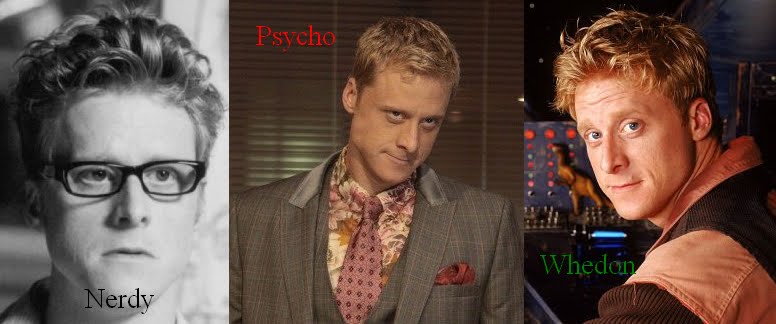

However, for a slightly younger actor.... Given the various acting jobs I've seen him do, I think Alan Tudyk should probably be on call for that one: I've seen him play nerds, neurotics, normal guys, absolute sociopaths, and Joss Whedon characters. He's a solid six feet tall, but I've only seen him look big maybe once—and with Lord of the Rings, we've certain seen the games that camera perspectives can play (no, Elijah Wood really isn't a midget.... really).

Unfortunately, like with Sean Ryan, I'm no better this year at coming up with a different name for this part.


Manana Shushurin—even though I had based this character on a real person (on the near left), I don't think I could coax her into playing the part, since she has a life.

Based on physical build and coloring, some have suggested Olivia Munn—both the build and coloring match, and even the facial structure works, at the right angles, but I have no idea if she could act her way out of a paper bag.

However, since last year, reflecting on this a little bit more, there is always Eliza Dushku.

Yes, Eliza Dushku has played in a lot of Joss Whedon productions, but have you seen her acting range?  One look at the various and sundry parts she played on the short-lived Dollhouse displayed an impressive array of acting qualities.

And, like Manana Shushurin, Dushku has a good record of going through combat sequences. It's been a staple of hers for at least two Joss Whedon shows.

And Shushurin is supposed to be able to speak in any accent she wants, so a Russian speaker isn't necessary for the role.

Anne Hathaway HD 11x17 Sexy Actress #05 HDQAlso for Manana Shushurin, my friend Jason has suggested Anne Hathaway.  An idea that might not suck at all.  She's not unattractive, she's apparently able to do her own stunts ....

I'll be interested to see if she's able to handle her role as Catwoman in the upcoming The Dark Knight Rises.

Any thoughts on any or all of these, please comment below.