Showing posts with label masks. Show all posts

Wednesday, August 19, 2015

SFCS -- Strong Female Character Syndrome.


I believe it was Stuart West who told me in private correspondence that he appreciated how many strong female characters I have. I was a little thrown there because it took me a moment to figure out what he was talking about.


In my novels, I have Manana Shushurin, who's a spy that's more James Bond than George Smiley.  She reads, likes music, has a degree from Wittenberg university .... has no social life, and technically, lives with her mother (technically, I say, because she really lives in her office). She also has a secret that's eating a hole in her life.


I also have Maureen McGrail.  She's an Interpol detective, local Dublin cop, relentless, tenacious, and she knows about three martial arts.  She's also pining for a guy who came into her life, swept her off of her feet (just by being himself, really) and disappeared, without showing even a hint of romantic interest in her.


Then there's Wilhelmina Goldberg, who is 4'11", computer nerd, daughter of two esoteric languages nerds. She likes science fiction and fantasy, programs her computer to talk like characters out of Lord of the Rings, and has a subscription to Security magazine.


In context, I should point out that Stuart was using the strong female character comment as a segue into a completely different point, an issue he found in my writing. (Apparently, I shouldn't be putting in bust size as far as describing a female character.  I neglected to tell Stuart that if I knew anything about clothing, I would probably include men's jacket sizes to paint a clearer, more accurate picture of them, too. But I don't know any men who are the sizes I need. Me? OCD?  Nah....)


In any case, the SFC term struck me, and stuck with me.


And then there was this article, entitled I hate Strong Female Characters.  If you read through it, you might find a few points to agree with, and a few problems.


Now, I agree with the author on the initial point.  I also have problems with the SFC label. I really do, because it tends to detract from, oh, the point. In the example they used of Buffy-- she was smart, witty, with outside the box solutions to non-vampire problems (shall we start with the fertilizer bomb in the high school, or the rocket launcher?).  But "Strong" is the only descriptor one can come up with?


In my own work, I spent so much time on developing characters like Manana and Wilhelmina, their quirks and habits and hobbies, that I feel a little awkward if the best description anyone can come up with about them is just "strong."


Though you want my problem with this author?


1)  "I want good complex characters!"


.... And then, let's focus completely on Buffy, because she's the STRONG character.... and ignore Willow, who saves the day repeatedly, but is physically as strong as your average anemic? Faith, who's as physically strong as Buffy, but a broken character? How about Cordelia, who starts out a vacuous California mean girl, and becomes more interesting within the first half of season 1? Anya, who goes through a fairly strange character arc of her own?


And, while they're talking about complex characters, they boiled Buffy down to only "SFC." How about witty? Smart? Creative? The example used in the article was the end point of a two-episode arc exposing just how vulnerable Buffy really is. Yes, she's got superpowers, but she's still a teenager, with all the problems that comes with it, in addition to waging a constant war against everything that came to kill her, swallow the Earth, etc. The author managed to ignore the entire point of a two-part story!


Who demands good complex characters! and then ignores them when s/he gets them?  If this article had said that the "SFC" label shoved a character into a box and left them there, then I could agree to some degree.  But this author seems to be guilty of doing just that.


2) I want a 1:1 ratio of complex characters, male and female! 


The author prattles on about Peggy Carter of Captain America: The First Avenger, complaining that she was unbalanced and cartoonish, making a lot of assumptions.


The author mentions that Peggy Carter shooting Captain America's shield is a temper tantrum that no guy would have gotten away with. Obviously, this person never saw the 100 generic Stupid People Tricks that are on cable, and mostly male.  The author assumed that in firing, Peggy had been too stupid to not be listening to the toymaker Stark prattle on about his cool toys for however long she'd been in his general orbit. The author also assumed that no one in the entire room knew that the shield was bulletproof-- which is kind of like people in Q's lab not knowing to duck on a regular basis.


The author then insists that this "over-the-top" reaction is because she's one of two women with a speaking part, and there be more women on screen to counter stuff like this. (Which is odd, since I counted four -- which included a grandma with a tommy gun, and a SHIELD agent at the end of the film).


My real problem?  First, the author makes these above assumptions and then kvetches that they could have shoe-horned in more women. Why? Just to shoe-horn in more women. So we could have a 1:1 ratio of women in the film. Really?


Hey, maybe we could have put in more cardboard cutouts. Besides, if you really want equality, then Captain America: The First Avenger, was perfectly equal. There were only two complex characters in the whole film.  Tommy Lee Jones was playing....Tommy Lee Jones.... Zola was Mad Scientist #2 ... The Red Skull was Psycho Villain #6 ... Eskine was "Dr. Littleoldmun" from Mel Brooks' High Anxiety. And Stark was very much "Howard Hughes Carbon Copy #1."  Outside of the sidekick Bucky (Plucky Sidekick #9), are any of Captain America's team referred to by name?


In short, Carter and Rodgers were the only two characters of any substance in the film. This isn't a complaint. I'm sure they were plenty deep in character design, but there was little enough of it on the screen. Not to mention-- it's a movie. If you're Peter Jackson, you get nine hours of films for develop all of your character. If you're a Marvel film, you have, at most two hours and thirty minutes.  If you have two well-written and developed characters, you're ahead of the game.  I feel fortunate to have one, some days.


But for the 1:1 ratio this author wants?


Maybe this author would have liked more 2D characters. As she suggest, let's gender swap.... Dr. Zola?  So we can have a weak, simpering little woman be bullied by Tommy Lee Jones? Dr. Erskine? So we can have a little grandmother figure play the martyr?  Hey, we could gender swap Tommy Lee Jones, and have him played by Kathy Bates!  Why not have the Red Skull played by Angelina Jolie?


Now, a reasonable argument I got from Karina Fabian is from the point of view that, there were certainly a heck of a lot more women in the WW2 military than were seen in the film. There were secretaries, WACs, women who transported planes, codebreakers, nurses, etc.  That way, we could have had a lot of women.... but they would have been in the background, and probably would have completely boiled away this author's argument.


3) Women are at the back of the bus...um, movie poster, like Black Widow.


"Strong women are supposed to kick ass and keep their mouth shut." Really?


How about, oh, that Black Widow WAS THE ONLY ONE WHO OUTSMARTED LOKI?  IN THE ENTIRE MOVIE! GAAAHHHH!!!


How about that BLACK WIDOW WAS THE ONLY ONE WHO COULD CLOSE THE PLOT DEVICE DESTROYING NEW YORK?


How about the fact that there were maybe five deep moments in the entire film, and Black Widow was in two of them (The five moments were Stark and Banner in Lab, Stark and Rodgers reconcile, Coulson, interrogating Loki, and Black Widow and Barton, post-brainwashing....six scenes, if you count Black Widow and Bruce Banner in India, giving her half the deep moments in the film).


Oh, hey, how about Sam Jackson? Maybe we should say The Avengers was racist, because he was in the back of the poster?


I'm sorry, but unless you're Iron Man or Thor, you're in the back of this poster.


4) Where's Thor?


Seriously, where's the movie Thor in this discussion?  You know, the movie that was mostly Kat Denning and Natalie Portman handling Chris Hemsworth as he was enduring culture shock? With some occasional exposition from Mr. Skaarsgard? Portman's character, astrophysicist Jane Foster, isn't "strong," in this sense, is she? Because last time I checked, most of my female friends could break her like a toothpick. Foster is instrumental in Thor's change from prick to hero, but is she thrown on the bonfires of the blogger's vanity because she doesn't come with a complete bio and genealogy?


Or does this author consider her merely as a damsel in distress?  Which would be odd, because if you were in the New Mexico town in Thor, you were in distress, up to and including the three beefy supporting characters and the Valkyrie that (quite literally) drop down out of the sky.


Or does this not count, because the end of the movie involves the Warriors Three, Odin, and Loki? Making it three more male characters on screen than women?  Do we count Freya, who tried to stopped three assassins coming to get Odin? Or because she wasn't on screen that often, should we throw her aside?


While not physically strong, I thought Jane Foster was very well written. She was the love interest, sure, but that love motivated both of them to be better.  He was motivated to be a better person, and she was motivated to continue pursuing interstellar/inter-dimensional travel.


Am I wrong? Or, as I asked, does she just not count?


Conclusion: Equality!


As I said at the beginning, I don't like the SFC label.  If you can shove my characters into a nice neat little box, I'm going to be pissy -- either at you for demeaning my characters, or at myself for making them cardboard cutouts.


I would have liked this article more if it were less obvious. It's clearly pushing an agenda -- not about creating good characters, but numerical "equality!" for "equality's" sake. By the end, I felt like I was reading a review of 300 that insisted that there should have been 150 female Spartans at Thermopylae (this is not a joke, I did read one of those).


I honestly couldn't tell you the ratio of my characters if you dared me to.


In A Pius Man, I've got Maureen, Manana and Wilhelmina named above as main characters. Is the ratio 1:1 if I include Giovanni Figlia's wife, the forensic specialist?


Is the ratio no longer 1:1 if I count the three priests in the background?


Is it all right if I have Scott "Mossad" Murphy, who can't shoot, is pale, anemic-looking, and pair him up with the sexy gunslinger Manana?  Does that make him weak, even though he will take gunfire and is a pivotal part of the book?


Does Wilhelmina Goldberg not count if she doesn't shoot anybody, but is a key part to hunting down the bad guys by the end?


At the end of the day, the SFC label is too simple. But so is reducing "equality" to numbers of people on screen and counting lines.  If you're keeping score with 1:1 ratios, exactly what will satisfy you? I have no idea.


Now, if you'll pardon me, I have to go write a scene where Manana has to save Scott. Again.


Tuesday, April 16, 2013

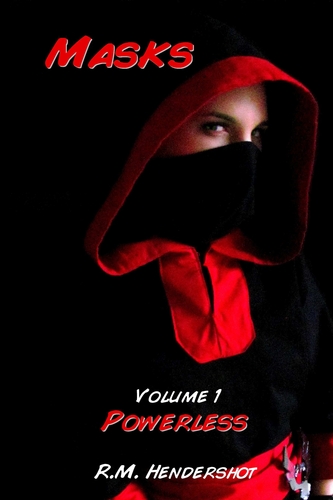
Book review: Masks, by RM Hendershot.


Unlike other blogs, I try not to allow personal issues to show up here. I usually only use personal issues when they’re of use to anyone, usually in the form of writing.

However, I have to post a disclaimer here in the name of honesty.

Long time readers may remember that, for a while, I had posted about a blog a week, referring to my friend RM Hendershot, the author of Masks. If you’re wondering why I stopped, we had a falling out. Some things were said, and, to be honest, I’m not 100% certain what happened. It was very sudden, and very one-sided – and I wasn't on the side that knew anything.

However, I had promised her that I would review her book, and review it I shall. I keep my promises, if nothing else. Obviously, you know that I will not be giving her a good review out of love – eros, agape, or any other kind – and I will avoid a hatchet job, if I can.

To begin with, all of the heroes were dead. Dead as a doornail. Ten years ago, they were all slaughtered as part of a supervillain’s killing spree after he learned that he was dying of cancer. After that, no superheroes call LA their home anymore.

Enter Rae Masterson , the “mask” known as Peregrine -- powerless, unless you count snark as a superpower. She has nine arrests under her belt, even though five of them have been of Captain Catastrophe, whose name is suitable in more ways than one. Our story opens with Rae witnessing the kidnapping made by one of the local supervillains, Cobalt.

In another part of the universe, Trevor Gray, a former sidekick, modeled somewhere along the lines of Tim Drake, has been recruited by one of his fellow homeless to find his friend – someone who had been kidnapped by Cobalt.  He's a genius-level detective ... but he still can't understand girls.

As Rae and Trevor investigate the abduction from two different angles, they run into each other, and hilarity ensues.

I generally don’t like Young Adult novels. You have to get someone very specific and very good to get me to bother with one. Timothy Zahn, David Weber, Peter David, CS Lewis, are the few authors of YA books that I’ve read and that I’ve liked. Take your Hunger Games and your Twilight, and I’ll sooner given you back Sherrilyn Kenyon’s Chronicles of Nick first.

However, I like this one. It’s witty, and it’s fun, and it’s smart. It’s better than anything comic books – the usual medium for such things – has put out in years. I thoroughly enjoyed the book, and that’s not because I helped with one of the death traps. It has a lot of stuff most comics lack – character, for one. Everyone here has a surfeit of personality, even the bad guy, and the sidekicks, and the local superman equivalent (everyone has at least one). Chapter eleven has a shootout between three female characters, and not one mudwrestling joke…. someone should sent it to DC Comics.


Everyone in it has a solid story arc ... or a character arc, if you prefer. And our hero and heroine have some good, natural chemistry.

It has the snobbery of high school, the stupidity of bureaucracies (in short, it's very realistic) and, the most important part: this book doesn’t treat the audience like they’re stupid.  It has offhand references to the Fischer King of Arthur, and even Universal monster movies. They also have some nice nods to actual comic books -- there is a Busiek hall, named after the creator of Astro City, a Lieber hall, named after Stanley Martin Lieber, who also goes by the name Stan Lee.

Not to mention, I also like the art. I’d post a few samples, but they’re not mine to post. No, this isn’t illustrated; they’re just pictures at the opening of each chapter, that’s all. But they’re nice and straightforward, and I can tell who’s who. Which puts the artwork above some Marvel comics I’ve read.

All in all, it was fun. There were some nicely executed Hitchcockian moments along the way, as well as some moments that J. Michael Straczynski would love.

Quite enjoyable.

Tuesday, August 28, 2012

Book review: Masks, by RM Hendershot.

To begin with, all of the heroes were dead. Dead as a doornail. Ten years ago, they were all slaughtered as part of a supervillain’s killing spree after he learned that he was dying of cancer. After that, no superheroes call LA their home anymore.


Enter Rae Masterson , the “mask” known as Peregrine -- powerless, unless you count snark as a superpower. She has nine arrests under her belt, even though five of them have been of Captain Catastrophe, whose name is suitable in more ways than one. Our story opens with Rae witnessing the kidnapping made by one of the local supervillains, Cobalt.


In another part of the universe, Trevor Gray, a former sidekick, modeled somewhere along the lines of Tim Drake, has been recruited by one of his fellow homeless to find his friend – someone who had been kidnapped by Cobalt.  He's a genius-level detective ... but he still can't understand girls.


As Rae and Trevor investigate the abduction from two different angles, they run into each other, and hilarity ensues.


Welcome to the world of Masks, by RM Hendershot, a superhero novel that openly states that this will be "different" from all the others out there.  Is the author right?


I generally don’t like Young Adult novels. You have to get someone very specific and very good to get me to bother with one. Timothy Zahn, David Weber, Peter David, CS Lewis, are the few authors of YA books that I’ve read and that I’ve liked. Take your Hunger Games and your Twilight, and I’ll sooner given you back Sherrilyn Kenyon’s Chronicles of Nick first.


However, I like this one. It’s witty, and it’s fun, and it’s smart. It’s better than anything comic books – the usual medium for such things – has put out in years.  Unless you count J. Michael Straczynski.  I thoroughly enjoyed the book, and that’s not because I helped with one of the death traps. It has a lot of stuff most comics lack – character, for one. Everyone here has a surfeit of personality, even the bad guy, and the sidekicks, and the local superman equivalent (everyone has at least one). Chapter eleven has a shootout between three female characters, and not one mudwrestling joke…. someone should send it to DC Comics.


Everyone in it has a solid story arc ... or a character arc, if you prefer. And our hero and heroine have some good, natural chemistry.


It has the snobbery of high school, the stupidity of bureaucracies (in short, it's very realistic) and, the most important part: this book doesn’t treat the audience like they’re stupid.  The last time I saw someone treat the audience like this with superheroes it was Straczynski. It has offhand references to the Fischer King of Arthur, and even Universal monster movies. They also have some nice nods to actual comic books -- there is a Busiek hall, named after the creator of Astro City, a Lieber hall, named after Stanley Martin Lieber, who also goes by the name Stan Lee.


Not to mention, I also like the art. I’d post a few samples, but they’re not mine to post. No, this isn’t illustrated; they’re just pictures at the opening of each chapter, that’s all. But they’re nice and straightforward, and I can tell who’s who. Which puts the artwork above some Marvel comics I’ve read.


All in all, it was fun. There were some nicely executed Hitchcockian moments along the way, as well as some moments that J. Michael Straczynski would love.  Is it Les Miserables? No, of course not -- the book's too short.  But it's fun.  But Ms. Hendershot also has a plan, and a multiple-book arc, so we'll see how it all shakes out. 


The novel is quite enjoyable. I recommend it to anyone who believes in truth, justice, intelligence, and heart.  And ghost cowboys. Can't forget the ghost cowboys.


Buy it here -- seriously, for some reason, it's disappeared from Amazon and B&N.

Tuesday, February 14, 2012

Building a better death trap: working with Masks author RM Hendershot

A few months ago, friend and fellow author Rebekah Hendershot asked me about what I would do if I were an evil super villain who wanted to hold prisoners .... specifically, a Robin-esque ex-sidekick, a werewolf, and a Golem.

I asked "Why?"

Well, Rebekah explains her reasons better than I could, so I'll let her do that here.  Suffice it to say, she needed those three people in a prison they couldn't escape from -- and oh, yes, keep in mind, the villain is a teleporter, so he can come and go as he pleases.

"Cool," says I. "Mountain cage. If they leave, they all freeze to death."

Nope, we need something closer to Los Angeles.

"Okay. Three tiered, vertical death trap: your sidekick is chained up, hands bound by the chain. Below him, a block of cement in which the golem is trapped in, and, at the bottom, the werewolf -- obviously, in a silver cage. Stripped naked, for extra pain!  If the other two try to escape, the other falls, and there's death all around Muahahahahhaa!!!!"

Then Rebekah talked me off of a ledge.

"Keep the silver cage and the concrete, only stick them in a shipping container, on a ship -- dangling off the floor, suspended by four chains to opposite walls. If they move too much, splat."

We can't keep the concrete, our protagonist can't pick concrete with his lockpicks.

"Oh, all right, I never get to have any fun."

As to how everyone gets out of the problem.....

Well, I'll let Rebekah give you that solution as well.

I present to you Chapter 26 of Rebekah Hendershot's Masks: The Fire.

This was one of the better 2am conversations I’ve ever had, I think.

Enjoy.

[Oh, and for those of you who don't know what a golem is -- I'd link to it, but Wikipedia wants to go into hiding today to stop the anti-pirating legislation from the fools on The Hill.   I wonder if miss "Pass the Bill to find out what's in it" Pelosi will be about to do anything with Wikipedia shut down.  Anyway, a golem is a stone man, traditionally a Jewish myth about a man made from clay in order to protect the Jewish peoples from harm. Mary Shelley, eat your heart out.]

Tuesday, January 31, 2012

Saved by a superhero

And here I thought I would have nothing to talk about, I'm saved by Rebekah.

You remember Rebekah Hendershot, don't you?  You may not, it's been a while since I wrote about her, and her strange, strange little universe of Masks. News items and essays she dealt with have inspired a few blog entries, and even a few stories .... my story "God Hates ... Superman?" is actually stolen from her original blog title of the same name. Masks has appeared all over the blog, including: “So, you want to be a writer?” and Disasters to Marvel At: A Comic Discussion, and others.

Madam Hendershot inspired my Writer's Rules For Villains; and The Masks Blog beat up on Fred Phelps before this blog did.

Masks also made a brief appearance in one of the first stories on this page, Boys of the Old Brigade.  As well as the direct sequel, Coyote Christmas.

Now, what the hell is Masks?

Masks is a novel series written by Rebekah Hendershot, who has been a friend of this blog and its supporting pages since day one. Seriously, she provided the first comment on the entire blog.

Masks is, essentially, what would happen if you had someone who wanted to seriously write an original novel about superheroes. She's it. Unlike some novels, like Soon, I Will Be Invincible, or other novelists who spend more time making fun of the genre than actually enjoying it, Rebekah is having fun with it. Imagine if Jim Butcher wanted to write an original comic book, you get Masks.

Masks also tries to make superheroes "real"-- rule one, NO SPANDEX.

It's a book written for those people who want something more edifying than Twilight, and without a retarded fanbase... Rebekah is far too polite to beat up on Twitards. Obviously, I don't have that problem.

Her premise: Something killed off the superheroes of Los Angeles. And it's still there. Cue Dracula theme.

Now, the only thing standing between the civilians of LA and supervillains is .... a sixteen-year-old girl with a snark function permanently set to "kill." She has allies ... after a fashion. She's aided by a screwed up Tim Drake meets Winter Soldier, she has a demon coyote who's stalking her, and a cowboy grim reaper seems to have an interest in her as well.

There's a love story in there as well, but I can only cover so much.


Over the last few years, she has supported gamers, comic books, and Young Adult fiction that men can read (YA fiction that isn't Twilight.)

When you check out her blog ... and what are you still doing here reading mine? .... you might notice some common themes between her blog and this one. A lot of writers are similiarly warped. We're weird that way.

And Lord knows that any fantasy elements in Masks is about ten times better than any fantasy used in Star Wars recently.

One day, Jim Butcher's Harry Dresden will come up against a mad scientist, and it'll look a lot a Masks novel. Or, Butcher, or even Laurell K. Hamilton, will try to write something that is a solid mystery, and it may be as good as the Agatha Christie-like Zephyr Street.

All in all, it's a fun ride. If you have the time, you might want to get on. And buckle up

Because her book is released!!!!

Now, go buy it. You're welcome.

Wednesday, December 14, 2011

Coyote Christmas: the full story


Last week, I introduced a tale of Sean AP Ryan, in a twitter format.


This is the rest of the story.


You'll notice that a few things are different, and some things are spelled out better here than last week ... because, while Twitter can have a whole range of sequences fitted into 140 characters or less, some things can get lost in the process.


Now, if you don't recall Sean A.P. Ryan, he is a security consultant, a mercenary, and someone who is possibly quite, quite mad.


He has faced people who are NOT Fred Phelps of the WBC.


He has dangled someone off of the Empire State Building -- which is a little important to this story, though not much.


He has bargained his way out of an LA jail.


And this is just in the short stories that have appeared on this site. (Linked to in the left hand column.)


Today, he runs up against someone who is decidedly not RM Hendershot, author of Masks.  I can guarantee you won't even see the word Hendershot appear once.  Honest.


Coyote Christmas.

Wednesday, November 9, 2011

FAQ: Where do you get your ideas?


I've touched on this briefly during the series on how I created A Pius Man, but, apparently, the question many authors are besieged with is “How do you come up with your ideas?”


Short answer: formal viewpoint. Or a functional mentality.


For example, last year, I saw Forbes Magazine with cover article about how al-Qaeda was losing money, and it suggested that Osama "needed a new business model."


I can not make this stuff up.


The point is, people look at things from a “formal viewpoint.” I would look at a large pile of money and think of where a character would hide it. An accountant would probably count it all. A pyromaniac would look at it as stuff to burn.

[More below the break]


In my case... to use an example, in 1998, my family went to London and stopped off to see the Crown Jewels. Everyone else stared at the jewels. I went and looked at the security. I didn't take notes, since I didn't want to be thrown out of the Tower of London by the fastest possible route [the jewels were a few floors up]. The British Museum got the same treatment from me -- The Elgin Marbles from the Greek Parthenon had their own wing.... so, if the Greeks really wanted them back, they could steal them with a few construction helicopters and just airlift the whole wing—the Israelis did that with an Egyptian radar tower once to great effect.


Basically, it's a matter of looking at things from a certain viewpoint. I suspect that if I go see the Mona Lisa, the majority of my time will be pondering how someone could disable the security guards, the electronic surveillance, and walk away with a few paintings from the Louvre. Though the answer would probably be to steal something from the basement storage area—less security, without the individual alarms on every piece.... hmm, now that's an idea....can someone scan for Semtex at the entrypoint to the Louvre? Hrm...


The sad thing is that the above was really thought up as I wrote it.


I created one character because a teacher in high school, on the first day of class, said “I'm a wanted terrorist. I've been hunted for 19 years.... I can kill you with two fingers.” He was the creative writing teacher, so we went with it....


And I wondered... “What if he was telling the truth?”


He's in a back pocket somewhere, for when I get around to writing that novel. The annoying thing is, I have it outlined....


Some, like Harlan Ellison, have described writing as a compulsion, and that's because that's how we seem to be wired. Be it the Tower of London or the British Museum, writers wonder how we can do something with where we are, what we're doing, some little factoid we picked up, or a stray comment.


I don't think I've ever gone to someplace and not wondered how to blow it up, shoot it up, or what would be required to do something like that.


Rebekah Hendershot, author of Masks, described a similar experience when creating her book: “Why doesn't LA have any superheroes?” Answer: “Because something killed them all. And it's still here.”


With A Pius Man, Scott “Mossad” Murphy came out of the mass of Evangelicals flocking to Israel after 9-11. What does Israel do with all of these meshuge goyim? And what do you do with them if they want to join the military, or even the intelligence services? Answer: the goyim brigade—Mossad agents who not only "don't look Jewish," but aren't.  Murphy was just a throwaway character I had come up with to use “someday.” He had literally been shoved into a notebook and left there for three years. I had used him once as a supporting character in one book, and all but forgot him. Later, he came in handy.


And that's why writers have notebooks—to keep track of all the random neurons firing off with ideas. You never know when there's going to be something that comes in handy. Stephen King supposedly has a trunk filled with notebooks of ideas past.


So, if you ever think that a writer is odd, well, they are. They look at things from different points of view—if only because they have to be able to see things from the points of view of different people as they write them. Stephen King writes about things that scare him... and that seems to be everything... the author of Rebekah saw how much LA had been shortchanged of superheroes and decided to explain why. I think up various and sundry ways to kill someone with a ballpoint pen (I'm on nine).


That's how we find ideas. We're wired to.


But then again, who'd go into this profession if we weren't?

Monday, October 24, 2011

Don't Panic: a writer's guide to disaster

I should start by mentioning that this is going to be less about writing disasters, and more about a character reacting to them.
My characters have all sorts of problems.

In my books, I've had people confronted with Being beaten to deathDestruction of public propertyheartbreaka small war, as well as vampires and the end of the world.

In most cases, this is easy for writers to put down. Fear is easy, everyone has experienced it in one way or another.

In my case, not so much.

There are two moments in my life that highlight the reasons my characters react the way they do.

One New Year's eve, I was over at a friend's house.  My sister decided to be helpful in the kitchen, and went to work cutting vegetables with a mandolin slicer.

Somehow, my sister managed to cut off the pad of her little finger.

The husband of the house couldn't look at the sight of blood. The wife felt immediately ill. My sister felt faint from blood loss almost instantly.

I rolled my eyes, sighed, made sure that the severed part clicked into place with the rest of the meat puzzle of my sister's finger, wrapped it, and drove her to the nearest ER.  We were seen immediately, since it was only 6pm on New Year's eve.  Midnight would have been a different kettle of fish, I'm sure.

I didn't freak out before, during, of after the incident. I was mostly annoyed that the evening might be shot to hell.  I went out into the parking lot with my cell phone and started calling people to wish them all a happy new year.  It took about 90 minutes for my sister's nine stitches to put her back together again. And a fun time was had by all.

And this isn't gloating. This isn't "I kept my head while others lost theirs!" moment. This was a moment of irritation, annoyance, and "Damnit, I have to play ambulance driver? Really?"

Now, you could say this happened to someone else. so why should I worry.

Then there was the time I was accused of being a terrorist....
[more below the break]

Wednesday, October 19, 2011

How to exposition like crazy


A Pius Man, as has been noted, has a lot of history in it.

Good ways to deliver data to the audience can be seen all over the place.  Bad ways can be seen in The Da Vinci Code; being pedantic lost me a few pages into that book, and I'm a history major, you would have thought pedantic would have been right up my alley.

However, if you want to see a good, clean delivery of data, you might want to see Masks, chapter 12: The Diversion.  Rebekah has a nice, straightforward and Hitchcockian way of delivering data while having a threat going on in the background.

However, welcome to A Pius Man ... based off of a graduate paper I did on the subject.

Which means about a metric ton more information.

Thankfully, a lot of what I've done with it has been a matter of cutting away ....

What do I mean?

It's sort of like having a cliffhanger in the middle of a scene: "Your hero is about to have his head bashed in ...."

Next scene: discussing history and what the latest information means.

Repeat as needed.

Run, as pissed off readers throw novels at you.

And, of course, people CAN skip the history ... if they don't mind missing the major plot points I slip in.

I'm evil and I'm glad.

Muahahaha....

That is all. 

Monday, October 3, 2011

Sex, DC Comics, and ... wtf?


Long term readers know my opinion on sex in writing.  I'd say my opinion on sex in general is very Catholic, but since no one understand that, I'm not even going to bother.


However, I can sum up my thoughts on sex in fiction very easily: who needs it?


As Rebekah says, we all know the mechanics. What possible reason is there for a blow by blow description? Pardon the pun, but you know what I mean.


Since my first article on sex, I've written a few sex scenes .... by few I mean two, and they were in the same book.  However, the "sex scene" was in someone's dream, and the protagonist was having a conversation with his dead wife through most of it. The sex was incidental, and mostly has to do with the fact that she was killed on their honeymoon.  The second sex scene was so vague, any less detail would be as clear as a Salvatore Dali painting, only with words.

Yes, I brought in Dali to an article on sex. I'm weird. However, there is a point.

Even during these scenes, there's no blow by blow description. (I'm going to stop apologizing for that phrase, just roll with it.).  It's not necessary, unless someone's writing porn.  Even something as intimate as noticing a tattoo on someone during sex doesn't necessitate that much detail -- the audience does not need to know what specific act the individual was doing when s/he noticed the tattoo.  It's sex. Nudity happens.  Next chapter.

So, what prompted today's rant?

DC Comics seems to be going back to the 1990s, where the artistic style was summarized by my friend Jason as "Big boobs, big guns."

The current version seems to focus on women and sexuality, with an overemphasis on the sex.

I've no problem with sexuality, or with women -- look at my model for Manana Shushurin if you don't believe me --  it's that it's bad writing.

Starfire, in costume
Take, for example, the character of Starfire.  She's an alien with red hair, green eyes (and I don't mean with two green irises, I mean the entire eye is green), orange skin, with measurements somewhere in the 36 DD battery range.

Normally, I would stop reading at green-eyed redhead (I grew up with a crush on the female lead in Riverdance, leave me alone).  The character has always been sexually relaxed, it was mostly a cultural thing.  And, for the most part, it was used properly -- as comedy.  For example, in the classic Crisis on Infinite Earths, Starfire walks in with Nightwing, meets an old friend, and introduces him as "This is Nightwing, my lover."

Nightwing's reaction is such that you suspect he's glad that he has to go and face the end of the world.

And that was it.  One panel. Move on.

[More below the break]

Monday, September 26, 2011

Impossible Odds: From Masada to Talisman

"Whether it's the Trojan War, the Battle of Thermopylae, or the Last Stand at the Alamo, many of the famous battles in history were sieges in which small forces took on much larger armies. Unfortunately, sieges don't make good stories because the smaller force won. They make the history books because the little guys fought well, before they died." ~Michael Westen, Burn Notice. Last stand, Ep 4.18
I like thousand to one odds.  Love 'em.  Can't get enough of them. Make it an intelligent war, I'm with you all the way.

300 Spartans (with about 10,000+ other Greeks) versus one hundred thousand (or a million, depending who you ask) Persian Imperial forces?*  I'm there.

Nearly seven hundred Jewish rebels vs. a Roman legion at Masada?** I'm with you ...

The Alamo ... Okay, not so much, but I'm more familiar with the players involved, and I can't say that I liked any of them, on any side.

A hundred thousand Orcs of Mordor versus Gondor? That's at least worth an Academy Award....

In my own writing, I have a tendency to give the bad guys the upper hand as much as possible.  I try not to leave it as a matter of "evil badguy gains upper hand because he's using underhandd methods, while virtuous goodguy never sinks so low." Anyone who had read even one my self defense articles knows better.  When in doubt, bite a nose off, pull at an ear, gouge the eyes, and, of course, kick 'em in the groin, whenever possible.  My characters fight like their lives depend on it, usually because it does.

No, when I give the bad guys the upper hand, it's because they either have better training, better equipment, more people, or all of the above.

That's when I whip out The Anarchist's Cookbook, and go to work.  Because when my characters are out-manned  outgunned, outmaneuvered, and when things have stopped looking grim and have moved on to "we're all going to die" ....

That's when my characters get smart, get sneaky, and become very, very dangerous.

[More below the break]


Wednesday, September 21, 2011

"Suffer characters suffer!" Jim Butcher, JMS, Masks.

I love screwing around with my characters, about as much as I like messing around with my audience.

Over time, we've talked about who can you trust in A Pius Man, how I like to keep my characters vague ... sometimes the most vague being the one who is the most blunt.

Now, I didn't get into writing to be a sadist of my own personal playthings. Unlike some authors, like J. Michael Straczynski, I don't "torture my characters." In some cases, like JMS, he does it literally.

And guys like Jim Butcher have literally said "Suffer characters, suffer!" in describing his writing style.  Back at DragonCon, he practically leaped at the microphone when asked about beating up on characters, and said "I'll take that one."

In my case, I just enjoy giving them mental problems that confuse the hell out of them.

And, also in my case, I like throwing in a love story, just to screw with some of them.

[More below the break]

Wednesday, September 7, 2011

Terror is also a form of communication: Intimidating Characters

When I write a character, I like to have them a little vague.  This doesn't necessarily mean that they're all mysterious.  In fact, one of the most vague characters in A Pius Man, is the most blunt, and the most straightforward, and the person who's seemingly the most willing to tell you exactly what's on his mind.

Sean A.P. Ryan: mercenary,self-described cleanser of the gene pool, and he lists his resume in terms of property damage and body counts.

While blunt, Ryan doesn't necessarily have to be evil. After all, you have comic book characters like Wolverine who slash hordes to pieces all the time, and his kill count is probably somewhere in the thousands by now ... assuming he doesn't get rebooted into being a hippy....

But I digress.

However, in the case of Sean Ryan, he's working for the Vatican ... he's supposed to be training priests and nuns in nonlethal combat.  His third scene in the novel has Sean crippling an opponent -- not many people recover well from a shattered kneecap.

And people wonder why I make the Pope a suspect in A Pius Man ... if he's hired this lunatic, almost nothing could be put past him.

But, do you necessarily need violence for a good, intimidating character?  Heck no.  All you need is the implication that there will be very, very, very bad things that happen if someone crosses him/her.

Frankly, all you need is a reputation.

For example, take a clip from the tv show Doctor Who -- a series about a time traveling alien (there's a reason why there are Romans and spaceships in the same scene) ....

[more below the break]

Monday, August 22, 2011

Fighting and Writing, 3: Krav Maga in fiction: Masks

As one of the various and sundry hats I wear, I have, from time to time, given advice about writing fight scenes, "blocking the action," or just plain giving thoughts on how stuff can get done.

Illustration by Nicole Le
Source: PocketCoyote.com
If you've been keeping up with the online novel Masks, the most recent chapter involved using a Krav Maga gun disarm.  Krav Maga wasn't mentioned, but I know it was used ... mainly because I told the author about it, and she said she would use it.

The most obvious reason it's the same technique I told her about .... the broken finger. (If you have no idea what I'm talking about, that means you haven't been keeping up with Masks, have you?  Well, if not, I suggest doing so now. It's fun, and it's only on chapter five and ... well, it's free.  If you have no idea what I'm talking about ... now you do.)

Watch the video below ... stolen from Spike TV's Human Weapon.  It's an older Krav Maga technique, where they grab the wrist as part of the gun disarm ... then grab the gun with the other hand, twist it out of the attacker's grip, and pull away.


In this case, this technique works going to the "outside" (as shown in the video above) or the "inside" (which would mean the defender would move more square with the attacker.)

You can find a simplified, written version of the technique here.

When I suggested this to Rebekah at the time, she preferred to go more the route of grabbing both the wrist and the gun, mainly because it fit the character better (The character having been trained in multiple martial arts).

However, one thing that the "inside" gun defense has going for it .... Imagine the average gunman.  Consider where all of his fingers are on the gun.  Middle, ring, and little finger are on the pistol grip; the thumb is either on the grip, or on the hammer of the gun. And where's the index finger?  Still in the finger.

And then imagine the average thug being taken by surprise with an "inside" defense.  Trust me when I tell you, that if the finger is still in the trigger guard, the finger is going to break.

So, as you read through Masks, and you're wondering "nah, this person couldn't possibly do that," the answer is ... yup, he can.

And now you know why.

Wednesday, August 10, 2011

On Editing


This will be a short post today.


I'm not done posting the seemingly endless stream of John Ringo novels.  I loved reading these books, but as I look at my own facebook page, cluttered with links to posts about John Ringo posts, I'm starting to get tired about writing about them.


So, on Monday, we will have the last of the John Ringo posts, and the most about the books for free on the Baen website.


But, today, I'm going to look at a very strange phenomenon: editing.


I'm not going to talk about editing A Pius Man, mainly because it's almost impossible for me to edit my own work, a problem a lot of authors face.


For example, Stephen King had one amusing problem with the edits of Salem's Lot.  He found one of his friends laughing hysterically over a page that was supposed to have the locals of the town of Salem's Lot "shooting pheasants for food."


Instead, King's friend found himself reading a line that the citizens of Salem's Lot were "shooting peasants for food."


Oops.


You may remember Karina Fabian, who guest-blogged for us back in April during her virtual book tour for Infinite Space, Infinite God II..  She recently asked for beta readers for her upcoming novel Discovery, which was based around the Rescue Nuns in outer space who starred in her short story Anti-venin, which I called "Snakes on a Starship." (more below the break)


I liked Discovery, though there were some issues I had with the draft I read.  I may be one of the few people who read visually.  I see events as I read about them.  I even picture events as I hear about them (which have lead to some embarrassing moments for me, I can tell you now). So, as I read through the novel, I had made a few notes of "I'm sorry, can I get descriptions / details on these people?"  She had the details on the characters, I just had to go back and forth because they were spread all over the book.


Given her reply, I'm starting to think I'm one of the few people who reads like that.  With luck, I can go into a full review on the novel some other time.  I liked the book, and I suspect I'll love it by the time she gets to her final draft.


I was also an editor on Rebekah Hendershot's Masks, for at least the first ninety pages. And I found something inadvertently funny.


Rendering of Peregrine

As done by artist

Nicole Le.

Stolen from the Masks

Website


The original second paragraph of chapter one is a description of her costume (pictured on the left).  It's supposed to be a simple ninja tunic that fit over her street clothes.  The draft I read looked like this.


Rae Masterson crouched on the edge of the roof and tried to stifle the butterflies flitting madly around her stomach. She had done this before. She’d trained for a whole year and a half, memorized a hundred contingency plans, even field-tested her costume. She could do this. The summer sun was roasting the black cotton of her costume tunic. Rae reached up under her deep hood and wiped sweat off her exposed forehead, above her lower-face mask.

The description is wonderfully done, isn't it?  It's nice, and neat and concise.  And, as you can see even in the final version of chapter one, Rae has an instance where she leaps off of a roof and lands on top of a bad guy.


The arc was perfect, and she sailed feetfirst through the air, her loose black tunic fluttering around her, tugging at the red sash that cinched her costume tight around her waist. The tunic hung to her knees when she stood still, but it was slit up to the hip on each side to let her run and kick, and the front and back flaps snapped like flags in the light breeze. Her hood lifted free of her head and billowed out like a sail behind her, her brown ponytail rising off her neck as she fell. She thought of the figure of the scarlet peregrine falcon on her back, and felt like she was flying.


Elegantly written, isn't it?


Can you spot the problem?


There's a reason I posted the photo.  Every other editor had seen it as well.


If you'll go over the description, you'll see there's nothing about her wearing jeans.


Apparently, of Rebekah's multiple readers, I'm the only one who spotted it. And the part about her flying through the air, the flaps on both sides ... you get the idea.


If you ever wonder why professional authors, who have published multiple novels, sometimes have problems with sentences, punctuation, etc, this is why.


I would publish some of my own gaffs, but the first draft of A Pius Man was written about seven years, six rewrites, ten beta-readings, six beta readers, four computers, and Lord knows how many drafts ago. And when Rebekah looked at it, her only problem was when I got long winded on the historical portions.   


And that's just one book.


And this is why authors tend to thank their editors.  A lot.


Anyway .... you all might want to read through Madam Hendershot's Masks.  It's fun.  This is the week that the two plotlines collide like a train wreck. In a good way. 


Wednesday, August 3, 2011

Author Review: John Ringo, Part 1 (Free Books, and Princess of Wands)

When Jim Baen was still alive and running Baen books, he had several principles.

1) He hated agents
2) It didn't matter what your political philosophy was, as long as you stated it well, you could be published by his company.
3) He  figured that giving away the books was the best way for people to get into them.

I'm quite serious about #3.  However, this was before the rise of the e-readers, and Mr. Baen died before that.  The company hasn't changed that stance, however....

So, you want a book for free?

Today, I'm looking at author John Ringo .... who, by the way, has no relationship to outlaw Johnny Ringo, of the old west.  If you look at his novels, you can see he's somewhere around libertarian / right-wing ... however, he actually has reasons for what he believes in, and when it's relevant, he'll explain. When it's not relevant, politics won't enter into it -- usually because too many people are busy shooting at our protagonists.

John Ringo, who was never a member of the Beatles, started his career with the Posleen War series, which has spun out of control into about a dozen books by now. The first four are self-contained, however-- a battle against cannibalistic Mongol hordes from space. He's former 82nd airborne, so the battles work.

And, you can download most of the books he's written for free, here.   And it's 100% legal.

Now, Ringo has only been an author for about ten years now.  He's published 35 novels. Thirty-five.  I've been writing on my own for fifteen years, and I only have about twenty-four.  So, professionally, I hate his guts. Personally, I have enjoyed everything he's ever written.  However, due to the sheer quantity of what he has published, I'm going to have to break him up into several series in order to get this into a readable format.

I should note now that this list of Ringo books is more or less written in order of series that I highly recommend, and that I think you will enjoy the most, in the order than I think you will enjoy them. Promise.

Book one ....  [below the break]


Friday, July 29, 2011

Week-In-Review 7-29-11

Oh Hell, this has been a crappy week. You'll notice in the paucity of articles that have been posted.  However, I've been doing some research, and I've got a good start on articles for the week to come.

Okay ... to start with, I did two Examiner.com articles this week.

One was on the trials of Dominique Simone-Khan, the Frenchman from the IMF, and Rape. It is a subject I am very touchy about.

Levi Aron, Leiby Kletzky, and "stranger danger".  It's a local event. If you don't know about it, you'll soon know ... well, enough.

Anyway ...

My first blog of the week was another list, the Writers blogs of A Pius Man ... thus far.

I did a little article on the terrorist attacks in Oslo, Norway.  An article that already has a follow-up.

And, the Worlds of Jim Butcher.... in which I explain some of the genius that is the creator of Harry Dresden.

And, in other news, Masks has a new chapter up.

Enjoy

Wednesday, July 20, 2011

Masks ... Didn't I do this blog already? Not quite.

[If you read the first blog, you might think this is a bit of a rehash .... it's not, trust me.  If you remember the blog from January very well, skip to the break. ]

At the start of the year, I noted that constant readers of this blog will have noticed several posts that link back to the Masks blog. It's all over the place. My story "God Hates ... Superman?" is actually stolen from her original blog title of the same name. It appeared in “So, you want to be a writer?” and Disasters to Marvel At: A Comic Discussion, and others.

Madam Hendershot inspired Writer's Rules For Villains; and The Masks Blog beat up on Fred Phelps before this blog did.

Masks also made a brief appearance in one of the first stories on this page, Boys of the Old Brigade.

Now, what the hell is Masks?

Masks is a novel series written by Rebekah Hendershot, who has been a friend of this blog and its supporting pages since day one.  Seriously, she provided the first comment on the entire blog.

Masks is, essentially, what would happen if you had someone who wanted to seriously write an original novel about superheroes.  She's it.  Unlike some novels, like Soon, I Will Be Invincible, or other novelists who spend more time making fun of the genre than actually enjoying it, Rebekah is having fun with it.  Imagine if Jim Butcher wanted to write an original comic book, you get Masks. 

Masks also tries to make superheroes "real"-- step one, NO SPANDEX.

It's a book written for those people who want something more edifying than Twilight, and without a retarded fanbase... Rebekah is far too polite to beat up on Twitards. Obviously, I don't have that problem.

Her premise:  Something killed off the superheroes of Los Angeles.  And it's still there.  Cue Dracula theme.


Now, the only thing standing between the civilians of LA and supervillains is .... a sixteen-year-old girl with a snark function permanently set to "kill," Rae Masterson, a girl so smart, she can take college courses while still in high school, and still has time for a little sideline at night as Peregrine.

In the opening, we see Rae foiling a robbery by her regular nemesis Captain Catastrophe.  There's a reason for that, he's a bit of a loser .... a loser who invests in death rays.  Taking him out is no problem, but getting into the costume might be.

And then, after the villain is nicely tied up into a little bow ... Rae hears a horse. In the middle of LA.  It's the Black Mask, a cowboy grim reaper who appears whenever superheroes in LA disappear or simply die.  The villain runs back into the store he just robbed so he can hide. When Rae herself hides, she's a witness to a crime -- a superkid who is kidnapped right in front of her.

And then the fun starts .....

How do I know this?

Because chapter one is online. She's posting the entire book.

Yup, the whole book. Online. It's an idea I'm considering myself. It might make my life easier.

In future chapters, you get to meet a screwed up Tim Drake meets Winter Soldier, a lycanthropic feline, the super-kids training program, a werewolf, and the return of the demonic cowboy. And his horse.

The official Mask-cot: The Url is Pockcoyote.com

After all. :)
Over the last year or so, she has supported gamers, comic books, and Young Adult fiction that men can read (YA fiction that isn't Twilight.)

When you check out her blog ... and what are you still doing here reading mine? .... you might notice some common themes between her blog and this one.  A lot of writers are similiarly warped. We're weird that way. 

One day, Jim Butcher's Harry Dresden will come up against a mad scientist, and it'll look a lot a Masks novel.  Or, Butcher, or even Laurell K. Hamilton, will try to write something that is a solid mystery, and it may be as good as the Agatha Christie-like Zephyr Street.

All in all, it's a fun ride.  If you have the time, you might want to get on. And buckle up.

Monday, May 30, 2011

Evil religion / Atheist: Conclusion.


This is the very last post of anything remotely "High-intellectual." I'm tired, and I want to take a nap now. If you've been tracking the blogs of the last day, you don't need the disclaimer. If you haven't, this blog will make no sense to you.

However, if you've been paying attention, you probably already know where I've been going with all of the Evil religion and Atheist blogs.

My Conclusion: Culture makes people stupid, not religion.  Assuming that people aren't stupid to start with.
[More below the break.]

Anti-theist complaints: Indoctrination of children


[Disclaimer: When Lent started, I figured I would do a whole bunch of "Snarky Theology" blog posts, followed by "Evil Religion" blogs. And, while I was at it, I asked Matt, friend of this blog, artist, atheist, and a few other things, to generate a list of what he found to be problematic with religion. He gave me a few.


I promised him I would use it. And I keep my promises


This is the last week I'm doing what my friend Jason calls "high-intellectual" blog posts. They are time consuming, draining, a lot of work, and I'm not sure they are at all entertaining. They've garnered some response, much of it hate mail.


My replies are long-winded, so this may take a few posts.


If you find yourself here by accident, or have no interest in the topic, I invite you to look around. Our most popular blogs are in the sidebar, as are the short stories, what this book is about, and we have entries on why anyone can enjoy this book, any politics involved, spytech, and even a section for fans of Sherlock Holmes and science fiction. If we don't have something you like ... wait five minutes. :)


Anyway, onto the complaint ....]


Indoctrination of children


I'm half with atheists on this one. Evangelicals run Jesus camps, which are really freaking creepy. I think “Children of the Corn.”


However, I know someone who went to a Jesus camp, skipped out on all of the camp stuff, and is a believer despite those particular schmucks.


And for Catholics … oh good God. This isn't indoctrination, this is drivel … not because of the ceremonies, etc, but my friend Matt once pointed out, I haven't found any Catholic school that explains what the hell the ceremonies are for! I only know reasons for them because I have a father with a PhD in Catholic Philosophy, I've a graduate degree in history, and I had to do most of my own fricking research. Catholics don't indoctrinate their children in the faith, they educate their children … badly.


Besides, if Catholics  indoctrinated kids, we'd have a better retention rate....


What? You think I ran all of these apologetics blogs to explain stuff to non-Catholics? Please, the Catholic educational system, like all private schools, are leaps and bounds over public schools ....


Except in teaching Catholicism!!!!!


Yeah, anyway....


Anyway, at the end of the day, I would like to see children raise kids without religion. And I mean any religion, even if it's the religion of santa, or "won't get better if you pick at it", or even "kisses make it better" and "your face will freeze that way." (Idea stolen from R. Hendershot, telephone conversation)


I think I can summarize a world without religion like this. It is an exchange from Terry Prachett's novel Hogfather -- where the Hogfather is the equivalent of Santa Clause. In a world run by the materialists of the day, I'd like to see them answer it.


Death: Humans need fantasy to *be* human. To be the place where the falling angel meets the rising ape.

Susan: With tooth fairies? Hogfathers?

Death: Yes. As practice, you have to start out learning to believe the little lies.

Susan: So we can believe the big ones?

Death: Yes. Justice, mercy, duty. That sort of thing.

Susan: They're not the same at all.

Death: You think so? Then take the universe and grind it down to the finest powder, and sieve it through the finest sieve, and then show me one atom of justice, one molecule of mercy. And yet, you try to act as if there is some ideal order in the world. As if there is some, some rightness in the universe, by which it may be judged.

Susan: But people have got to believe that, or what's the point?

Death: You need to believe in things that aren't true. How else can they become?