Showing posts with label books. Show all posts

Monday, January 26, 2015

Recommended Reading; Larry Correia


Up until I embraced my inner politicians (which I gotta tell, you, is draining as all heck), I had never heard of Larry Correia.  He's published through Baen books, and I read their top authors already -- David Weber, John Ringo and Timothy Zahn -- and yet I had only been vaguely aware of him from my visits to Barnes and Noble.


After hearing his name bandied about on a political fiction group on Facebook, I shrugged and said "Oh, what the hell? Why not?"


And, being a bit of a cheap bugger, I figured "Screw it, I'll get the 3-in-1 of his biggest series, Monster Hunter International."


My reaction?


Yes, I have, at long last, resorted to gifs.


I promptly went out and bought ... well ... everything else Correia has written, including the rest of MHI, his three Grimnoir and his Dead Six novels.


Seriously, these books are kinda awesome.  I finished all of them in a matter of days.


One thing at a time, though


The really, really, really short version about Larry Correia is that he is an unstoppable writing machine who pumps out books the size of Tom Clancy doorstoppers at least once a year, in addition to maintaining an almost daily blog, is almost omnipresent online, and has a BS tolerance threshold lower than mine.  Which tells you something, if you've been here a while.


Correia is, personally ... Libertarian? I think? His politics show up very little in his books.  Any anti-government feeling here could be summed up by the same feeling in 24, or Harry Potter (see: the Cassandra Effect. Honest). He prefers his heroes to be smaller, private groups, rather than sprawling government bureaucracies, though even the bureaucracies get a fair shake in his books (one of them at the very least).  He also owns a gun range, so he likes his weaponry. Big deal.


I'd say he has an ongoing grudge match against John Scalzi and the SFWA, especially over the Hugo awards, but it seems more like Scalzi and SFWA has an ongoing war against everybody I find remotely interesting. There's a lot of ranting against Correia because he's "a straight white man," even though his background is Portuguese -- don't even ask me how that works.


If you care about personal politics and online grudges, I'm sure you can find a few links.  From what I read on his blog, a lot of Correia is just plain common sense. But me and common sense have very little to do with each other.


But, on to the important part: BOOKS.  And I highlight books because I haven't gotten to any of his short stories. If I've missed a few, don't shoot. I've had a lot of books to dig through lately, but I'll add them as I find them.


Before I begin, MHI has nothing, repeat, nothing, to do with the Monster Hunter video game series. Thank you.


There are five books in the MHI series THUS FAR (it's ongoing), and you'd think there'd be an odd one out, if only for the regression to the mean (heck, there's one John Ringo novel I don't recommend, and at least two David Webers).  But, no, even though there's one novel in the series that you swear is going to be boring, it rallies at the midpoint, and ends with a demonic werewolf hellspawn and his legion of unkillable feral weres.


Imagine a fully-developed world for Buffy the Vampire Slayer, where the government has been aware of monsters for decades, and those civilians who have been dragged into the nightmare little world in the shadows have become Bounty hunters in their own right.  Of five books, I saw only two punchlines coming ... only one of them was more like a feinted jab so we could be decked with an uppercut. That's not bad.


Five days after Owen Zastava Pitt pushed his insufferable boss out of a fourteenth story window, he woke up in the hospital with a scarred face, an unbelievable memory, and a job offer.


How can you argue with a description like that?


Yes, chapter one involves a brawl between the above mentioned Owen Pitt, and his boss, who has become a monster of a completely different stripe than he had been.  Let's just say that I would have considered throwing him out a window before he became a large furry sociopath.


Yup. Pitt has to go toe-to-toe with a freaking werewolf.  And he has no silver.


After Pitt hands in his resignation the hard way, he has officially fallen down the rabbit hole. Monsters are real -- all of them. Pick a B-Movie horror film or a Lovecraftian monster. There are only two forces that deal with the legion of nightmares (that we see in this book).  One is the Monster Control Bureau (MCB), a government bureaucracy that looks like it's run by either the Keystone cops, or whatever random thugs can be brought in off the street (though it'll turn out that they aren't random). The other group is Monster Hunter, a private organization dedicated to collecting bounties as they exterminate the world's nastier pests -- including vampires, giant spiders, and a few creatures from the black lagoon.


And MHI offers Owen Pitt a job. The perks are good -- play with weapons, hang out with the stunning woman who recruited him, and the paychecks are insane -- and, well, why not?


Unfortunately for Pitt, his first day on the job is going to get messy.  He soon finds himself being haunted by an old Jewish ghost, is getting visions of an ancient entity called "the Cursed One"who just arrived on US soil, is hip deep in ghouls, vampires, flying killer gargoyles that bleed magma, and did we mention that the Cursed One might be about to end the world?


MHI has a wonderfully colorful cast of characters. From a former Vegas stripper who is more vicious and bloodthirsty than the lot of them, to Julie, a member of MHI's founding family, who is also a sniper... and her physical description in the book reminds me a lot of Bayonetta, but we won't go there.


There is a wonderfully broad collection of folks here, from the high school chemistry teacher who had to blow up his school filled with spiders, to the poor guy who had to kill his zombiefied students, to the explosive-happy Q-variant, to Earl Harbinger -- an old member of MHI's founding family with an interesting history.  The characters are likable, the dialogue engaging, and I don't think I came across a single flaw in the execution.


And yes, this book was awesome from start to finish.  It didn't really slow down.  Despite the constant description of these books as "gun porn," I have yet to be bogged down by a single page on guns.  Most of the time, the weapon details are critical to the plot, considering what fresh new horrors they run into all the time. The chapters that amount to a large training montage are detailed and interesting, and establish the characters better than heading straight into the action.


Then the shooting started, and didn't really stop for another three hundred pages or so.


And just remember: vampires only sparkle when they're on fire.


By the end of MHI #1, all is right with the world. The Cursed One is finished, Pitt got the girl, and while there were a few residual hiccups along the way involving some of the crew becoming vampires, everything is perfect ....


Except at one point, the government accidentally dropped a nuclear bomb through an interdimensional portal, getting the attention of a Cthulian elder god, who decides that only one human creature is to blame...Owen Pitt.  Yup. He has Murphy's own luck.  Pitt is being hunted by a death cult known as the Church of the Temporary Mortal Condition, led by necromancer known as the Shadow Man, who all want to feed him to their monstrous, world-devouring deity.


The (n)ever-helpful government wants the Shadow Man, and gives Pitt his own troop of bodyguards, including one MCB man known only as Agent Franks. It's the MHI versus the army of darkness, only they're better armed than Bruce Campbell ever was.


Interestingly, despite Correia's attitude on government in general, while he could have left the MCB crew as a bunch of mindless government automatons, even they get character development in this book.


MH: Vendetta might arguably be better than MHI. We need little to no setup for the action, the plot jumps out at you and never really leaves you alone, and we can't even have a nice, simply plot-starting exposition without it being menacing (when the two people telling Pitt that he has to save the world ... again ... are vampires, it's hard to have a relaxed conversation).


Vendetta really proves that Correia has assembled a strong cast, and a great sprawling universe out there.  There are no cardboard cutouts as characters, even the ones that you're not supposed to like.


Earl Harbinger has been around MHI for a long time. Longer than anyone suspects.  When an old Cold War enemy comes out of the shadows to threaten his position, Earl goes hunting.  Unfortunately for him and his enemy, a third player is in play, manipulating both of them.


This one starts off ... slower.  I really didn't feel much of anything towards Earl over the course of the previous two novels, and I found myself missing the rest of the MHI ensemble.  We have a group of MHI wannabes, a corrupt and cowardly MCB agent, a local sheriff who is a redhead (bitten by the wolves) as well as Earl and his personal nemesis. They're all sort of blundering around a bit for the first third or so.


But as I said, Alpha rallies at the midpoint, and ends with a demonic werewolf hellspawn and his legion of unkillable feral weres.  This is when the tree hits the submarine (Sum of All Fears reference), making four plot threads come together like your classic Tom Clancy novel, and we're off to the races.


While not as good, I'd still recommend reading it.  The first half is a three-star novel, the second half is a five-star novel, so average it out and call it a four out of five-star book.  And every element in this book becomes pivotal to...


We're back with the old team again, and this time, we're going to Vegas.  MHI is going to join with other monster hunter groups from around the world at the first ever monster hunter convention. Yaaayyy.... Unfortunately, my first thought was "We've just made for a great big target."  You know this has to go wrong, otherwise there's no story.


When the handler for all of Strike Task Force Unicorn (STFU) challenges the various hunters to hunt down and kill an unleashed beastie, no one has any idea of the sort of Hell that is to be unleashed. Soon, all of their worst nightmares are literally about to haunt them, and just consider that nightmares the men and women of MHI will have, and you just know we're about to have a party.


For Legion, Correia is in full form, and I mean full.  The various and sundry side characters? All of them are colorful, well-designed and developed. The MCB? They're getting more interesting. The government bureaucracy? More and more insidious as time goes on.


As for this book ... well, the opening gif kinda summed it up.


And did I mention there's a dragon?  Yes. Smaug can eat his heart out.


A few days after the events of Legion, Agent Franks of the U.S. Monster Control Bureau has to clean up a different mess -- one created by the people he works for.  Franks is a bit more than human, and he's been around for a long, long time, stopping America's enemies, and, for the most part, being the thing that stands between America and bigger monsters. He's even under contract ... With Ben Franklin (long, long story). As long as the US holds up its end of the bargain, so will Franks.  If the US violates the agreement, Franks is well within his rights to kill anyone involved.


And then there's Project Nemesis, a factory for building to-it-yourself monsters. And they can't be bothered creating one.  Oh no. They have to make a baker's dozen, lucky 13. It's in violation of Franks' agreement.  And then we're off to the races.


Don't ask me why, but this one worked so much better thank Alpha did.  Franks is ... interesting, and engaging in a way Earl and his story wasn't. It could be that there was more to Franks' story. No matter what, it still worked. Also, Franks has his own ensemble, with recurring appearances from the MHI team we've come to know and love.


And Nemesis may very well be the best of the bunch. It's hard to compare, next to Legion.  Either way, it proves that the series is only getting better.


Also, there was an sequence of Frankstein versus the Wolfman. It was brilliant.


If you can't tell by the lack of numbering and the slight larger font, Grimnoir is a different series than MHI. This is a trilogy centering around an alternate universe where magic is real, and human history has changed. The Grimnoir are a secret society of magic users dedicated to stopping the threat of the Japanese Empire, which has already taken over China by 1933.  Book one deals with the Japanese leader Tokugawa, otherwise known only as the Chairman, who kills with a touch, and has his own armor of magic-wielding operatives and teleporting ninjas.


And that's only book one.  Book two has to deal with a demon straight from Hell, and the third features universe-destroying monster from beyond the cosmos.  And the only two people who can stop this threat are Jake Sullivan, a veteran of the Great War, and Faye Vierra, a teenage girl, and vicious killing machine.


This is a great little world, and I enjoyed every minute of it, from first to last. There are Iron Man suits of powered armor, a version of Marvel's Silver Samurai, great, epic battles on dirigibles, at least one army of darkness, depending on how you'd count them. There are "cogs" -- Correia's version of the Sparks of Girl Genius -- and teleporters and gravity manipulators and ... Imagine if the X-Men weren't whiny emo douchebags who complained about being picked on all the time, and make them really awesome.  That about sums it up.


Oh, who are we kidding? Imagine the best Marvel film you've seen, and Grimnoir at least matches it pound for pound.  This is the series that got Correia nominated for a Hugo ... and made everyone go batguano insane over it.


No, I'm not 100% clear on the name of the series.  But let's just go for Dead Six thus far, shall we?


In a world that's only slightly altered from our own, this series is about two men: Michael Valentine, and "Lorenzo".  Valentine is a vet and former member of a elite private military contractor.  In the first books, he's been recruited to hunt down and eradicate terrorists.  Lorenzo is a thief who doesn't mind killing people from time to time, he's a master of disguise and of the heist.


Co-written with Mike Kupari, this one is actually darker than the others, and slightly stranger.  There are elements of paranoid thriller -- just plain don't trust anyone in these books -- and hints of dark, supernatural forces around the corner.  The series hasn't totally fallen off the map into fantasy, and is content to just hint at the deeper darkness. For now.


Thus far, the primary thread between these two books have been the Swords of Exodus, a religious group dedicated to wiping out evil on Earth, no matter where it might be.  They're terrorists, or extremists, and a few other labels slapped on them.


I enjoy this series just as much as any of the others, but I'll be damned if i could figure out where it's all going.


Thus far, my only complaint with the series is that they've both ended on cliffhangers. Kupari and Correia seem to think it's funny to play tag team with who they can threaten at the end of each novel.


In Conclusion


Read some Larry Correia, already, damnit.  Is he Ann Lewis writing Sherlock Holmes level of perfectly awesome?  No. But few are. He'll have to settle for five stars out of five stars, instead of six out of five.

Tuesday, January 20, 2015

Review: The Book of Helen

So, I'm going through the internet, and one of the forums I'm on is asking for reviews of this book, The Book of Helen.


In the interests of honesty, I should inform you that I got a kindle copy of this book for free in exchange for a review.... yes, I have a Kindle now. I caved in.


Premise: Remember Helen of Troy? In this version, she has lived to a ripe old age, her husband Menelaus died of natural causes, and her step-children are all interested in showing her the door, one way or another. Her only option is to fly to Rhodes, only Queen Ployoxo has other ideas for her.


Despite being a historian, I tend to be wary of "historical novels," mainly because they try too hard to be "authentic." For example, with Stephen Pressfield's Gates of Fire, you can find more minutiae about Spartan equipment than you ever need to.  The Book of Helen doesn't have this problem.  Sure, it has various and sundry elements of Greek life, but they're implemented casually and effortlessly. Like Bernard Cornwell's Sharpe novels, it might be in a historical setting, but it doesn't try to ram all of their studies down your throat.


There are parts of this book that read like a Greek myth version of The West Wing (the early years, when it was about strategy and process, and not about slant). Helen is a political genius, almost a savant, and can manage crowd, and is basically "the hostess with the mostess" on steroids.


The style feels very much like a bit of Mary Stewart meets Clare Booth Luce.  On the one hand, like Stewart's Merlin trilogy, The Book of Helen retells the story of the original Troy incident with little to no interference from deities, and no magic.  If there is a god involved anywhere, the meddling is implied, with just a hint of an explanation. With Stewart, when Merlin transports Stonehenge from Ireland to England, it's via engineering, not magic. When Paris meets Helen, she assumes that the story of discord's apple is merely a pickup line.  On the other hand, like Clare Booth Luce's play The Women (do not, repeat, do not see the horrid remake from the past decade. Just don't), Antonetti has a nice, crisp way of addressing the character traits and social tactics of other women. And let's throw in flashbacks reminiscent of John Le Carre's Tinker Tailor Soldier Spy (if you must, see the Alec Guiness miniseries, not the Gary Oldman movie), where the stories are told in interrogation-style fashion.


From a historical point of view, it's nice that someone remembers that Helen was of Sparta, as in "THIS! IS! SPARTA!" Yes, she does know how to shoot arrows at people. Thank you, Katniss, let's leave the sniping to the adults. Sparta and its society also acts as a major plot point.  Also, just for fun, it seems that author Sherry Antonetti, at times, makes fun of the Sparta element, when Helen thinks that her stepsons as declaring "This is Sparta!" as though that would solve all of their problems.


One of the more interesting elements in the story revolves around Helen's servant, Pythia, a slave who becomes Helen's scribe.  The relationship between the two of them is very much like a Doctor Who companion, or Dr. Watson to Sherlock Holmes -- while Helen is a political and social genius for the big picture, almost bordering on the savant, she has blind spots about comment sense matters that Pythia must smack her upside the head over.  The interplay has some fun elements to it, and adds a lot of the charm to this book.


Also, this has some nice themes along with it: grief, envy, hard work, a sideways pro-life message if you want to read into it that way.  This is also the first time I've seen someone turn the concept of bella figura into a working concept in fiction (It's an Italian concept that basically says that it is not enough to do good, one must also look good).


Now, why is this review not a 5/5?  Let's discuss.


So, everyone knows the entire story of the Illiad and the Odyssey?  Yes? Good, because there is almost no back story or explanation for what's going on here at the beginning.  Menelaus is dead on page one, and if you don't know the original Homer, you're going to be only a little lost for a few chapters.  You should be able to track this if you've seen one of the half dozen miniseries or movies on the subject in the past 15 years, but I've done my best to forget most of them. I was able to follow the book without a problem, since I'd read the Odyssey when I was 10.  However, the backstory will be filled in, you just need to hang in there.


There is a little too much talking at times, and not enough action. But then again, Greek mythology version of The West Wing.  I also wanted more physical descriptions.  Helen now has grey hair, or is it still blonde?  I caught implications that she was either going grey, but had enough blonde still left over to hide any grey; she's "still as beautiful as ever," but has she aged gracefully like Erin Grey, or did she not age at all? No idea.


And damnit, the speeches. They just kept going. Maybe if they were broken up a little more and turned into something like discussions, and not Dostoevsky monologues from The Brother's Karamazov. It still would have been too much talking, but it wouldn't have been a blizzard of words, just a flurry. There were moments my eyes were crossing.  Chapter six is the first time the reader will come across it, but if you slog through it, I promise that the rest of the book will be worth the time.


By the end, I wanted more. I wanted more of the story, more of the people, more time with the various and sundry characters, just more. The Book of Helen has a potential for a sequel, though it may just be named The Book of Penelope. If and/or when it comes out, I will be reading it.

Monday, January 19, 2015

@DragonCon, 2014: An Hour with Jim Butcher


It's fun listening to author Jim Butcher, if only to hear someone else be such a nerd.


Butcher is the author of The Dresden Files novels.  There was, briefly, a tv show that ... ended badly.


Year in review -- 2014


This has been such an odd little year.


I got A Pius Legacy and A Pius Stand published, finishing out the trilogy I began with A Pius Man.


I joined in a few political fistfights, mostly having to do with women in books for some reason.


I've had fun with Marvel, both Captain American and Agents of SHIELD.


I reviewed books all over the place.  Like Amy Lynn, and Night Machines, and a bunch of others here and there.


I've been at the Catholic Writer's Guild, and had some odd times there.


And then there's my job at American Journal.... fun fun fun.


I've looked at tv and video games and a whole bunch of other stuff.


Thankfully, I haven't lost a whole collection of authors, like last year.


I want to thank all of you for making this such an interesting year.


And here's to 2015, and selling a ton more book.


Sunday, January 18, 2015

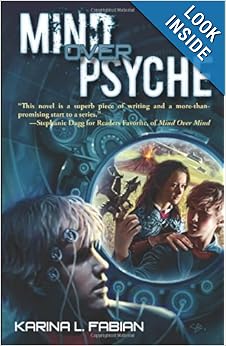
Interview with Karina Fabian of Mind Over Psyche.


If you don't remember Karina Fabian ... that's too long a story to get into here, just click on "Fabian" keyword below, and you'll find her quick enough.


If you don't remember the first book in this series, Mind Over Mind, you can see my review of it here.


Now for a look at Mind Over Psyche.


Deryl isn’t crazy; he’s psychic.  Desperate to escape the insane asylum, Deryl  teleports to Kanaan, a world of telepaths who regard him as an oracle.  But freedom comes at a price.  The Kanaan expect their oracle to teach them to use their powers to wage war.  Meanwhile, he’s falling in love, but to be with her means to share his psyche, which could drive her insane.  Most dangerous of all, he hasn't escaped the Call of the Master, enemy of the Kanaan, whose telepathic manipulations were why Deryl was committed in the first place.  Now, the Master will forge Deryl’s powers into a weapon to kill all he loves or destroy his mind trying.


Interview
Questions for Mind Over Psyche by Karina Fabian


1.  In Mind Over Mind, you had a romance between
Joshua and Sachiko.  Will we see more of
that in Mind Over Psyche?


No.  It’s Deryl’s
turn to fall in love, and it will be a very different experience from
Joshua’s.  For one, Tasmae is an
alien.  Kanaan mate for life and when
they meet their soul mate, it’s usually a compulsion.  They know, on a biological and telepathic
level, that this is their soul mate, and they figure out the rest later.  Of course, Deryl being human makes things a
little confusing for both him and Tasmae.
There’s more danger involved, as one or the other could drive each other
insane in the literal sense.  Kanaan
bonding is more than joining hearts or bodies.
They link minds.  Readers of Mind
Over Mind
know that’s traumatic enough for Deryl even with limited human
contact.  What’s worse, however, is that
Tasmae is under the psychic influence of her ancestor’s memories—her ancestor
who had gone mad.  Add to that the fact
that some of the Kanaan close to Tasmae see Deryl as a threat, not an oracle,
and you can understand why Joshua is really worries about Deryl and Tasmae ever
having the chance to be alone together.


2.  Joshua practices a form of psychiatry called
neuro linguistic programming.  He used it
extensively in Mind Over Mind.  Will he
use it in Mind Over Psyche?


Some, but it really doesn’t work with aliens.  He will, however, save a child’s life with
it, and will use some techniques to help Deryl and Tasmae out of danger.  This book, he also gets to exercise his
musical talents.


3.  What is your favorite scene?


Tasmae is deeply under the influence of her ancestor’s
memories and the pain and confusion have made her violent.  They’re causing Deryl pain a well, and he
begs Joshua to help her.  He’s a
psychiatric prodigy, right?  Never mind
that he’s 19, an intern, has no drugs or orderlies as backup and oh, yeah, is
dealing with aliens.  I loved imagining
what Joshua, Deryl, and especially Tasmae were thinking and doing.  Crazy can be a lot of fun…when it’s not real.


4.  What’s the challenge about writing about a
psychic people?


They don’t communicate just in words, but also images,
emotions, and simple knowing.  For
example, why have a name for a person when you can pass on the knowledge of who
that person is?  Ditto for places.  However, to reach a reader, I have to use
words.  No one wants to read “the captain
of the Kanaan guard” ten times a page, so some characters needed names, and I
needed a reason for them to have one.  In
the end, humans and the Barin (who also have verbal language) name certain
things.  This will be fun in Mind Over
All, because Joshua will joking name a young boy who clings to him, “Axel,” and
it sticks, to Sachiko’s ire.


Also, with no written language, there needs to be a way to
preserve history.  This is vital in Mind
Over Psyche, as memories are stored in psychic plants.  You experience things as the person
experienced them—no sanitizing, no skimming, no skipping the yucky parts
(unless the plant allows it.)


5.  Tell us about the everyn.  They’re more than just small dragons, right?


Oh, yes.  The everyn
are part of the sentient animals species called Bondfriends.  They have a symbiotic psychic relationship
with certain Kanaan (also called Bondfriends).
Without this psychic bonding, an everyn reverts to a fully animal state,
while a Kanaan will ignore their physical state until they die before they
reach puberty.  Bondfriends life separate
from “regular” Kanaan, who don’t’ really understand their psychic
relationship.  Also, because they are an
animal/person mind, so to speak, they are a bit wilder than the Kanaan.

6. Where do you get your ideas? 

All over—from TV, from conversations with friends, from something on the news (or Facebook), from another book I’ve read, from a call for submissions for an anthology… There’s actually a psychological term for it: cognitive disinhibition. People with CD do not organize/file away information as well as people who don’t have it. As a result, we have a lot of stuff floating around in our minds, synapses snapping around until they link up with something else, and BOOM! Idea! Interestingly, schizophrenics also have CD, but on a more extreme level. So to all the people in college who thought I was inhibited—HA!


7. What’s a common mistake new writers make?

Following “rules” too closely. Really, there aren’t rules, just guidelines. For example, I had a friend who tried to remove every single adverb in her novel because “the rules” say “No –ly words.” Those words are a legitimate part of the English language and used judiciously (Look! -ly word), they can have an impact.


8.  You write a lot of different stuff—horror,
fantasy, science fiction, comedy, devotionals…
What won’t you write?

Erotica, for one, or anything with an excess of gratuitous sex or violence. I have a rule for writing: If I’m not comfortable reading it aloud to my kids, I won’t write it. I've put aside novels because the characters want to share more than I’m comfortable writing.


Also, I won’t write something deliberately hurtful or insulting. I don’t hold back my opinions, nor do I resist a good joke just because it might offend someone. People are too prone these days to take the most innocuous stuff personally—or “personally” on behalf of someone else or some particular demographic. I spent too much of my childhood with a thin skin; life is more fun when you realize a joke is a joke.


I sometimes take on controversial subjects. The Mind Over series has a subplot concerning abortion, for example. I try to put myself aside and stay true to my characters’ feelings and attitudes. I won’t go so far as to say I’m always balanced; again, I write what I’d want my kids to read. So, while I won’t write a pro-abortion story I also don’t cast the woman who had one as the obvious villain. Life is complex, but there is a right and wrong.


9. You often decry on Facebook that you have too many ideas. How do you decide which to write first?


I have a rubric:

1. Will I get paid? (as in right away)

2. Am I on deadline?

3. Do I have a contract or an expectation from a publisher?

4. Will it sell more books?

5. Has the story grabbed me?


Sometimes, these blur, and once in a while, they go out the window. For example, I had an idea for a flash piece that I sent to a friend’s website. It will earn me nothing, and no one was expecting it, but the idea did not want to let go.


10. Is there a world of another writer you’d like to write in?

Madeleine L’ Engle’s Time Trilogy. Daydreaming up stories about Charles Wallance is what got me started. In fact, Mind Over Mind started in high school about Charles Wallace as an adult. Of course, it has radically changed! Deryl is nothing like Charles Wallace now, and the worlds are totally different. However, I still have one story that would work best with Charles Wallace. It takes place when he’s in his seventies and must again go in and out of people like he did in Swiftly Tilting Planet. One day, I plan to write it and use technology instead of withining—unless, of course Madeleine L’Engles’ estate wants to contact me about it!


I have been invited to write a novel in another author’s universe, incidentally. I don’t want to say more, though, until we have something more concrete. Let me just say, it’s a very interesting world premise and potentially a lot of fun.

Review: Mind Over Psyche, by Karina Fabian


Some days, it feels like Karina Fabian is being reviewed on this blog every three months. It's not entirely accurate, but close enough for government work.  Especially government right now.


So, if you remember Mind Over Mind, you don't need much of an introduction.  If not....
Deryl isn’t crazy; he’s psychic.  Desperate to escape the insane asylum,
Deryl  teleports to Kanaan, a world of
telepaths who regard him as an oracle.
But freedom comes at a price.  The
Kanaan expect their oracle to teach them to use their powers to wage war.  Meanwhile, he’s falling in love, but to be
with her means to share his psyche, which could drive her insane.  Most dangerous of all, he hasn’t escaped the
Call of the Master, enemy of the Kanaan, whose telepathic manipulations were
why Deryl was committed in the first place.
Now, the Master will forge Deryl’s powers into a weapon to kill all he
loves or destroy his mind trying.


First, I must say that I like this world she's created.  It's one of the most comprehensive scifi worlds I've seen in a while -- one of the better planet-as-character routine I've seen since Dune, and possibly one of the better Christian science fiction premises I've seen in print since C.S. Lewis penned Perelandra.  We've got flora, exotic fauna, aliens who mate for live, like wolves or Catholics, and did we mention that there's a war coming?


At the end of the day, one of the more interesting threats is Deryl himself.  Sorry, I've got a thing for where the hero is one's own worst enemy. And in his case, if he's not careful, he's going to develop psychokinetic abilities and level Tokyo....


Oh, wait, he already has telekinetic abilities.


Yes, everyone's in trouble.


We also have an interesting introduction to the Twilight Zone. Season 1 to be precise. Literally, there's a section narrated by Rod Serling. And it's quite awesome.  Not to mention that there's a large segment of the novel that looks like The Last Temptation of Christ meets The Prisoner.


The book can be broken down into three sections, so much so that they're almost like vignettes strung together.  First, there's the incident that precipitates the accidental teleportation to an alien world.  Next, we have the Oz effect -- as in "we ain't in Kansas no more" -- complete with your standard writing conflicts of man vs. nature, man vs. self, and a man vs. society, all to varying degrees along the way. Much of it is interesting, though there are moments you might want to take Deryl and smack some sense into him. The book's strengths lay in the exploration of the alien world via the two "sidekicks," Joshua (Deryl's friend/shrink in the last book), and Tasmae, the local alien contact.


Then, part three, we actually have man vs. man .... if "the man" in this case is an alien who can kill you with his brain and throw you into a nice, ready- made nightmare. So, fun.


I like the world, I like the characters ... though there are some scenes that were exceptionally drawn out. I liked The Prisoner as much as the next guy -- maybe more than the next guy -- but when we, the readers, already know what is and isn't real, hallucinations can get tedious.


Thankfully, by the end of the day Mind Over Psyche is the payoff we wanted from Mind Over Mind.  Round three should be interesting.

Monday, January 27, 2014

Why are sexist books best sellers?


Women in novels:

How I see them.
Yes, I've injected some gross hyperbole into that title.  I don't like throwing around terms like "sexism," since I think the term's been overused to the point where it's almost meaningless (like the term "fascist" just means anyone who doesn't agree with you online).


However, these are some books that hit it really fricking big in the last few years, and that still confound friends of mine with their popularity, and even with their very existence.  This might count as a rant, but, damn it, some of these things are stupid. And wrong.


Now, keep in mind, I haven't read any of these books, but I've been told about them, researched them a little, and every stupid little thing I've seen has amounted to one great big question: Who the Hell is reading these books and why?


If you remember the "Strong Female Character" blog, you can see this as a bit of a sequel.  We've gone from fully fleshed out, well-developed, kick-ass women .... to this.  Books that treat women like crap, and they're made into bestsellers.... by women!


Twilight .... Where do you start with Twilight? Maybe over at RM Hendershot's blog, where she discusses how the main characters have little to no personality, and there's almost no plot at all.


Maybe with my friend Annie (wife of my co-author from Codename: Winterborn) noting that "Vampires are going crazy over blood from a paper cut. why aren't they going insane every time the heroine has her period? Have we forgotten that teenage girls have periods?"  Or, another of her sayings, "Vampires don't sparkle! They immolate!"


Another quarter is an online fellow named "The Nostalgia Critic" on YouTube, who sums up Bella Swan like this .... (WARNING: R-rated language ahead.)


I think Twilight was summed up for me in a matter of minutes when I tripped over the movie played on cable. Two characters were in a diner, and the vampire explained to our hapless nimrod (named "Bella") that he could read the mind of every person in the diner except for her.


Bella: "What's wrong with me?"

Vampire: "I tell you I can read minds, and you ask what's wrong with you."

That's it. Twilight, summed up by its own content.


A friend of mine on Facebook once asked how the last book/movie ended for Twilight.  I had been told through another acquaintance, so I informed her.  My friend replied: "Stop making fun of me."  I kid you not. She didn't know I was being deadly serious.


After decades of women's equality (I'm Irish, our women have been ass-kickers even in our mythology), going from Equal Pay for Equal Work, to Rosie the Codebreaker (the codebreakers from World War II who would staff the NSA) to every strong female character on television, to .... Bella Swan?  And teenage girls are even allowed to read this garbage?  And adult women buy these books in droves?


When did we fall off the merry-go-round? [Answer below the break]


Girl with The Dragon Tattoo.  This is the one where the post title is almost certainly hyperbolic.  I don't know an awful lot about this one, but every time I hear something about it, I'm turned off even further. Yes, it's about a rebellious young female computer hacker and a journalist looking at underground sex clubs... Yeah, you see that last part? That's where you lost me.


Then I'm told, "Oh, but the writing, it's sooooo good.  There was this really well done rape scene that was a chapter long and --"


Wait? A what?  Who writes a rape scene for a whole chapter? Is it just me, or it that a form of sadism on the part of the writer, and masochism on the part of the reader who puts up with it?


If you're not exactly following my line of thought on this, well, let me elaborate.  I don't care how "well done" a rape scene is written, RAPE IS NOT A FORM OF ENTERTAINMENT. EVER, IN ANY CONTEXT.


Mayhaps I should back up a bit? I have, in my life "collected" rape victims -- meaning that I have encountered people who have informed me with stories of being raped. Notice I said "people," there are two guys in this list. This list is at ten people.  Imagine that, would you? Listening to the guy who was assaulted with a broom handle, the girl who was kidnapped on California by an online associate, the one who was gang raped, the two who were date-raped, or the three who were molested by relatives...


I don't care how well the story's told. I'm not going to find rape and underground sex clubs entertaining.


50 Shades of Grey -- While I have no read this one, I have heard audio clips of people reading from it. The point of the audio clips is to show exactly how bad the book is written.


Premise: a bored housewife signs a contract to enter into a dominant-submissive relationship with a billionaire.  There is sex..... The end.


The truly bewildering part of this is the audience for 50SoG -- women.  There's a reason this is referred to as "mommy porn."  So, in 100 years, we've gone from Equal Pay for Equal Work to "tie me down, spank me, treat me like a slave"?


Really? Really?  How about no. Just no.


Now, before you ask, no, I'm not necessarily against all sex in novels ... just make sure sex is used in a context where it adds to the story.  However, when sex is the story .... why bother buying it? It's called porn, and easily accessible online...


No, I'm sorry, it's called "erotica," also easily available online.  Don't believe me? Even I can find some websites that can cater to every taste on the planet, from romance to bondage, to fantasies over your favorite celebrities, and some of them STILL have better characterization and plot than this lousy novel.


It's porn. And on top of that, it's lousy porn.  "Good" porn you can at least laught at. Hell, nowadays, porn parodies have as much content as the source material.  50 Shades is just awful.


And yet, in print on demand publishing (pre-"brick and mortar publisher"), this book sold a quarter of a million copies.  For those of you who prefer numerals, that's 250,000 books sold, with at least a million dollars of profit.  Shoot. Me. Now.


I think the last word on the subject came from a story told by an agent acquaintance of mine on Facebook. Usually referring to it as "Fifty shades of poop," one of the authors she represents is quoted as saying "I could eat alphabet soup and defecate a better novel."


And yet, at the end of the day, we've got sites like the NewStatesman whining about how female characters like Buffy aren't really developed characters, they're merely "strong."


Well here's the other end of the spectrum.  And between a one-dimensional character like Bella Swan, or books like 50Shades, I'll take a two dimensional Xena, or a comic book Black Widow any day of the week.

Friday, April 26, 2013

Music blog: Game to Play the Game (of Thrones)

And so, while you (and my life) are put on hold this week, enjoy some music. This is Peter Hollens and Lindsey Stirling performing the main theme to the tv show Game of Thrones.

Something to listen to while reading A Pius Man.


Thursday, April 25, 2013

Review: I Left My Brains In San Francisco


Neeta Lyffe, Zombie Exterminator, is back in Neeta Lyffe 2:  I Left My Brains In San Francisco.  After hosting the show Zombie Death Extreme (which has spun off more copies of the franchise than anyone in the book can count), Neeta is back to her job Re-killing the undead.  However, for this book, she's off to a Zombie conference in San Francisco. There will be scientists, government researchers, fellow re-killing experts, as well as enough vendors to outfit a small armory.

Also tagging along is her business partner and sort-of/maybe boyfriend Ted, who had been a cameraman on Zombie Death Extreme, and has joined her as an exterminator with a penchant for setting things on fire. Usually zombies.

But there's something out in the dark waters of the bay that is restless, cold, and dark, and hungry.  And Neeta is about to have a busman's holiday from hell....

No, that's not the summary from the back of the book, that's the short version of my own summary.

Now, let's start with all of the good things about this book.

The details put into this world is impressive, and even reminds of me of early Laurell K. Hamilton (when the books were dedicated to building up her character's world, not her list of sex partners).  The global politics are well put together, the various legal systems regarding zombies, etc (and, sadly, I can see some idiot passing a "no eco-profiling" act). I liked the shots she took at the Occupy movement, and creating degrees in professional protesting (since anyone who read my self defense columns knows my opinion there), and, once the book gets started, they have a solid, amusing running gag involving a group of eco-terrorists.

There is also a ton of details and thought put into the development of anti-zombie weapons systems, from monofilament swords (model such as "the Buffy," or "The Highlander", and, of course, the "Inigo Montoya"), to specialized squirtguns, and flamethrowers.  There is a talking GPS named Majel (Star Trek joke), and a whole bunch of little moments that make this book quite enjoyable. And, of course, having recently been to DragonCon, I could easily believe some of the panels at this particular convention.

And, frankly, Madam Fabian may have already spoiled the best scene in the book for you the other day in her own guest post.

Now, I have to be honest, this book will be tough to get into.  In the first 20 pages, we've split four different ways.  There is Neeta -- her convention, her vacation plans, and her relationship with her business partner/maybe-boyfriend.  Yes, her maybe-boyfriend.  Along the way, we also have excerpts about an eco-terrorist group called TREE (Terrorism for Radical Environmental Enhancement), and dropping TREE"s founder down a watery grave.  We also trip over a professional protester wandering around the Bay area. At that point, the reader has no ideas what's going on.  It's a little like reading a Tom Clancy novel -- you have several things going on at once, but you don't know how they interact until page 100. In this case, we're not that lucky.

I have to say that I like making fun of San Francisco. I do it often. However, when I'm reading a book, I want to have a story, character, and plot. *Then* you can go on for pages at a time having fun at a city's expense. By page 25, she is so wrapped up with making fun of the strangeness that is San Francisco, I honestly started to wonder why I cared.  The jokes were funny -- probably because I've been there -- but the travelogue making fun of the practices and policies of the Left Coast probably could have been saved for later on, when the story, characters and plot were better established.  Instead, I was leftwondering why I kept reading.  This was one novel that refused to get out of its own way.

In the previous novel, script excerpts from a proposed documentary were used to fill in the back story of the history of how zombies work in Karina's world.  She once again falls back on the model to explain the history of TREE.  While this model worked to great effect in the first novel, that was because the relevance of zombies were established on the first page.  Here, we have no idea EXACTLY what impact TREE will have on the plot until page 167 (of 229), while the documentary snippets explain the history of TREE back on page 15.  Early Terry Prachett novels barely got away with similar methods of dropping in "huh?" elements early in the book (showing you things that you have no idea the significance of just yet), but he usually saved the explanations until you knew what the heck was going on.  Mrs. Fabian allows no such leeway to her readers.  She has put Descartes before the horse (sorry, math joke).

CHARACTER

In the last book, Neeta was witty, and smart, and tough. As we opened, she seems to have lost her wit and her smarts are not as on display. Her toughness is only tested with a zombie in the opening and the strength of character from the first book doesn't even return until more than halfway through the novel.  For a lot of this book, stuff happens to her, and she seems to be dragged from one event to another with little to no say in the matter. It felt like a forced character arc -- "Oh no, she was too self assured in the last book, we need to make her more neurotic in order to make her interesting, and then fix her."

Also, Neeta's thoughts continually go to an apprentice she lost on page one of the first book.  Which is odd, because she dwells more on the loss of that particular idiot (he died because he eschewed his body armor in order to show off his abs for the audience) in this book than she did in the first.  It was jarring and inconsistent with her previous behavior. There are even moments when it looked like said dead apprentice would become relevant in some way, but mentions of him peter out by the end of the novel.

There are brief, fleeting mentions of pills, and a psychologist, and one presumes we're supposed to deduce from these bits of detail that she's suffering from PTSD, but the only reason I even notice them now is that I have a PDF copy, and a search engine.  If PTSD is the diagnosis Madam Fabian wants us to come up with, she should have been a little bit more clear -- also, Neeta should have had flashbacks, heightened awareness, and not merely bad dreams and "stress." After all, if any normal person had her job, bad dreams should be par for the course (in fact, the subject of her bad dreams -- having to re-kill loved ones -- was an entire chapter in book one). Also, if PTSD is the conclusion we're supposed to draw, then it is entirely undercut by one scene with Ted, which makes all of her behavior seem like a result of inborn neuroses.

In short, this book doesn't begin to get interesting until page 40, when we actually get to a convention, and reconnect with several characters from the previous novel.

After page 40, the book only gets slow when Neeta is no longer on the page (though to be honest, those good parts might have had more to do with her sort-of-maybe-boyfriend, Ted, who stole many of their scenes together). The exception to that rule is a scene where a zombie horde runs into a survivalist store. It doesn't end well for the zombies.

There are a  lot of interesting characters in this book. Sadly, they're not used very well.  In fact, they are barely used. One of the strengths of the first book was the ensemble cast of strong and quirky personalities. Instead, we are given a neutered Neeta who only knows what to do when there's a Zombie in the area, and Ted, who we only see through the eyes of other people, who may be the more interesting character this time around.

SPOILER ALERT

By the end of the book, Ted proposes to Neeta. I'm a sucker for a good romance. Pity we didn't see any romance whatsoever. For most of the book, Neeta is wondering what her relationship is with Ted.  Now, I am not the sharpest knife in the drawer when if comes to social cues, and things like that.  However, the idea that Ted is going to propose to Neeta when she's not even sure if they're dating takes being thick to a whole new level of brain dead. Considering how perceptive Ted turns out to be by the end of the book, it's a striking oversight, and I mean more like a backhand.  Much like Neeta's personal character arc, it feels forced, almost obligatory.

END SPOILER

I have no idea what's going on with the story, but so many things felt forced, it feels like someone else wrote the book.

Again, I had fun with this book.  At the end of the day, I think most people will enjoy it, especially if you have faith that, eventually, everything will tie together.  Trust me, it does.  However, if you read book two back to back with book one, you're going to have to just go with it. You'll probably enjoy it more if you don't argue with the narration, and turn your brain off.  Treating this like a murder mystery, where you try to solve the riddle of what's going on here, will not work.

If there is a book three, I will read it. I would assume that many of the little things that were "off" about this book were one-offs.

At the end of the day, if you have some extra money kicking around, and you want something to read, you could do worse than this.

Monday, April 8, 2013

Forget Sparta. I! AM! PUBLISHED!!!!!

I waited three hundred posts just so I can use that headline. Really....

Okay. No, not really. It just turned out that way.

But it's true. I'm published.  Not only is It Was Only On Stun! is available on Amazon.com. But so is A Pius Man.And you can also buy a kindle copy, right here. And a schedule for a virtual book tour, and maybe even a real life book tour, will be forthcoming .....

But I'm going to take a moment here.

I'm not sure you know what this means to me.

It's been fourteen years.

Two million words. Dozens of rewrites. Entire novels spiked. Two agents. A dead economy, "the end of publishing," and every negative thing about the business of publishing you've ever read in The New York Times.

There have been bridges burned with people whom I have deeply loved. There are people that I owe this to who are no longer talking to me. People who cared just enough to encourage me, but not enough to stay. There have been people I, admittedly, drove away while I was being driven insane by the thorns of this world.

It's been a long road, with a lot of work. I want to thank all of you who stayed around to read what I've had to say.

And, of course, there are specific people who have stuck with me that I need to thank, like: Jason Bieber, Karina Fabian, Kelly Garcia, Ester Lamm, Matthew "Funtime" Pryce, Allan and Annie Yoskowitz, Ann Margaret Lewis, various and sundry people from the Catholic Writer's Organization (Ellen Gable Hrkach, Jacqueline Vickers, Ann Seeton, and, of course, Walter Staples, who can now compare writer's notes with The Great Author). And, of course, there is my family, including my sister Margaret, who helped me with her editing services of Just Write! Ink (on Facebook).

I owe all of you. And I only hope I remembered you all in the acknowledgments. It's all been kind of a blur, so if I missed you, my aim will improve next time around.

Hopefully, you'll like A Pius Man to a ridiculous degree. You'll want to gift copies to all your friends, and insist that they do the same. Unlikely, but I've been living on hope and Red Bull for so long, I'm shooting for Mars (because the moon is just not ambitious enough). It's also a fairly kick-ass action, mystery, and comedy.

And, if by some chance you don't like it, well, I've got a dozen more books, each with a different flavor and style. The next book will be A Pius Legacy.  One way or another, it will be published.  Will it be by Amazon.com? Maybe.

Winston Churchill (everything interesting said in World War II is attributed to him), after the battle of El Alamein, said, "This is not the end. This is not the beginning of the end.  This is, pray God, the end of the beginning."

This is my beginning.

Thank God.

And thank you, too.


But, enough sentiment: here's a fun video with epic music, and weapons.


By the way, while this is an aside -- I also have a new website. Enjoy, all.

Tuesday, August 28, 2012

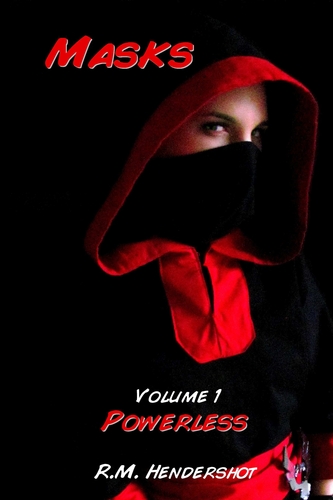
Book review: Masks, by RM Hendershot.

To begin with, all of the heroes were dead. Dead as a doornail. Ten years ago, they were all slaughtered as part of a supervillain’s killing spree after he learned that he was dying of cancer. After that, no superheroes call LA their home anymore.


Enter Rae Masterson , the “mask” known as Peregrine -- powerless, unless you count snark as a superpower. She has nine arrests under her belt, even though five of them have been of Captain Catastrophe, whose name is suitable in more ways than one. Our story opens with Rae witnessing the kidnapping made by one of the local supervillains, Cobalt.


In another part of the universe, Trevor Gray, a former sidekick, modeled somewhere along the lines of Tim Drake, has been recruited by one of his fellow homeless to find his friend – someone who had been kidnapped by Cobalt.  He's a genius-level detective ... but he still can't understand girls.


As Rae and Trevor investigate the abduction from two different angles, they run into each other, and hilarity ensues.


Welcome to the world of Masks, by RM Hendershot, a superhero novel that openly states that this will be "different" from all the others out there.  Is the author right?


I generally don’t like Young Adult novels. You have to get someone very specific and very good to get me to bother with one. Timothy Zahn, David Weber, Peter David, CS Lewis, are the few authors of YA books that I’ve read and that I’ve liked. Take your Hunger Games and your Twilight, and I’ll sooner given you back Sherrilyn Kenyon’s Chronicles of Nick first.


However, I like this one. It’s witty, and it’s fun, and it’s smart. It’s better than anything comic books – the usual medium for such things – has put out in years.  Unless you count J. Michael Straczynski.  I thoroughly enjoyed the book, and that’s not because I helped with one of the death traps. It has a lot of stuff most comics lack – character, for one. Everyone here has a surfeit of personality, even the bad guy, and the sidekicks, and the local superman equivalent (everyone has at least one). Chapter eleven has a shootout between three female characters, and not one mudwrestling joke…. someone should send it to DC Comics.


Everyone in it has a solid story arc ... or a character arc, if you prefer. And our hero and heroine have some good, natural chemistry.


It has the snobbery of high school, the stupidity of bureaucracies (in short, it's very realistic) and, the most important part: this book doesn’t treat the audience like they’re stupid.  The last time I saw someone treat the audience like this with superheroes it was Straczynski. It has offhand references to the Fischer King of Arthur, and even Universal monster movies. They also have some nice nods to actual comic books -- there is a Busiek hall, named after the creator of Astro City, a Lieber hall, named after Stanley Martin Lieber, who also goes by the name Stan Lee.


Not to mention, I also like the art. I’d post a few samples, but they’re not mine to post. No, this isn’t illustrated; they’re just pictures at the opening of each chapter, that’s all. But they’re nice and straightforward, and I can tell who’s who. Which puts the artwork above some Marvel comics I’ve read.


All in all, it was fun. There were some nicely executed Hitchcockian moments along the way, as well as some moments that J. Michael Straczynski would love.  Is it Les Miserables? No, of course not -- the book's too short.  But it's fun.  But Ms. Hendershot also has a plan, and a multiple-book arc, so we'll see how it all shakes out. 


The novel is quite enjoyable. I recommend it to anyone who believes in truth, justice, intelligence, and heart.  And ghost cowboys. Can't forget the ghost cowboys.


Buy it here -- seriously, for some reason, it's disappeared from Amazon and B&N.

Monday, July 9, 2012

Forget Sparta. I! AM! PUBLISHED!!!!!


I waited three hundred posts just so I can use that headline. Really....


...


Okay. No, not really. It just turned out that way.


But it's true. I'm published.  It Was Only On Stun! is available on Amazon.com.  Buy it here, now.  And you can also buy a kindle copy, right here. And a schedule for a virtual book tour, and maybe even a real life book tour, will be forthcoming .....


But I'm going to take a moment here.


I'm not sure you know what this means to me.


It's been fourteen years.


Two million words. Dozens of rewrites. Entire novels spiked. Two agents. A dead economy, "the end of publishing," and every negative thing about the business of publishing you've ever read in The New York Times.


There have been bridges burned with people whom I have deeply loved. There are people that I owe this to who are no longer talking to me. People who cared just enough to encourage me, but not enough to stay. There have been people I, admittedly, drove away while I was being driven insane by the thorns of this world.


It's been a long road, with a lot of work. I want to thank all of you who stayed around to read what I've had to say.


And, of course, there are specific people who have stuck with me that I need to thank, like: Jason Bieber, Karina Fabian, Kelly Garcia, Ester Lamm, Matthew "Funtime" Pryce, Allan and Annie Yoskowitz, Ann Margaret Lewis, various and sundry people from the Catholic Writer's Organization (Ellen Gable Hrkach, Jacqueline Vickers, Ann Seeton, and, of course, Walter Staples (who can now compare writer's notes with The Great Author). And, of course, there is my family, including my sister Margaret, who helped me with her editing services of Just Write! Ink (on Facebook).


I owe all of you. And I only hope I remembered you all in the acknowledgments. It's all been kind of a blur, so if I missed you, my aim will improve next time around.


Hopefully, you'll like It Was Only On Stun! to a ridiculous degree. You'll want to gift copies to all your friends, and insist that they do the same. Unlikely, but I've been living on hope and Red Bull for so long, I'm shooting for Mars (because the moon is just not ambitious enough). It's also a fairly kick-ass action, mystery, and comedy.


And, if by some chance you don't like it, well, I've got a dozen more books, each with a different flavor and style. The next book will be A Pius Man.  One way or another, it will be published.  Will it be by Amazon.com? Maybe. If that's the case, I'm going to have to find a way to pay Matt for his cover art.


Winston Churchill (everything interesting said in World War II is attributed to him), after the battle of El Alamein, said, "This is not the end. This is not the beginning of the end.  This is, pray God, the end of the beginning."


This is my beginning.


Thank God.


And thank you, too.


But, enough sentiment: here's a fun video with epic music, and weapons.


By the way, while this is an aside -- I also have a new website. Enjoy, all.


Monday, May 21, 2012

Blog in review, March / April 2012


First, February knocked me out.  The whole month sucked, and you can probably guess why.


Then in March, I started getting pulled down -- first with bouts of depression, then I was busy with video games, girlfriends, and a new job.  And since then, let's face it, I haven't been that great at keeping to schedule. So, sorry about that.


I started March with a character generation chart, for those people who want an easy way to create characters.  WARNING: characters make develop minds of their own in short order.  To follow up on that, there is a more advanced version with the psychology of characters, with real psychology, if you don't consider that an oxymoron.


In April, I had an interview with Karina Fabian about her new book Live and Let Fly, which I also reviewed.


And, I made a quick study of Writer's Block.  And, to go along with it, I explained my current situation in getting published: it's situation normal.


In music, I posted a blog for Simple Gifts ... just go with it. It works.  And, if you don't know Loreena McKinnett ... have a sample, I can recommend her work.  We also had a return to the awesome Lindsay Stirling, and her tribute to Skyrim.


But what about the Catholic Writer's Guild conference? That was covered in March!  Well, that was so self contained, I did that as a separate entry.


Be well, all.