Showing posts with label karina. Show all posts

Sunday, January 18, 2015

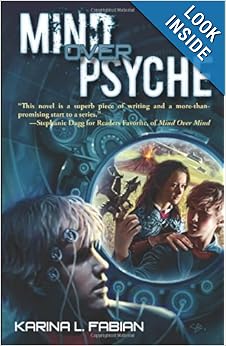
Review: Mind Over Psyche, by Karina Fabian


Some days, it feels like Karina Fabian is being reviewed on this blog every three months. It's not entirely accurate, but close enough for government work.  Especially government right now.


So, if you remember Mind Over Mind, you don't need much of an introduction.  If not....
Deryl isn’t crazy; he’s psychic.  Desperate to escape the insane asylum,
Deryl  teleports to Kanaan, a world of
telepaths who regard him as an oracle.
But freedom comes at a price.  The
Kanaan expect their oracle to teach them to use their powers to wage war.  Meanwhile, he’s falling in love, but to be
with her means to share his psyche, which could drive her insane.  Most dangerous of all, he hasn’t escaped the
Call of the Master, enemy of the Kanaan, whose telepathic manipulations were
why Deryl was committed in the first place.
Now, the Master will forge Deryl’s powers into a weapon to kill all he
loves or destroy his mind trying.


First, I must say that I like this world she's created.  It's one of the most comprehensive scifi worlds I've seen in a while -- one of the better planet-as-character routine I've seen since Dune, and possibly one of the better Christian science fiction premises I've seen in print since C.S. Lewis penned Perelandra.  We've got flora, exotic fauna, aliens who mate for live, like wolves or Catholics, and did we mention that there's a war coming?


At the end of the day, one of the more interesting threats is Deryl himself.  Sorry, I've got a thing for where the hero is one's own worst enemy. And in his case, if he's not careful, he's going to develop psychokinetic abilities and level Tokyo....


Oh, wait, he already has telekinetic abilities.


Yes, everyone's in trouble.


We also have an interesting introduction to the Twilight Zone. Season 1 to be precise. Literally, there's a section narrated by Rod Serling. And it's quite awesome.  Not to mention that there's a large segment of the novel that looks like The Last Temptation of Christ meets The Prisoner.


The book can be broken down into three sections, so much so that they're almost like vignettes strung together.  First, there's the incident that precipitates the accidental teleportation to an alien world.  Next, we have the Oz effect -- as in "we ain't in Kansas no more" -- complete with your standard writing conflicts of man vs. nature, man vs. self, and a man vs. society, all to varying degrees along the way. Much of it is interesting, though there are moments you might want to take Deryl and smack some sense into him. The book's strengths lay in the exploration of the alien world via the two "sidekicks," Joshua (Deryl's friend/shrink in the last book), and Tasmae, the local alien contact.


Then, part three, we actually have man vs. man .... if "the man" in this case is an alien who can kill you with his brain and throw you into a nice, ready- made nightmare. So, fun.


I like the world, I like the characters ... though there are some scenes that were exceptionally drawn out. I liked The Prisoner as much as the next guy -- maybe more than the next guy -- but when we, the readers, already know what is and isn't real, hallucinations can get tedious.


Thankfully, by the end of the day Mind Over Psyche is the payoff we wanted from Mind Over Mind.  Round three should be interesting.

Thursday, April 25, 2013

Interview with Karina Fabian, author of "I Left My Brains In San Francisco"


So, round two. Yesterday was the guest blog for Karina Fabian as part of her virtual book tour for I Left My Brains In San Francisco.

The premise?


Zombie problem? Call Neeta Lyffe, Zombie Exterminator--but not this weekend.

On vacation at an exterminator’s convention, she's looking to relax,
have fun, and enjoy a little romance. Too bad the zombies have a
different idea. When they rise from their watery graves to take over
the City by the Bay, it looks like it'll be a working vacation after
all.


Enjoy the thrill of re-kill with Neeta Lyffe, Zombie Exterminator.


Q: The first NL was a great satire of reality shows, with just the occasional shot at politicians. What made you go to a Zombie Exterminator Convention in San Francisco? Why San Francisco?

I’d just gone to World Fantasy Con in San Francisco, and my brother-in-law worked at a refinery in Richmond, and thought it’d make an awesome location for a zombie attack. (He’s been promoted and lives in LA now; no connection to the book). Plus, my publisher lives in San Jose, and she loves San Francisco, so it was an easy choice.

Q So it wasn’t just an easy way to slip in more political shots along the way? If that's the case, was DC taken?
California is an easy target, but it was the thought of zombies at the famous tourist sites that I enjoyed, although I didn’t get in as many as I’d expected. The story demanded other locations. Still, there are some great vignettes at famous spots. Maybe someday, I’ll write some short stories of the other sightings that didn’t get in the book.

Q: In the first NL, the EPA was going after detergents that Neeta thought was most effective about fighting zombies. Did you throw that in to imply the EPA would go after it *because* it could fight zombies, or was it just for fun?


They didn’t go after it because it would fight zombies, but because they’re hard on the environment. That was kind of the point—never mind that they’re our best defense against zombies; in large quantities they might affect the Spotted Peeing Mouse or somesuch. Of course, the whole idea of bleach being an effective zombie repellant is pretty ridiculous, so the real point is fun.

Q: The Neeta books seem to be your most political. They take swipes at the EPA, trial lawyers, eco-terrorists, the Occupy movement, and I'm sure a few other political targets that I'm missing.
I should have a contest to see how many things I poke fun at in these books.

Q Why Zombies? Were vampires taken?

Zombies were not my idea, actually. Kim Richards founded Damnation Books and asked folks to write stories for an anthology called *The Zombie Cookbook* to kick off the publishing company. So I wrote a funny one called “Wokking Dead,” which was more food puns and silliness than anything, but people loved Neeta and she asked me to write some novels.

Q: In the last book, the main adversary of the book seemed to be general stupidity -- be it of reality show producers, or everyone who seems to think they know better. In this, it seems to be eco-terrorists of the group called TREE. What made you decide to focus on them as a primary bad guy?


I needed a reason for zombies to attack a fuel refinery, and by the logic I’d already set up in Neeta Lyffe, Zombie Exterminator, it couldn’t be random coincidence. They had to have a reason to make the effort to go there, and to do damage once there. Eco-terrorism just made sense.

Q: This blog's latest release has been about a murder mystery at a science fiction convention -- essentially, humor via culture shock. What's your approach to it?
To humor? Twist cliché’s, take a trend to ridiculous extremes, puns, and generally amusing myself as I strive to amuse others.


Q: Did you have to work VERY hard on all of the in-jokes? The GPS voice named Majel? The monofilament sword called "The Buffy"? That sort of thing.


Oh, no! That’s the easy part. Those come to me as I write, but I (and my family) crack those kind of jokes all the time, so I have lots of practice. Ditto with puns. We used to reward our kids for coming up with puns. Rob and I actually fell in love during a pun war while eating pizza and watching Looney Tunes cartoons at a Shakey’s in San Angelo, TX. Humor is important in our house.

Q: What's next for Neeta? A. Zombie for Presidential candidate?
Zombies are not considered persons—there was a lot of debate and work on that, and even in the 2040s, there are still some who try to get them registered to vote. (And some that rise from the dead in hopes of completing their civic duty—amazing, I know!)

The next thing for Neeta and Ted is a ski vacation in Utah. Unfortunately, when a ski team killed in an avalanche returns from the dead to finish the competition, it turns into a working vacation. “Shambling in a Winter Wonderland” will be a story written in serial to raise money for Operation Homestead. Folks will find it in mid-November at http://skizombies.karinafabian.com

Q So, what's next for you?

Right now, the serial story. When that is finished, I’ll probably finish Gapman, a super-hero spoof in my DragonEye, PI universe. I’m also toying with publishing some of my novellas via Kindle.

Q: What've you been reading lately? In fiction, or non-fiction, or politics?

I just finished *Monster Hunters: Legion* by Larry Correia, which was an awesome book—definitely “popcorn” reading, but fun! I also have been reading a lot on the space industry, so Space News, Nations Space Society, etc. I’m blogging about it at http://fabianspace101.blogspot.com , Rocket Science for the Rest of Us. I get enough “politics” via Facebook. I’ll be glad for November!


Review: I Left My Brains In San Francisco


Neeta Lyffe, Zombie Exterminator, is back in Neeta Lyffe 2:  I Left My Brains In San Francisco.  After hosting the show Zombie Death Extreme (which has spun off more copies of the franchise than anyone in the book can count), Neeta is back to her job Re-killing the undead.  However, for this book, she's off to a Zombie conference in San Francisco. There will be scientists, government researchers, fellow re-killing experts, as well as enough vendors to outfit a small armory.

Also tagging along is her business partner and sort-of/maybe boyfriend Ted, who had been a cameraman on Zombie Death Extreme, and has joined her as an exterminator with a penchant for setting things on fire. Usually zombies.

But there's something out in the dark waters of the bay that is restless, cold, and dark, and hungry.  And Neeta is about to have a busman's holiday from hell....

No, that's not the summary from the back of the book, that's the short version of my own summary.

Now, let's start with all of the good things about this book.

The details put into this world is impressive, and even reminds of me of early Laurell K. Hamilton (when the books were dedicated to building up her character's world, not her list of sex partners).  The global politics are well put together, the various legal systems regarding zombies, etc (and, sadly, I can see some idiot passing a "no eco-profiling" act). I liked the shots she took at the Occupy movement, and creating degrees in professional protesting (since anyone who read my self defense columns knows my opinion there), and, once the book gets started, they have a solid, amusing running gag involving a group of eco-terrorists.

There is also a ton of details and thought put into the development of anti-zombie weapons systems, from monofilament swords (model such as "the Buffy," or "The Highlander", and, of course, the "Inigo Montoya"), to specialized squirtguns, and flamethrowers.  There is a talking GPS named Majel (Star Trek joke), and a whole bunch of little moments that make this book quite enjoyable. And, of course, having recently been to DragonCon, I could easily believe some of the panels at this particular convention.

And, frankly, Madam Fabian may have already spoiled the best scene in the book for you the other day in her own guest post.

Now, I have to be honest, this book will be tough to get into.  In the first 20 pages, we've split four different ways.  There is Neeta -- her convention, her vacation plans, and her relationship with her business partner/maybe-boyfriend.  Yes, her maybe-boyfriend.  Along the way, we also have excerpts about an eco-terrorist group called TREE (Terrorism for Radical Environmental Enhancement), and dropping TREE"s founder down a watery grave.  We also trip over a professional protester wandering around the Bay area. At that point, the reader has no ideas what's going on.  It's a little like reading a Tom Clancy novel -- you have several things going on at once, but you don't know how they interact until page 100. In this case, we're not that lucky.

I have to say that I like making fun of San Francisco. I do it often. However, when I'm reading a book, I want to have a story, character, and plot. *Then* you can go on for pages at a time having fun at a city's expense. By page 25, she is so wrapped up with making fun of the strangeness that is San Francisco, I honestly started to wonder why I cared.  The jokes were funny -- probably because I've been there -- but the travelogue making fun of the practices and policies of the Left Coast probably could have been saved for later on, when the story, characters and plot were better established.  Instead, I was leftwondering why I kept reading.  This was one novel that refused to get out of its own way.

In the previous novel, script excerpts from a proposed documentary were used to fill in the back story of the history of how zombies work in Karina's world.  She once again falls back on the model to explain the history of TREE.  While this model worked to great effect in the first novel, that was because the relevance of zombies were established on the first page.  Here, we have no idea EXACTLY what impact TREE will have on the plot until page 167 (of 229), while the documentary snippets explain the history of TREE back on page 15.  Early Terry Prachett novels barely got away with similar methods of dropping in "huh?" elements early in the book (showing you things that you have no idea the significance of just yet), but he usually saved the explanations until you knew what the heck was going on.  Mrs. Fabian allows no such leeway to her readers.  She has put Descartes before the horse (sorry, math joke).

CHARACTER

In the last book, Neeta was witty, and smart, and tough. As we opened, she seems to have lost her wit and her smarts are not as on display. Her toughness is only tested with a zombie in the opening and the strength of character from the first book doesn't even return until more than halfway through the novel.  For a lot of this book, stuff happens to her, and she seems to be dragged from one event to another with little to no say in the matter. It felt like a forced character arc -- "Oh no, she was too self assured in the last book, we need to make her more neurotic in order to make her interesting, and then fix her."

Also, Neeta's thoughts continually go to an apprentice she lost on page one of the first book.  Which is odd, because she dwells more on the loss of that particular idiot (he died because he eschewed his body armor in order to show off his abs for the audience) in this book than she did in the first.  It was jarring and inconsistent with her previous behavior. There are even moments when it looked like said dead apprentice would become relevant in some way, but mentions of him peter out by the end of the novel.

There are brief, fleeting mentions of pills, and a psychologist, and one presumes we're supposed to deduce from these bits of detail that she's suffering from PTSD, but the only reason I even notice them now is that I have a PDF copy, and a search engine.  If PTSD is the diagnosis Madam Fabian wants us to come up with, she should have been a little bit more clear -- also, Neeta should have had flashbacks, heightened awareness, and not merely bad dreams and "stress." After all, if any normal person had her job, bad dreams should be par for the course (in fact, the subject of her bad dreams -- having to re-kill loved ones -- was an entire chapter in book one). Also, if PTSD is the conclusion we're supposed to draw, then it is entirely undercut by one scene with Ted, which makes all of her behavior seem like a result of inborn neuroses.

In short, this book doesn't begin to get interesting until page 40, when we actually get to a convention, and reconnect with several characters from the previous novel.

After page 40, the book only gets slow when Neeta is no longer on the page (though to be honest, those good parts might have had more to do with her sort-of-maybe-boyfriend, Ted, who stole many of their scenes together). The exception to that rule is a scene where a zombie horde runs into a survivalist store. It doesn't end well for the zombies.

There are a  lot of interesting characters in this book. Sadly, they're not used very well.  In fact, they are barely used. One of the strengths of the first book was the ensemble cast of strong and quirky personalities. Instead, we are given a neutered Neeta who only knows what to do when there's a Zombie in the area, and Ted, who we only see through the eyes of other people, who may be the more interesting character this time around.

SPOILER ALERT

By the end of the book, Ted proposes to Neeta. I'm a sucker for a good romance. Pity we didn't see any romance whatsoever. For most of the book, Neeta is wondering what her relationship is with Ted.  Now, I am not the sharpest knife in the drawer when if comes to social cues, and things like that.  However, the idea that Ted is going to propose to Neeta when she's not even sure if they're dating takes being thick to a whole new level of brain dead. Considering how perceptive Ted turns out to be by the end of the book, it's a striking oversight, and I mean more like a backhand.  Much like Neeta's personal character arc, it feels forced, almost obligatory.

END SPOILER

I have no idea what's going on with the story, but so many things felt forced, it feels like someone else wrote the book.

Again, I had fun with this book.  At the end of the day, I think most people will enjoy it, especially if you have faith that, eventually, everything will tie together.  Trust me, it does.  However, if you read book two back to back with book one, you're going to have to just go with it. You'll probably enjoy it more if you don't argue with the narration, and turn your brain off.  Treating this like a murder mystery, where you try to solve the riddle of what's going on here, will not work.

If there is a book three, I will read it. I would assume that many of the little things that were "off" about this book were one-offs.

At the end of the day, if you have some extra money kicking around, and you want something to read, you could do worse than this.

Wednesday, April 24, 2013

Guest post: Karina Fabian on Zombies

So, when Karina Fabian offered to write a guest post for the blog, I figured I'd take her up on it. After all, I was slowing down after all of the DragonCon posts.

The topic I gave her? I wanted to know why the heck anyone wanted to be bothered with zombies.

She sent me the following.

Keep in mind, I think the following includes the best scene in her latest novel, Neeta Lyffe 2: I Left My Brains In San Francisco.

Why Zombies? Using the absurd in  fiction to show the absurd in life.


Survival Hardware
hadn’t seen such a rush of customers since the last Armageddon
prediction coincided with Black Friday.

Manager Clint
Sanders rubbed his hands with glee. Oh, Marley, if only you
hadn’t gotten drunk and decided to go zombie hunting. Was it only
last Christmas?
He hurried to
Customer Service, crafting an announcement in his mind. “You want
to live! We want to live! That’s why you are going to file calmly
to the back if you need a suit.”

Yeah. Sense of
urgency, plus that “We’re in this together” crap.

He got to the
counter and nodded at Bitsy, who had rung up a chainsaw and a
half-crate of bleach.

God bless
survivors.
Clint continued to the back. Out of habit, he checked
the exit door, even though it was always locked from the outside. He
needed to delete Marley's old code from it.

He cleared his
throat. “Listen up! You want to live! We want to live!”

The exit door
clicked.

“That’s
impossible!” he declared. The store fell silent.

“Boss?” Bitsy’s
voice ended in a squeak.

“That’s not
what I meant! Security team to customer service!”

He reached under
the counter for a shotgun. Bitsy grabbed the chainsaw. They had
filled them that morning—another example of the excellent service
at Survival Hardware.

The door swung
open, and the zombiefied remains of his late business partner,
Marley, staggered through.

Clint to blasted
him with the shotgun. The impact knocked the Marley out the door.

Clint used the
gunsight to scan the parking lot. “He brought friends! Call
Nine-One-One. I’m putting this place on shutdown.”

“Screw that!
I’ve been prepping all my life for this!” With a howl of
challenge, Bitsy dashed out the door. She swung low and decapitated
her former boss before moving on.

Thundering
footsteps signaled the customers following in her wake.

He gaped at the
carnage while Dirk called 9-1-1. It’d be too late by the time they
got there. All that’d be left was to clean up the zombie parts and
get the customers back in to pay.

God bless
survivors.


---From I Left My Brains in San
Francisco
, by Karina Fabian


In the 2040s, zombies have become a
reality. They rise from the grave, intent on eating brains or
sometimes completing something that they didn't finish in life--even
if it's a beer and a TV show. And, true to so many phenomenon in
life, we are caught unprepared and unaware. That's how I started the
world premise, and I let the story take me from there: People want to
understand them, defend them, study them, use them--but above all,
they want those vermin out of their yard! Thus, the hero of the
story--Neeta Lyffe, Zombie Exterminator.


It's an age-old science fiction
writers' trick--use the future to discuss an issue of today. In my
case, the zombies are just part of a world gone a little loopier than
it is now. You’ll find a great example of government waste and
bureaucratic infighting in the Broken Bridge, started as a
cooperative effort and halted with 120 feet to finish—and one side
60 feet lower than the other—because neither side communicated with
the other. Video blog sites have exclusives on banned videos of a
gruesome carnage—but only for members. California has subsidized
protesting; and everyone gets an Adult Starter Allowance until
they’re 25, as long as they aren’t working, of course. The
newest environmental theory is Global Fattening, and the hot new
protestors, the undead!


All of this makes a delightful mishmash
of insanity into which to drop one woman who just wants to protect
people by rekilling the undead--and hopefully making a little money
and having some kind of social life while she's at it.


I hope you’ll enjoy I Left My Brains
in San Francisco
. It’s all in good fun, but if any of it comes
true, I’ll be back in 30 years to say “I told you so!”


Bio On The Author


If there’s such a thing as ADD of the imagination, Karina Fabian has it—in spades. Craft books, devotionals, serious science fiction, comedic horror and chilling fantasy—she follows her interests and the characters that tell her their stories. 


Even before she could write, Karina strung tall tales about everything from making human pyramids in Kindergarten to visiting alien worlds. Her first attempt at novel writing was in fourth grade; she completed her first novel in college. However, her first published work was an anthology of Christian science fiction, Leaps of Faith, an EPPIE finalist for best anthology in 2006. Her next anthology, Infinite Space, Infinite God, featured Catholic characters and themes and won the EPPIE for science fiction. The second Infinite Space, Infinite God anthology came out in 2010. 


Watching the comedy improv show, Whose Line Is It, Anyway, inspired her noir-style dragon detective, Vern. Vern and his partner, Sister Grace, have solved mysteries and saved the Faerie and Mundane worlds numerous numerous times in the DragonEye, PI stories and novels. Their serial story, World Gathering, won a Mensa Owl; and the novel, Magic, Mensa and Mayhem (Fabian’s first published novel), won the INDIE for best fantasy in 2010. The second DragonEye book, Live and Let Fly, came out in April 2012. 


At a friend’s request, Karina wrote a funny story about a zombie exterminator, which grew into the Neeta Lyffe, Zombie Exterminator novels. The first, Neeta Lyffe, Zombie Exterminator, won the 2011 Global E-Book award for best horror, and was runner-up in the eFestival of Words for best YA. 


She also writes serious science fiction. Her SF novels, Discovery and The Old Man and the Void, are currently under consideration, and she’s working on the next DragonEye novel, a superhero spoof, Gapman. 


Karina has a strong faith, which she explored in her devotional, Why God Matters: How to Recognize Him in Daily Life, which she wrote with her father Steve Lumbert, and which won the 2011 Christian Small Press Publisher Award. She also writes Catholic school calendars and has written three craft books for the Little Flowers/Blue Knights clubs. 


Fabian is married to Colonel Robert A. Fabian of the USAF, and they are currently enjoying a long distance relationship while he’s stationed in Iraq. They have four children, an overgrown pup, and a harried cat. When not writing, teaching writing, or chatting about writing, she’s hanging out with her kids or swinging a sword in haidong gumbdo. 


Tuesday, May 22, 2012

Review: Karina Fabian's "Neeta Lyffe: Zombie Exterminator"


You might remember that, a while back, I had been involved in a Catholic Writer's Guild online conference. I ran a workshop on fight scenes, and ran a discussion on creating a villain. During the course of that latter chat, I mentioned that it helped if the villain had the brain. Mindless, shambling zombies were not really that much fun, as villains go … Then I remembered that one of the people in the chat was Karina Fabian … who had written – surprise – a book about a Zombie Exterminator.

Now, if I had had my wits about me, I would have noted how, in zombie films, zombies are generally NOT the main bad guys. They set the scene, they act as cannon fodder (for an action franchise like Resident Evil, where the real villains are the Evil Corporation du jour), but most zombie movies are more about the people in the Zombie Apocalypse du jour rather than about the zombies. The zombies are window dressing.


Instead, my witless wonder moment had me hasten to add "Though I can't speak for every zombie storyline, I have yet to read Karina Fabian's." I think I inserted a smiley and went on from there.

Within two minutes, I heard an email click. I had just received an e-copy of Karina Fabian's Neeta Lyffe: Zombie Exterminator.


See, when I shoot from the lip, I have no idea what'll happen.


Neeta Lyffe: Zombie Exterminator, takes place in the 2040s, several decades after the zombie outbreaks started. There are no zombie apocalypses here.  It never happened. However, the undead can be annoying, so exterminators have to be called in -- exterminators with chainsaws.  Zombies are attracted to certain strong smells, and they don't like standard household cleaners.... don't ask.


Neeta Lyffe, a second-generation exterminator (motto: "I want to be buried like my mother, with my head cradled in my arms") is sued after an extermination call went into property damage. Now, in order to generate income, she's agreed to do the most terrifying thing in her life..... host a reality show.


Yes, you read that right. The reality show Zombie Death Extreme, where Neeta is stuck with a handful of exterminator wannabes, training them to re-kill the occasional nests of undead that threaten LA (then again, if parts of LA were turned into shambling mindless hordes, would anyone notice?). Also included: re-grief training ... for when you have to mourn for loved ones a second time, when they come back; and flash cards to tell the difference between a stroke victim, a drunk, and a zombie.  And you can probably guess, this has a sense of humor, unlike most zombie films ("We throw the grenades on the count of 3. 1, 2, 3."  Second person shouts "Five," and throws the grenade ... sorry, Monty Python joke.).


The cast looks like it should be stocked with the standard cliches: an ex-marine, a farm boy with a stutter, an African-American woman from an urban environment, an Afghan emigre who's first language isn't English (he speaks it perfectly well, but the producers want him so speak more like Hasan from a Bugs Bunny Cartoon). The Producer of the show is the standard two-dimension cardboard cutout, which means he's drawn very accurately -- however, he's never had to negotiate with someone who carries a chainsaw on a daily basis, including the occasional brainstorming session for the show.


All of the characters are vivid and brightly drawn ... and heavily mocked, in some cases. Everything you have ever hated about reality television is skewered ruthlesly, and wonderfully.


Possibly one of the best parts of this book (and there are plenty to choose from), use the running excerpts from a documentary on the rise of zombies, detailing a somewhat funny look on the matter, down to and including Darwin Award winners who tried to play tag with a zombie. That was fun.


In short, it's one part satire, one part action, and all parts fun.


Coming Soon, Netta Lyffe: I Left My Brains in San Francisco.

Monday, May 21, 2012

Blog in review, March / April 2012


First, February knocked me out.  The whole month sucked, and you can probably guess why.


Then in March, I started getting pulled down -- first with bouts of depression, then I was busy with video games, girlfriends, and a new job.  And since then, let's face it, I haven't been that great at keeping to schedule. So, sorry about that.


I started March with a character generation chart, for those people who want an easy way to create characters.  WARNING: characters make develop minds of their own in short order.  To follow up on that, there is a more advanced version with the psychology of characters, with real psychology, if you don't consider that an oxymoron.


In April, I had an interview with Karina Fabian about her new book Live and Let Fly, which I also reviewed.


And, I made a quick study of Writer's Block.  And, to go along with it, I explained my current situation in getting published: it's situation normal.


In music, I posted a blog for Simple Gifts ... just go with it. It works.  And, if you don't know Loreena McKinnett ... have a sample, I can recommend her work.  We also had a return to the awesome Lindsay Stirling, and her tribute to Skyrim.


But what about the Catholic Writer's Guild conference? That was covered in March!  Well, that was so self contained, I did that as a separate entry.


Be well, all.

Tuesday, April 17, 2012

Review: Live and Let Fly.


Karina Fabian has done some novels that could only be qualified as interesting. She's written theology, Catholic science fiction, rescue nuns, zombie exterminators, and those are just the ones that we'e taken a brief look at here.


And then there's Vern, the Dragon Private investigator.


Welcome to Los Lagos, Colorado, home of the Gap; in this case, the Gap is an inter-dimensional hole in time and space, and we can be grateful that this one isn't set in Cardiff.  The Gap has made Los Lagos home of plenty of interesting species from the Faerie dimension, a realm that is quite Catholic, and the original home to Vern, who was a dragon of some repute even before he had an encounter with a knight named George.


Now, banished to our world by the Duke of Pebbles-on-Tweed, Vern has made his living as a PI, along with his sidekick, the Vatican Mage Sister Grace.


Like every good PI story from Dashel Hammet to Jim Butcher, the story starts small, and spirals out of control quickly. What starts as the search for a missing ring after an assault, quickly turns into a murder mystery, with a kidnapping for a side dish, and it turns into race to stop the end of the world, dun dun dunnnnnnnn.....


But how do you stop a killer that leaves no trace? Not even a scent a dragon can follow?


Overall, the story is fun. There are some nice shots at Hollywood along the way(let's start with the chapter titles "Murky but Present Dangers," or "Gapraker").  And it includes the best take on Disney animatronics that I've seen since Peter David's Psi-Man series. The chapter titles were something else ("Seven Habits of Highly Defective Henchmen.")  In fact, the humor that works best is when Vern narrates events in term of cliche (see: excerpts here).  The satirical elements are possibly the funniest parts of the novel. I'm not sure if one of the villains was supposed to resemble Dilbert's Pointy-Haired-Boss, but it works.


Also along for the ride is the Bureau of Interdimensional Law Enforcement. ("BILE?" Vern thinks. "There's a name that must have been made in committee.")  With some entertaining parodies of James Bond thrown in, as well as one character who should be played by Marvel's Agent Coulson.


And, seriously, who can argue with a book where Shiva is a war correspondent?  Or where the Vatican has its own SpecOps team, giving a whole new meaning to the term "church militant"? It's right up there with John Ringo's Princess of Wands novel, that was based in the real world, with a little more strangeness attached.


There is also a wonderful sequence of negotiating with the kidnappers. It's only two pages long, but it's truly entertaining.


Live and Let Fly has some good solid action sequences. Like the attack of the killer animatronics, or a scene with an airship that was a cross between Final Fantasy VI and a John Nance novel.


And then, there's the line "I wanted the Holy Hand Grenades on standby in case all Hell did break loose."


Yeah, this was fun.

Monday, April 16, 2012

Interview with author Karina Fabian on "Live and Let Fly."


We've had a few interviews with Karina Fabian before.  She's appeared as a guest blogger once or twice. She's tolerated interviews from here for at least two of her books -- ISIG II, and Mind Over Mind.


And, now, we're on her novel Live and Let Fly.


What I'm going to do is simple.  This interview will not appear on the blog, but on my Examiner.com page.  Since the word count on the articles is supposed to cap at only about 500 words, it's been broken up into a four part article.


I asked how she came up with a dragon and a magic-wielding nun as a heroic duo.


I asked her about writing the novel, in part 2


World building was much of part three


And part four was on being Catholic and writing this book.


However, I'm not going to let you, loyal reader, and newcomer, leave here empty handed. No.  For coming here today, I'm giving you excerpts from the novel.


First, some background.


For a dragon detective with a magic-slinging nun as a partner, saving the worlds gets routine. So, when the US government hires Vern and Sister Grace to recover stolen secrets for creating a new Interdimensional Gap--secrets the US would like to keep to itself, thank you—Vern sees a chance to play Dragon-Oh-Seven.


No human spy, however, ever went up against a Norse goddess determined to exploit those secrets to rescue her husband. Sigyn will move heaven and earth to get Loki—and use the best and worst of our world against anyone who tries to stop her.


It's super-spy spoofing at its best with exotic locations (Idaho--exotic?), maniacal middle-managers, secret agent men, teen rock stars in trouble, man-eating animatronics, evil overlords and more!

And now, some snippets, and extra data.


Short:


Festival was Friday. We had two days to stop a Nordic demigod evil overlord—overlady, overbeing, whatever—from blowing up a nuclear power plant, possibly destroying half an island full of revelers in the process, and creating an Interdimensional Gap through which she can bring the rest of her giant relatives to set up housekeeping where the Faerie Catholic Church didn't have the power to control them. In other words, two days until Hel broke loose.

I've had worse deadlines. I could afford a long bath in our whirlpool tub and a good meal first.


Long:


Charlie
started to close the door behind us, his other hand gripping the
handle of his dagger so tightly I could hear the leather wrap on the
handle strain, as we listened to the footsteps coming our way, slow,
bored. My predator's instincts rose; then I had a great idea. I shook
my head at Charlie and winked, and he shuffled out of my way, leaving
the door ajar. I settled myself with my back to the door, just inside
the shadows and let the script play itself out:


CLUELESS
MINION enters Stage Left. He pauses, hearing a noise, but does not
report it. Instead, he fondles the stars on his nametag and moves
toward the empty hallway, his mind on adding another. (Probably
saying, "I was proactive today!")


CLUELESS
pauses at door, hesitating. He stands and, back to the door, reaches
for his walkie-talkie.


Suddenly,
a well-muscled and gorgeously scaled tail whips out from the crack in
the door and wraps itself around his neck. He only has time to grab
ineffectively at the tail before he's drawn into the darkness. The
door shuts behind him.


Pan
shot of the empty hallway.


FADE
TO BLACK


I
slammed my victim on the floor and pinned him with my forelegs, then
I leaned my face in nice and slow, making sure he got a good look at
my fangs before he saw my eyes. "Where's the girl?" I
growled low and menacingly.


"Wh-What
g-g-girl?"


Charlie
crouched down by Stutterboy and glanced at his nametag. "Look,
Philip, we're in a bit of a hurry. We know Rhoda Dakota's being held
captive somewhere nearby. Now you can be a good survivor and tell us
where…or you can be dinner."


"I-I
don't—"


"Phil
A. Minion." I mused and drooled a bit for effect. I live for
these moments, I really do. I licked his cheek and asked Charlie,
"Can I have fries with that?"


"Why
not? This is Idaho."


Wednesday, April 4, 2012

Fighting and writing workshop, day 5 and 6: military fight scenes

This is the online workshop in writing fight scenes that I did for the Catholic Writer's Conference.  Karina Fabian had managed to draft me ... or I volunteered, I'm not entirely certain.  Either way, it was an interesting little experience.

Since most of you folks have been with me for a while, I'm going to give it to you.

Don't worry, I wasn't paid for this, so giving this away for free will hurt no one. And, few to no people wanted to show up and play with my workshop, even though there were over 25 viewers for each post.  But, I've been told few people showed up anyway for the forums, something to do with schedule confusion.

So, here is day five and six.... Day five was merely an assignment. Day six was more interesting.


 Day Five: Putting It Together

 
At this point, you should have an idea of what you're doing. Take assignments three and
four, and put them together. Whether you start from a weapon and go to hand-to-hand, or vice versa, is up to you. This is the assignment.

Like with most writing, practice makes perfect. So don't be discouraged if you're not writing full-scale battle choreography by now.

 
Day Six: Writing For Military Fights

 
Writing a military fight scene is no different from any other, when you get down to it. Do some research on terms, maneuvers, etc., but don't overstress that part. It's mostly just a matter of vocabulary.

But, seriously, there's little difference from warfare fighting.

Character: In describing filming for Lord of the Rings, and the Battle of Helm's Deep, director Peter Jackson discovered a basic law of fight scenes – Jackson had hours upon hours of stuntmen beating
each other to a pulp, but the battle was boring when the camera was not on the primary characters.

The important thing you need to know is, no matter what, you need to focus on the individuals involved. The more modern your setting, the more things are done by groups of individuals, squads and fire teams, and not massive lines of fire, one against another.

However, no matter how many people you have fighting whatever enemy, you need to have individuals the audience can focus on and care about. Writing about a line of tanks is boring. Writing about someone the audience has met, and is invested in, is much, much better.

For great examples of this, read the Richard Sharpe series by Bernard Cornwell – he has, on average, about six players in any battle that he focuses on, as well as a massive, historical battle taking place.
 
Setting: If you want to focus on a full-scale battle, in whatever age and setting, one thing you'll
want to focus on is the field of battle. You're going to want to focus on the sounds, and the sights, perhaps even the smells. You want to recreate it as though the battlefield is a character. A loud, monstrous, messy, rampaging character, with lots of property damage.

The best I've ever seen of this type of recreation is John Keegan's The Face of Battle, where he recreated the battlefields of Agincourt, Waterloo, and Verdun.
 
Hand-to-hand combat and weapons:
Depending on the scenario, military battles do not start with close combat, unless it's a type of covert infiltration, where getting in close and killing people silently is important. And, let's face it, the use of weapons will vary wildly depending on what time period and setting you're using. For the most part, it boils down to individuals.

Fighting and writing workshop, day 5 and 6: military fight scenes


This is the online workshop in writing fight scenes that I did for the Catholic Writer's Conference.  Karina Fabian had managed to draft me ... or I volunteered, I'm not entirely certain.  Either way, it was an interesting little experience.


Since most of you folks have been with me for a while, I'm going to give it to you.


Don't worry, I wasn't paid for this, so giving this away for free will hurt no one. And, few to no people wanted to show up and play with my workshop, even though there were over 25 viewers for each post.  But, I've been told few people showed up anyway for the forums, something to do with schedule confusion.


So, here is day five and six.... Day five was merely an assignment. Day six was more interesting.


 Day Five: Putting It Together


At this point, you
should have an idea of what you're doing. Take assignments three and
four, and put them together. Whether you start from a weapon and go
to hand-to-hand, or vice versa, is up to you. This is the
assignment.


Like with most
writing, practice makes perfect. So don't be discouraged if you're
not writing full-scale battle choreography by now.


Day Six: Writing For Military Fights


Writing a military
fight scene is no different from any other, when you get down to it.
Do some research on terms, maneuvers, etc., but don't overstress that
part. It's mostly just a matter of vocabulary.


But, seriously, there's little
difference from warfare fighting.


Character: In
describing filming for Lord
of the Rings
, and the
Battle of Helm's Deep, director Peter Jackson discovered a basic law
of fight scenes – Jackson had hours upon hours of stuntmen beating
each other to a pulp, but the battle was boring when the camera was
not on the primary characters.


The
important thing you need to know is, no matter what, you need to
focus on the individuals involved. The more modern your setting, the
more things are done by groups
of individuals, squads and fire teams, and not massive lines of fire,
one against another.


However, no matter how many people you
have fighting whatever enemy, you need to have individuals the
audience can focus on and care about. Writing about a line of tanks
is boring. Writing about someone the audience has met, and is
invested in, is much, much better.


For great examples
of this, read the Richard Sharpe series by Bernard Cornwell – he
has, on average, about six players in any battle that he focuses on,
as well as a massive, historical battle taking place.


Setting: If you want to focus on
a full-scale battle, in whatever age and setting, one thing you'll
want to focus on is the field of battle. You're going to want to
focus on the sounds, and the sights, perhaps even the smells. You
want to recreate it as though the battlefield is a character. A
loud, monstrous, messy, rampaging character, with lots of property
damage.


The best I've ever seen of this type of
recreation is John Keegan's The Face of Battle, where he
recreated the battlefields of Agincourt, Waterloo, and Verdun.


Hand-to-hand
combat and weapons
:
Depending on the scenario, military battles do not start with close
combat, unless it's a type of covert infiltration, where getting in
close and killing people silently is important. And, let's face it,
the use of weapons will vary wildly depending on what time period and
setting you're using. For the most part, it boils down to
individuals.


Tuesday, April 3, 2012

Fighting and writing workshop, Day 4: Guns in Fighting.


This is the online workshop in writing fight scenes that I did for the Catholic Writer's Conference.  Karina Fabian had managed to draft me ... or I volunteered, I'm not entirely certain.  Either way, it was an interesting little experience.


Since most of you folks have been with me for a while, I'm going to give it to you.


Don't worry, I wasn't paid for this, so giving this away for free will hurt no one. And, few to no people wanted to show up and play with my workshop, even though there were over 25 viewers for each post.  But, I've been told few people showed up anyway for the forums, something to do with schedule confusion.


So, here is day four.


***


Day 4: Guns in Fighting.


There are more weapons in Heaven and Earth than there are in Thomistic philosophy. However, guns seem to be the magic weapon that everyone uses, and uses badly.

With any weapon you decide to use, make certain that you have a basic
knowledge of these weapons, even if it's merely researching them
online. This day will also assume that you've never even seen a gun
up close and personal – perhaps an erroneous presumption, but I'm
not going to assume everyone knows guns. If you have do know things
about guns, please bring it up.

Weapons are tools. Knives do more than stab people. Lead pipes do more than club people over the head. And guns do more than shoot people. Don't get me
wrong, guns are great. But if you're writing for someplace like New York, guns are not readily available to the general populace. 

 
Remember Day One,writing the rules for the culture on fighting? Now you know why we
bothered.

Everything in a fight has to feel fast-paced, as we said before. But when you introduce a weapon into any scenario, the characters and the writing have to move fast. Or at least intelligently. What do I mean by this? I mean that no one is going to outrun a bullet – the best they can do is be faster than the trigger finger of the person targeting them – but finding cover, providing distractions, and
shooting elements of the setting or other uses of the gun.

In actuality, gunfights are not like an Arnold Schwarzenegger movie – if someone is moving in a straight line, a smart gunman will lead the target. However, smart gunmen do not use fully-automatic fire in extended bursts. Firing a full magazine of ammunition on full automatic will not lead to a stream of bullets that come out in a straight line, but will cause the muzzle of the gun to jerk around like a spastic mime having an epileptic fit. In a gun battle, at a distance, even slight deviations of the gun's barrel will cause bullets to go wildly off course.

Then again, stupid things happen with guns. The average shootout with the police takes place at a distance of nine feet, but three out of every four bullets will miss, mainly because everyone is popping in and out of cover, snapping off shots and hoping they'll hit something.

Again, now is not the time for technical terms. If you're writing for a medieval setting, or a fantasy setting, if specific parts of specific weapons are going to come into play, you may want to introduce them before the fight even begins. And, if you're using a technical detail of a gun that only people who field-strip their own weapons would know, don't discuss it in the middle of a fight. A previous example has been the Lee Child model, where his character Jack Reacher describes how a fight will turn out and why, before the first punch was even thrown. You can have such discussion then, but when the bullets start flying, try not to dwell too much on the pieces and parts.

You can, however,  have a technical analysis as the hero/ine is taking cover, and thinking about what to do next. If the pieces of the gun are important to the solution, and you can provide a “lull” in combat (if that's how one can describe taking cover while being shot at),then by all means, make it relevant. However, you do not want to give the vital statistics on a gun in mid-battle. In fact, you mightnot want to go into it at all.

The most anyone needs to know about most guns might include:

Ammunition capacity: Do not use Hollywood forever shooters. You will want to reload – if only because it's more thrilling to have a count of how many bullets your hero/ine doesn't have. (Would the end of Die Hard work at all if John McClane had had a full magazine left, instead of just two bullets?)

Type of ammunition: This only matters for level of impact, and penetration. If it's a .22-caliber from a handbag pistol, you can stop if with a pocket Bible. If it's a .45-caliber, you will stop someone if only from the shock value (no one takes an impact from a .45, rolls into a doorway, and returns fire. It's gonna suck to be that person). If it's a .50-caliber handgun, you can disable engine blocks and amputate limbs. If you're writing science fiction, ammunition type is doubly important. 

Type of gun: Revolvers, pistols, assault weapons, submachine guns, hunting rifles, and machine guns all have different strengths, ranges, weaknesses, and abilities inherent in the type of gun. You will not put a bayonet on a pistol, and no one should try to rob someone with a sniper rifle.

Length of weapon (optional): many handguns make for great blunt-force weapons.
 
Appearance: I'm a very visual reader. There are some guns that are very visually distinct: a FAMAS assault rifle looks nothing like an M-16, which looks nothing like an Uzi, which looks nothing like an H&K G-11, which looks nothing like an AK-47. However, there are a lot of knockoffs that resemble M-16s, AK-47s, and Uzis. You don't need make, model, and serial number; just say “it looked like X, Y, or Z” gun, unless you want to go into more detail.

In essence, you can boil down someone's handgun to “short-barreled .22-caliber revolver,” or “a semi-automatic that looked more like a hand cannon” (for an example of this, look up the image of a “Desert Eagle” .50 caliber.)

 
Note:
Please remember that Kevlar is not a magic shield. At best, it will take that small metal object going at hundreds of feet per second, and redistribute its force so that your character will essentially feel like s/he's being slapped with sheet metal at ten miles an hour.
 
Assignment #4: Choose Your Weapon.

 
Take your setting, hero/ine and the enemy from assignment #3. Pick a weapon and put it into a fight between the two. It does not have to be a gun (for thoughts on weapons, and improvised weapons, check the “How To” article link in the initial documents packet). It doesn't matter if your hero has the weapon, or your villain does. It doesn't matter if the weapon was found at the fight location, or if it was brought.

If your hero does not have a weapon to start with, they will need to disarm the bad guy and/or find their own weapon.

Youcan check the how-to article again to at least get the principles for gun and knife disarms, though the principle is mostly based in common sense – don't get in the way of the weapon.

Remember, you do not need to have anyone killed, even if you're using a gun in the scene. Guns can shoot the environment, make people flinch, duck, or buy the characters time.


Monday, April 2, 2012

Fighting and writing workshop, day 3: Writing Fight Technique


This is my online workshop in writing fight scenes that I did for the Catholic Writer's Conference.  Karina Fabian had managed to draft me ... or I volunteered, I'm not entirely certain.  Either way, it was an interesting little experience.


Since most of you folks have been with me for a while, I'm going to give it to you.


Don't worry, I wasn't paid for this, so giving this away for free will hurt no one. And, few to no people wanted to show up and play with my workshop, even though there were over 25 viewers for each post.  But, I've been told few people showed up anyway for the forums, something to do with schedule confusion.


So, here is day three.


****


 Day Three: Now, Let's Talk About Writing Fight Technique.


There are a lot of basic moves that you
don't need to describe too much. Most kicks and punches are like
that, for example. You don't necessarily require a full description
on a “forward vertical defensive kick” (as seen in the article on
how to throw a stop kick) – you can just write “X kicked Y in the
chest the way a fireman would kick down a door.” It's the same kick, just a less technical way of writing it. 

 Speed of attack: keep in mind that most fights don't even last for five seconds. A kick to the groin, a punch to the throat, and it's game over. Even a fight with a weapon can only last so long. Fighting over a knife will ensure that all sides get cut, and someone will be hurt in short order.

And, keep in mind, fighting is hard work. Even something as simple as punching is going to take a lot out of someone. If you don't believe me, go hit a punching bag for a minute. Punch it, kick it, headbutt it if you like, but do it at full speed, as hard as you can. You're going to find that it is very, very hard work. After the initial burst of energy, you're going to slow down after thirty seconds. Stamina should not be important in a fight, because most fights shouldn't last very long.

Another element to keep in mind: the enemy is also reacting. We don't need three-dimensional chess with hand-to-hand combat, but we also have to remember that (for example) kicking someone between the legs (even if they're feeling no pain), will still force the body to lean forward, and that opens up possibilities. If we punch someone, their head will go back. If we feint, they become defensive, preferably where we don't want them to be

If you're going to have a long fight scene, it should be for a good reason. Either it's a war—in which case it's perfectly understandable—or there are multiple attackers, or both participants are very, very well-trained.
 
Yes, you can have a half-page of description for something that takes only a split second. You can have all of the technical details down cold, but you must at least convey to the audience the speed. And, even if you don't go into exacting, excruciating detail for your audience, you should at least know the mechanics, so you know what you're doing. Don't be insulted – trust me, I used to do that a lot.

If you like, look at the fights scenes of Lee Child's character Jack Reacher. He'll give a half-page dissertation on something like the tactical usefulness of a headbutt, or he will work out a fight, chess-like, before the first punch is thrown. He then does it, writes a few lines of the enemy's reaction, and keeps going.

Note: If you have formal training, or have practical experience in a self-defense system or martial art, realize that high kicks, spin kicks, or any kick that goes above the hip can pose a danger in a real fight. In a real close-combat situation, there are no rules, and there is no tapping out. This may sound patronizing, but trust me, there are plenty of people who try to use fancy moves they learn on a gym mat and try to use the same moves on concrete. It doesn't end well, sometimes.

Assignment
#3: Writing Hand-to-Hand Technique

Look at the various articles assigned here: http://shar.es/giQgA.
Choose at least one technique. Do not worry about plagiarizing; there are only so many ways to describe some moves.  All that I require is that you use one element of one described technique over the course of your fight scene.
 

Step 1: Set up the fight, be it a mugging, or something with a minor villain, what have you. Write out a full technical description of what your character will do – not only with the technique, but most importantly with what comes next. (Continue to fight, to run, et al). How does the other combatant react/reply? 

Step 2: Give reasons for their actions, and how it fits with your character.

Step 3. Repeat step one, only take the entire technique and condense it.  Boil the technique into only a paragraph, at most. Now that you know what your character is doing, there's no reason to belabor the point for your audience. You can go into great detail, if it's an obscure method, or if you have a style similar to Lee Child, described above. You don't have to do one or the other in your writing, but you should at least be able to do both.

Please note: when writing your fight scene, be certain that you, and your readers, can keep track of
what side everyone is on. Even professional writers of military fiction, like Bernard Cornwell, will occasionally leave out details like “Character Y is blocking with the sword and hitting with the empty hand, and kicking someone else …. what direction  are all of these people coming from!!

Tuesday, March 27, 2012

Fighting and writing workshop, Day 1: fighting, your characters, and your world


As I mentioned, two weeks ago I said I was going to host an online forum workshop in writing fight scenes -- it was loosely based on one of my own blog posts. It just spun out of control.  Karina Fabian had managed to draft me ... or I volunteered, I'm not entirely certain.  Either way, it was an interesting little experience.


Since most of you folks have been with me for a while, I'm going to give it to you.


Don't worry, I wasn't paid for this, so giving this away for free will hurt no one. And, few to no people wanted to show up and play with my workshop, even though there were over 25 viewers for each post.  But, I've been told few people showed up anyway for the forums, something to do with schedule confusion.


So, since this workshop screwed over my blog posts last week, I figure that I should get some use out of it.


This was the first day.


***


Day One:
Fighting, Your Characters, and Your World.


Before one even gets to writing a fight
scene, you have to answer multiple questions, not only about you
character, but about the world s/he inhabits.


For example: if your main character is
a civilian in the modern world, not only do you have laws to contend
with, but a question of training.


Start with a situation. Your character
is mugged. Some strung-out druggie who needs a fix wants your
character's money. This character has a feeling that things are going
to end badly no matter what s/he does. It is time to resist.


But then you have a problem before you
even get to the technical aspects of writing a fight. Why would your
character know how to fight?


Family – is fighting in the family
business? Mercenary, samurai, knight, military family?


Culture – does your world resemble
Sparta 2.0? Are there laws against fighting? For fighting? Is
dueling outlawed or celebrated?


Profession – is your character a
SEAL? An enthusiastic reservist?


Sports: Does your character like MMA?
Wrestling? Target shooting? Hockey? Soccer? Any of these can be
adapted to create the realities of a fight scene.


Hobbies: Your character may be nothing
more than a smart, reasonable person who believes in self defense.
S/he may also be a ballerina who can launch a nasty spin kick because
that's what s/he did in Swan Lake – don't laugh, it works
for actresses Jennifer Gardner and Summer Glau. S/he may have taken
capoeira because s/he thought it was only a dance class. If
s/he likes to fire off a hundred rounds a week at the local shooting
range, why not? Even the basics of handling a gun can be useful.


Now, fight scenes do not necessarily
require fisticuffs. Running away is a good, reliable tactical
maneuver. Your character can always run.


Why does this matter? Establishing your
character's own style of fighting is perfectly reasonable, otherwise,
you have fight scenes that you've stolen from action movies … Yes,
I've done that. Then I took a real self defense system, and I'vesince rewritten every last one scene.


Assignment
#1


1) What are the cultural
rules/legalities of your world when it comes to fighting? In modern
settings, these laws vary by country, and even by state. In New
York, if you defend yourself against an armed mugger, laws can be
used to prosecute you. In Texas, if you defend yourself, you get a
medal.


2) If your character had to fight, how
would they do it? What is the style of fighting your character uses?
It can be straight up punching and kicking, or furious punching and
gouging, or something more informal like Krav Maga, or much more
formal, like Tae Kwan Do. Does your character fight with improvised
weapons, or instead use traps and trickery to dispose of the
adversary? Or (also acceptable) do they run away until they can find
a solid position to fight from?


3) Why does your character know that
system of fighting? If you're writing the character of a Navy SEAL,
that's one thing. If it's the civilian offspring of a military
family, that's another. Does a family member teach the fight system?
Was it something they thought was cool when they were twelve? Did
they read too many thrillers growing up? Did they take ballet, or
soccer, or football – something with a lot of kicking?


Monday, March 26, 2012

Fighting and writing workshop, from the Catholic Writer's Conference: Introduction


Two weeks ago, I had mentioned that I was going to be hosting an online forum workshop in writing fight scenes, for the Catholic writer's guild.  Karina Fabian had managed to draft me ... or I volunteered, I'm not entirely certain.  Either way, it was an interesting little experience.


Since most of you folks have been with me for a while, I'm going to give it to you.


Don't worry, I wasn't paid for this, so giving this away for free will hurt no one. And, few to no people wanted to show up and play with my workshop, even though there were over 25 viewers for each post.  But, I've been told few people showed up anyway for the forums, something to do with schedule confusion.


So, since this workshop screwed over my blog posts last week, I figure that I should get some use out of it.


This is how I began.


*****


Introduction: Writing a fight scene –
Who or what is a “John Konecsni,” and why does he get to tell me
about fighting?


It's a good question, and one that
needs to be answered before many of you begin this workshop. I have
been writing fight scenes since I was sixteen. I've written many
novels, most of which fester on my home computer, and that I
constantly revise the more I learn about life, the universe, and how
to better destroy both. I grew up wanting to write thrillers and
science fiction military novels, and I originally thought the best
way to go about having a fast-moving novel was to have as many fight
scenes as often as possible. Then I read them, and spiked more fights
than I can recall.


In short, I'm a person who has studied
many a fight scene, and has learned from his own mistakes. I mention
this because there will be instances where you will read some of this
and wonder, “Why is he telling me this? Does he think I'm stupid?”


The answer is no, but these were
mistakes that I have made repeatedly over time, and sometimes still
make when I don't think.


One of the documents that you will need
can be found at this link here. It is a collection of “how to” articles for self defense and
fighting. It is a compilation of a lot of basic fighting techniques,
as well as things related to fighting. In short, you don't need any
previous knowledge of any fighting technique, martial art, or even
the basics of street fighting for this workshop. I will, however,
recommend right now that you check out the link, and at least give
each article mentioned a passing glance. They will be used over the
course of the workshop.


References for certain techniques:
http://shar.es/giQgA


References for army technology:
http://www.army-technology.com/


Recommended reading:


Bernard Cornwell's Sharpe series
(for fight scenes on both small and large scale)


Lee Child's Jack Reacher novels (for
hand to hand combat)


David Weber's Honor Harrington series
(for navel warfare)


John Ringo's Posleen War, Ghost
and Princess of Wands
series (mostly for hand-to-hand, infantry, and special warfare)

Monday, January 2, 2012

Month in Review, December, 2011


Well, that was a fun year, huh?  In fact, 2011 was so fun, let's just do it over again, and skip 2012, so we can wake up and election season will be over.


Oh well, can't have everything.


December was a bit of a mixed bag, and the year wasn't all bad. With luck, 2012 will be better. Apparently, after my rampage through Stumbleupon.com, making my November blog traffic spike through the roof, I retained nearly a thousand new visitors, who knew?


Then again, I had some aid in this from a strange and unexpected source -- actually, about three or four different times.


To start with, my tale Coyote Christmas, a Story by Twitter, was a strange success, viewed by over a hundred readers in the first month, and that's without having to post it all over the internet.  Even Coyote Christmas: the full story, written in standard prose, took in a goodly number of readers.  Who knows, I might have stolen someone's title without knowing it -- that would explain why I had a lot of readers looking for "the author of Coyote Christmas" in search terms.


And, did I mention that Rebekah Hendershot has been published?  Muahaha.


I suspect the success of these blogs had to do with Rebekah's novel, and my ties to it ... but I could be wrong.  But then again, you can never underestimate the power of a good death trap.


I had some nice music blogs, mostly because of a recent discovery on my part: Lindsey Stirling, and her epic violin. Seriously, this woman was awesome.  Not to mention that her Celtic Christmas was beautiful. And her rendition of Silent Night, it worked ... so, yes, I was probably saved by Christmas, and tripping over Madam Stirling.


Though there was one good thing in 2011 I wouldn't change at all, my new Self Defense column (which you can see reviewed for all of 2011 right here). And my Catholic column -- which is even newer.


And this year, well, I have a few tricks up my sleeve. Not many, but I'm working on it.